


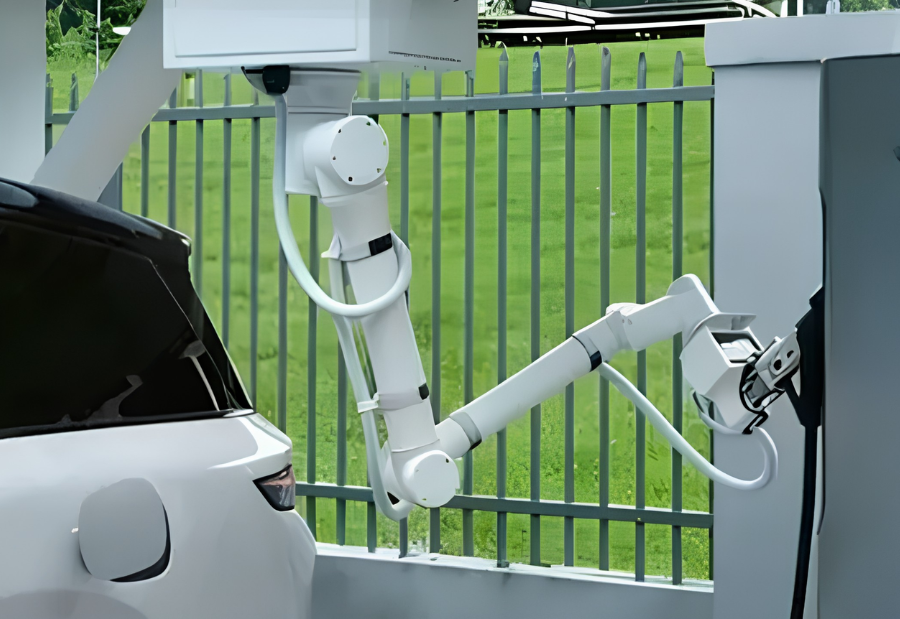
A new patent from China highlights the next phase of automation in electric vehicle infrastructure, combining charging and maintenance into a single robotic system.
BYD has filed a patent for a fully autonomous robot capable of charging electric vehicles and inflating tires without human intervention. Titled “A Robot,” the patent was submitted to China National Intellectual Property Administration on March 24, 2025.
The system is designed as a single robotic unit integrating 6 key modules. These include information acquisition, motion control, charging, inflation, dual-unit positioning, and a gripper and fixation mechanism to handle charging guns and inflation nozzles.
Once a vehicle enters a compatible parking bay, the robot scans battery levels and tire pressure across all 4 tires. Based on predefined thresholds, it determines whether charging, inflation, or both are required, and performs the tasks in sequence.
The system follows a closed-loop control process, where each step is verified before moving forward. This ensures precision and reduces operational errors during unattended use.
A key feature is that the robot does not require any hardware modifications to vehicles. It is designed to work with existing new energy vehicle charging ports, making it compatible with a wide range of EVs without retrofitting.
The development comes amid rapid advancements in automated EV charging across China. Li Auto, in collaboration with Chang Guang Xi Intelligent Manufacturing, has introduced a rail-mounted robotic charging arm capable of connecting to vehicles in under 0.6 seconds. Huawei has also deployed robotic charging systems in multiple cities, while Zeekr and BMW have demonstrated similar capabilities.
What differentiates BYD’s approach is the integration of maintenance functions such as tire pressure monitoring and inflation within the same workflow.
The push toward robotic charging is driven by infrastructure challenges. Despite over 20 million installed charging connectors in China, many residential and multi-storey parking spaces are difficult to retrofit. Mobile robotic systems address this gap by enabling flexible, on-demand charging.
The market for such solutions is growing rapidly. China’s mobile charging robot market was valued at around 400 million CNY in 2024 and is expected to expand further.
BYD has not yet disclosed a production timeline or deployment plans. The transition from patent to real-world application will depend on how effectively the system adapts to different vehicle designs and charging standards.
The patent reflects a broader shift toward multifunctional robotic systems that combine charging with integrated vehicle servicing.
Also read: Viksit Workforce for a Viksit Bharat
Do Follow: The Mainstream LinkedIn | The Mainstream Facebook | The Mainstream Youtube | The Mainstream Twitter
About us:
The Mainstream is a premier platform delivering the latest updates and informed perspectives across the technology business and cyber landscape. Built on research-driven, thought leadership and original intellectual property, The Mainstream also curates summits & conferences that convene decision makers to explore how technology reshapes industries and leadership. With a growing presence in India and globally across the Middle East, Africa, ASEAN, the USA, the UK and Australia, The Mainstream carries a vision to bring the latest happenings and insights to 8.2 billion people and to place technology at the centre of conversation for leaders navigating the future.