


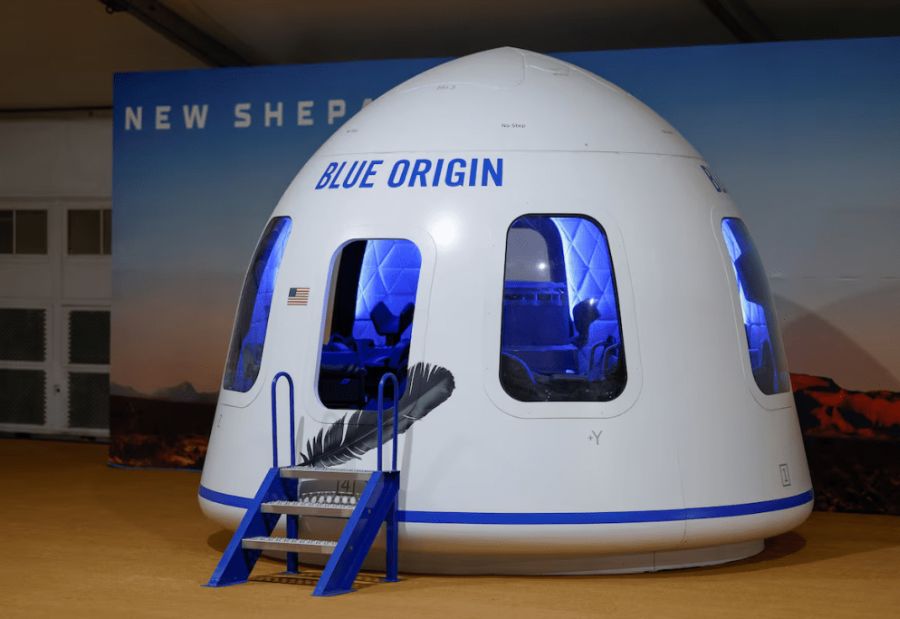
A major step toward sustained human life beyond Earth has been achieved as Jeff Bezos’ space company, Blue Origin, successfully extracted oxygen from Moon-like soil under laboratory conditions.
The breakthrough builds on years of research focused on unlocking oxygen trapped within lunar minerals, which make up a significant portion of the Moon’s surface. Producing oxygen directly from regolith could reduce dependence on costly supplies transported from Earth.
The process used is known as Molten Regolith Electrolysis. It involves heating Moon-like soil to extremely high temperatures until it melts. An electric current is then passed through the molten material, breaking chemical bonds and releasing oxygen as a gas that can be captured.
While the concept has been studied by organisations like NASA and the European Space Agency, the focus is now shifting toward making the system work reliably in real lunar conditions.
Lunar soil, or regolith, contains nearly 40–45% oxygen by weight, bound within minerals such as silica, iron oxides, and aluminium oxide. However, this oxygen is not freely available and requires energy-intensive extraction.
Blue Origin is increasingly working on infrastructure to support long-term human activity on the Moon. This includes technologies to produce oxygen, metals, and potentially solar panels using local resources. The company is also developing the Blue Moon lander to transport cargo and equipment to the lunar surface.
One of the biggest challenges remains energy demand. Heating regolith above 1,600°C and sustaining electrolysis requires a continuous power supply. Future missions may depend on solar arrays in high-sunlight regions near the lunar poles, while NASA is also exploring compact nuclear reactors for stable energy.
An added advantage of the process is the production of useful byproducts. After oxygen extraction, the remaining material contains metals like iron, aluminium, and silicon, which can be used to build infrastructure directly on the Moon. This approach, known as In-Situ Resource Utilisation, could significantly reduce mission costs.
Researchers are also exploring 3D printing using processed lunar material to build shelters and landing pads. These structures could help protect astronauts from radiation and micrometeorites while accelerating the development of permanent lunar bases.
Producing oxygen on the Moon could make space missions more sustainable. Oxygen is essential not only for breathing but also for water production and as an oxidiser in rocket fuel. This raises the possibility of the Moon becoming a refuelling hub for deeper space missions.
Although still in early stages, the development aligns with efforts like the Artemis program, which aims to establish a long-term human presence on the Moon.
The successful demonstration highlights how scientific concepts are now being translated into practical systems, bringing the goal of living and working on the Moon closer to reality.
Also read: Viksit Workforce for a Viksit Bharat
Do Follow: The Mainstream LinkedIn | The Mainstream Facebook | The Mainstream Youtube | The Mainstream Twitter
About us:
The Mainstream is a premier platform delivering the latest updates and informed perspectives across the technology business and cyber landscape. Built on research-driven, thought leadership and original intellectual property, The Mainstream also curates summits & conferences that convene decision makers to explore how technology reshapes industries and leadership. With a growing presence in India and globally across the Middle East, Africa, ASEAN, the USA, the UK and Australia, The Mainstream carries a vision to bring the latest happenings and insights to 8.2 billion people and to place technology at the centre of conversation for leaders navigating the future.