


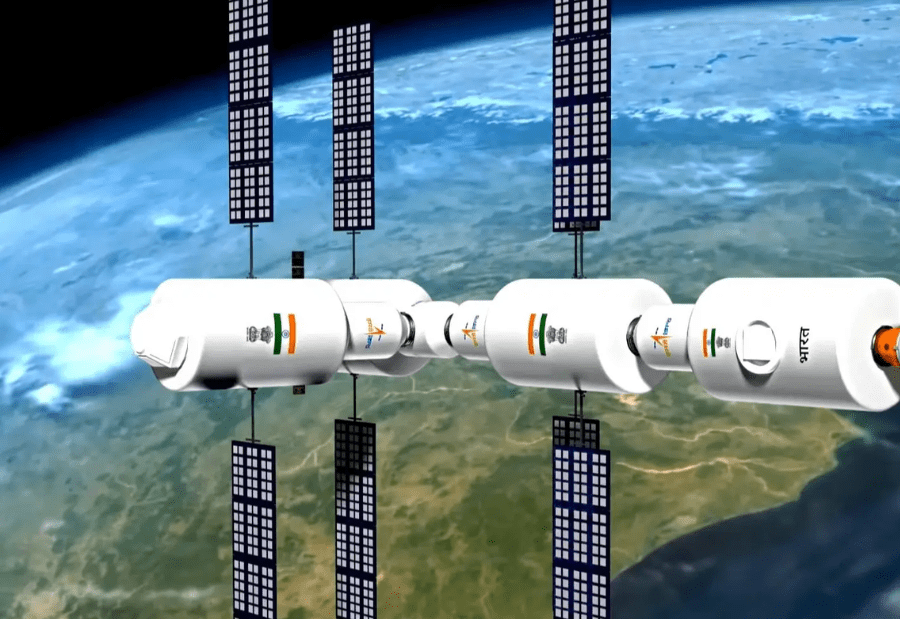
India and Russia are strengthening cooperation in space, with both nations expressing interest in using common technologies for their upcoming space stations.
At the Russian Space Forum in Moscow, Indian Space Research Organisation (ISRO) indicated its willingness to collaborate with Russia on the proposed Bharatiya Antariksh Station (BAS), or Indian Space Station. J. Asir Packiaraj, Director of ISRO’s Propulsion Complex, said, “For the preparation of the Indian Space Station(BAS), we are looking for good cooperation with Russia… to have common sub-systems for control, powering, communication, tracking.”
Russia, with decades of experience in human spaceflight since 1971, is seen as a key partner. Discussions come at a time when the International Space Station (ISS), jointly operated by multiple countries, is expected to be decommissioned by the end of this decade. Currently, China operates the only other active crewed space station.
India’s proposed BAS will orbit 450 km above Earth at an inclination of 51.6 degrees, matching Russia’s planned Russian Orbital Station (ROS). This alignment is expected to enable smoother collaboration.
Sergey Krikalev of Roscosmos highlighted that having stations at the same inclination would allow crew capsules to move easily between them. It would also support emergency rescue operations, cargo transfers, and shared tracking infrastructure.
He referred to the historic Soyuz T-15 mission, where astronauts travelled between two space stations in a single mission, demonstrating such flexibility.
Krikalev also stressed the need for standardised systems, including docking ports, communication, data transfer, and power systems, to ensure seamless cooperation.
On Russia’s plans, he said modules of the ROS would initially dock with the ISS before separating to form an independent station. The project is currently in its design and production phase.
India, meanwhile, is planning a 5-module space station with a total mass of 54 tons. Initial configuration and system-level planning are underway. The government has allocated ₹1763 crore (approx $176 mn) for 4 years (2025–2028) to develop and launch the first module.
The collaboration signals a shared vision for the post-ISS era, with both countries aiming to build interoperable and future-ready space infrastructure.
Also read: Viksit Workforce for a Viksit Bharat
Do Follow: The Mainstream LinkedIn | The Mainstream Facebook | The Mainstream Youtube | The Mainstream Twitter
About us:
The Mainstream is a premier platform delivering the latest updates and informed perspectives across the technology business and cyber landscape. Built on research-driven, thought leadership and original intellectual property, The Mainstream also curates summits & conferences that convene decision makers to explore how technology reshapes industries and leadership. With a growing presence in India and globally across the Middle East, Africa, ASEAN, the USA, the UK and Australia, The Mainstream carries a vision to bring the latest happenings and insights to 8.2 billion people and to place technology at the centre of conversation for leaders navigating the future.