


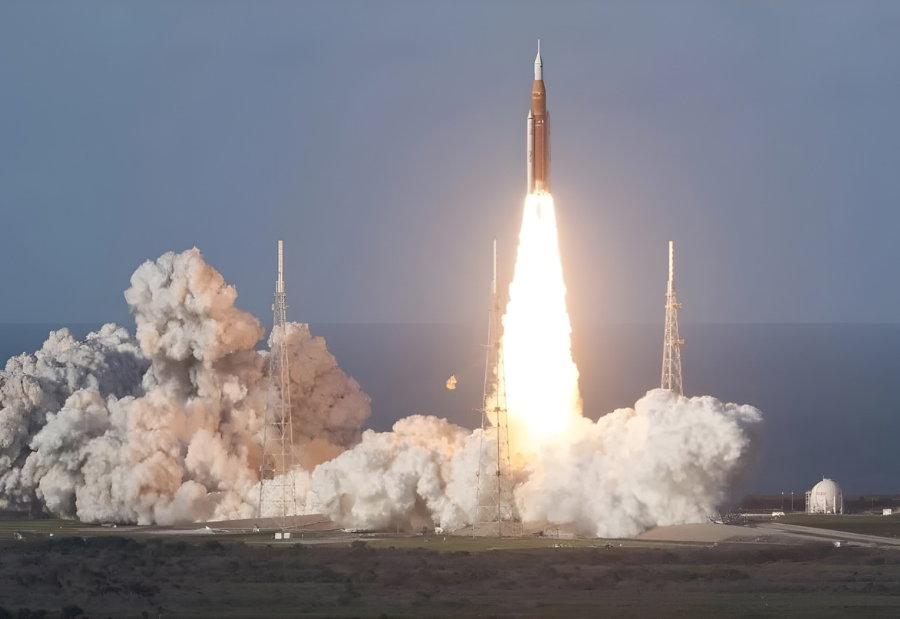
In a major milestone for space exploration, NASA has successfully launched the Artemis II mission, sending 4 astronauts on a journey around the moon for the first time in over 50 years.
The mission lifted off on Wednesday from Kennedy Space Center in Florida, with a 32-storey Space Launch System rocket carrying the crew into space. Tens of thousands of spectators gathered to witness the historic launch.
The Artemis II crew includes Reid Wiseman, Victor Glover, Christina Koch, and Canadian astronaut Jeremy Hansen. They are set to spend nearly 10 days travelling around the moon and back, reaching distances not achieved by humans in decades.
“On this historic mission, you take with you the heart of this Artemis team, the daring spirit of the American people and our partners across the globe, and the hopes and dreams of a new generation,” said Charlie Blackwell-Thompson. “Good luck, Godspeed Artemis II. Let’s go.”
Shortly after liftoff, commander Wiseman confirmed the trajectory, saying, “We have a beautiful moonrise, we’re headed right at it.”
The launch followed tense preparations. Earlier concerns included a hydrogen fuel leak during testing, but this time more than 700,000 gallons (2.6 million litres) of fuel were loaded without issues. Technical challenges, including a flight-termination system command issue and a battery temperature concern in the Orion capsule, were resolved before launch.
In the coming days, the crew will spend 1–2 days in high Earth orbit conducting system checks, including life-support, navigation, and communication systems. The spacecraft will then perform a translunar injection to head toward the moon.
Orion will travel behind the moon on a free-return trajectory, using gravitational forces to return to Earth with minimal fuel. This phase will take the spacecraft to its farthest distance from Earth.
The return journey will include further system testing before re-entry at speeds of about 40,233 km per hour (25,000 miles per hour). The mission will conclude with a splashdown in the Pacific Ocean.
“There are a lot of people who don’t remember Apollo. There are generations who weren’t alive when Apollo launched. This is their Apollo,” said Nicky Fox.
Also read: Viksit Workforce for a Viksit Bharat
Do Follow: The Mainstream LinkedIn | The Mainstream Facebook | The Mainstream Youtube | The Mainstream Twitter
About us:
The Mainstream is a premier platform delivering the latest updates and informed perspectives across the technology business and cyber landscape. Built on research-driven, thought leadership and original intellectual property, The Mainstream also curates summits & conferences that convene decision makers to explore how technology reshapes industries and leadership. With a growing presence in India and globally across the Middle East, Africa, ASEAN, the USA, the UK and Australia, The Mainstream carries a vision to bring the latest happenings and insights to 8.2 billion people and to place technology at the centre of conversation for leaders navigating the future.