


Organisations collect data from applications, transactions, devices, customer interactions and operational systems. Choosing the right architecture to store and analyze this information can affect data quality, costs, governance and analytics performance.
Data lakes and data lakehouses both support large-scale data storage, but they differ in how they manage structure, consistency and analytical workloads. Understanding data lake vs. lakehouse architecture helps technology leaders and data teams select an approach that fits their requirements.
What is a Data Lake?
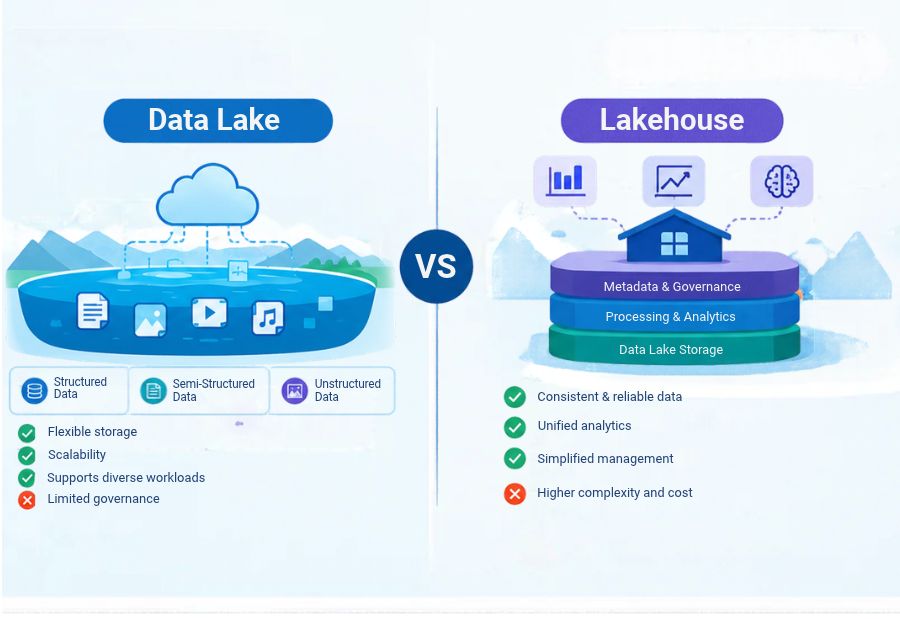
A data lake is a storage architecture designed to hold large amounts of data in its original or transformed form. It can support structured data, such as tables, alongside semi-structured and unstructured data, including logs, documents and media files.
Data lakes commonly use scalable object storage, with separate processing and analytics tools accessing the stored information. This flexibility makes them useful for data science, machine learning, historical analysis and large-scale data processing.
Benefits of Data Lakes
- Flexible storage: Different data formats can be stored in a shared environment.
- Scalability: Object storage can accommodate growing volumes of data.
- Support for varied workloads: Data can be used for analytics, experimentation and machine learning.
- Separation of storage and processing: Teams can select processing tools according to their workloads.
Limitations of Data Lakes
A data lake does not automatically provide strong data governance, transaction handling or consistent analytical performance. Without suitable controls, organisations may encounter duplicate datasets, unclear ownership, inconsistent definitions and difficulty identifying trustworthy information.
These problems are not inevitable, but they require deliberate architecture and governance decisions.
What is a Data Lakehouse?
A data lakehouse combines scalable data lake storage with management capabilities commonly associated with analytical databases and data warehouses.
Lakehouse architectures often use table formats and supporting services that provide features such as transaction consistency, schema enforcement, version history and more reliable updates. The exact capabilities depend on the chosen technology and implementation.
The objective is to support diverse data workloads while improving the reliability and manageability of analytical data.
Benefits of Data Lakehouses
- Improved data consistency: Supported table formats can provide transactional guarantees for data operations.
- Flexible analytics: A shared data foundation can support reporting, engineering and machine learning.
- Data versioning: Some implementations allow teams to track changes and access previous table states.
- Simplified data management: Shared storage and governance can reduce the need to maintain separate copies for different workloads.
Limitations of Data Lakehouses
Lakehouses can introduce additional requirements for table management, metadata services, optimisation and compatibility between processing engines.
Some capabilities also depend on the selected platform or table format rather than being universal features of every lakehouse. Teams must validate performance, governance and interoperability before committing to an architecture.
Data Lake vs. Lakehouse: 5 Key differences
1. Data Management
A traditional data lake primarily provides flexible storage, with structure and processing handled by additional tools.
A lakehouse adds a managed analytical layer, often providing stronger support for structured tables, transactions and controlled data updates.
2. Data Reliability and Consistency
Data lakes can store data reliably, but consistency across concurrent writes, updates and analytical operations depends on the storage format and processing tools.
Lakehouses commonly introduce table-management capabilities that help coordinate changes and maintain consistent analytical views. Teams should confirm which guarantees their chosen implementation supports.
3. Analytics and Workloads
Data lakes are useful for raw data storage, data exploration and specialized processing pipelines.
Lakehouses aim to support a wider combination of data engineering, SQL analytics and machine learning on a shared foundation. Actual workload performance depends on compute engines, data layout, query design and optimization.
4. Governance and Maintenance
Both architectures require access controls, data cataloging, lineage, quality checks and lifecycle policies.
A lakehouse may provide a more integrated management experience, but governance is not automatic. Organisations still need clear ownership, consistent definitions and controls that apply across users and tools.
5. Cost and Complexity
A data lake can be economical for storing large volumes of data, especially when compute resources are used only when needed. However, separate processing and management tools can increase operational complexity.
A lakehouse may reduce duplication and simplify some workflows, but its table management, compute and platform costs need to be evaluated. The lower-cost choice depends on workload patterns, storage needs and existing technology investments.
How to choose the right architecture
A data lake may be suitable when an organization prioritizes flexible storage, diverse raw data and specialised processing workflows.
A lakehouse may be more appropriate when teams need reliable analytical tables, frequent data updates and shared access for reporting, engineering and machine learning.
Some organisations will benefit from combining both approaches. Before choosing, assess data access patterns, transaction requirements, governance needs, workload performance and integration with existing tools. A proof of concept using representative datasets can help validate the decision.
Final Thought
The difference between a data lake and a lakehouse lies primarily in the data management and analytical capabilities built around the storage layer. Data lakes offer flexibility, while lakehouses add capabilities intended to make shared analytical data more consistent and easier to manage.
For The Mainstream readers, the right architecture is the one that meets real workload and governance requirements without adding unnecessary complexity. Evaluating performance, operating costs and data quality together will support a more sustainable data platform strategy.