


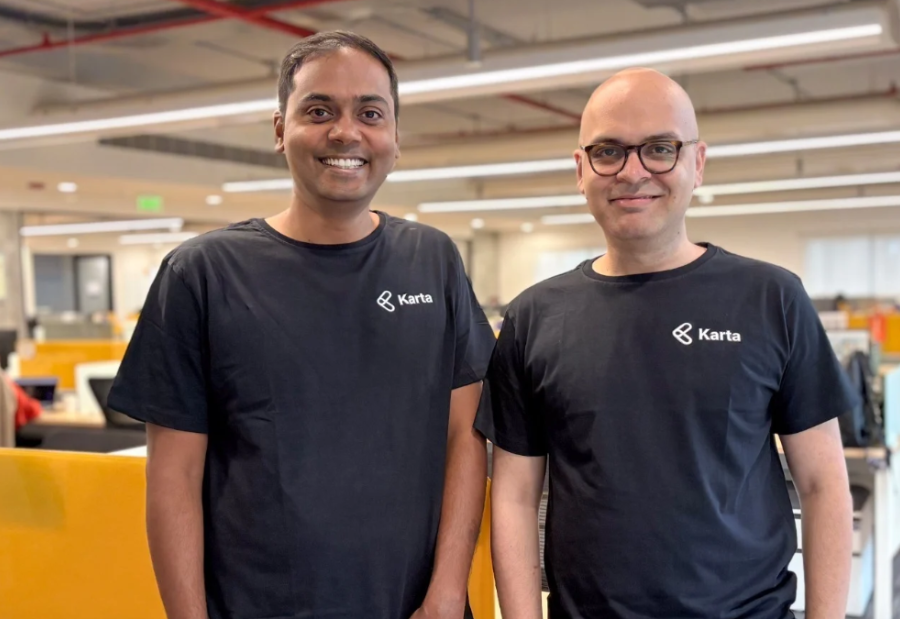
Agentic AI startup Karta AI has raised $3 Mn (around ₹28 Cr) in a seed funding round led by PeerCapital and Cedar Hill Capital, with participation from Wyser VC, CDM Capital and Seedstars. The company plans to use the funds to strengthen its go-to-market (GTM) strategy, expand distribution over the next 2 years and advance product development, particularly self-learning AI capabilities.
Founded in 2024 by former Razorpay executives Vijaypal Singh and Abhishek Kushwaha, Karta AI provides an omnichannel customer communication platform covering voice, chat, email and WhatsApp. The company initially focused on chat automation before expanding into voice in August 2025.
The startup primarily targets complex inbound customer queries in banking, financial services and insurance (BFSI). Its AI agents manage interactions involving multiple customer intents and enterprise systems, including failed payments, blocked cards, loan updates and insurance claims.
Karta AI claims to handle around 2 Mn customer conversations every month across more than 25 languages. It has 10–12 paying customers, including PhonePe, Pine Labs, Bajaj and Aavas.
According to co-founder and CEO Vijaypal Singh, the platform achieves 70–80% end-to-end automation in inbound proof-of-concept (PoC) deployments and has won all such PoCs so far. The company also claims to resolve around 70% of borrower queries without human intervention, reducing the cost per query by approximately 50%.
Focusing on complex customer interactions
Karta AI focuses on Level 2 (L2) and Level 3 (L3) queries that require agents to understand multiple customer intents, retrieve information from different systems and execute workflows. In comparison, Level 1 (L1) queries generally involve basic FAQs or simple API requests.
Singh estimates that L1 queries account for 30–40% of customer service volumes but around 10% of costs. L2 queries contribute another 30–40% of volumes, while L3 queries represent 10–20%. Together, L2 and L3 interactions account for approximately 80% of customer service costs.
The platform routes fraud-related, high-risk and poorly defined processes to human agents. Customers can also request human assistance.
How its AI platform works
Karta AI uses a proprietary context engine that combines standard operating procedures (SOPs), knowledge bases, previous conversations and API data. This helps its agents manage follow-up questions and execute workflows across enterprise systems.
The platform uses models from OpenAI and Google Gemini, alongside open-source models such as Kimi and Gemma. Its voice platform supports around 25 Indian languages, while its chat offering supports more than 200 languages. Voice capabilities include Hindi-English code-switching, regional accents and dialects, although performance varies across languages.
The company also incorporates compliance safeguards and tests its agents internally, with customers and through AI-based testing systems before deployment.
Karta AI plans to develop reusable, industry-specific capabilities before expanding into international markets.
Also read: Viksit Workforce for a Viksit Bharat
Do Follow: The Mainstream LinkedIn | The Mainstream Facebook | The Mainstream Youtube | The Mainstream Twitter
About us:
The Mainstream is a premier platform delivering the latest updates and informed perspectives across the technology business and cyber landscape. Built on research-driven, thought leadership and original intellectual property, The Mainstream also curates summits & conferences that convene decision makers to explore how technology reshapes industries and leadership. With a growing presence in India and globally across the Middle East, Africa, ASEAN, the USA, the UK and Australia, The Mainstream carries a vision to bring the latest happenings and insights to 8.2 billion people and to place technology at the centre of conversation for leaders navigating the future.