


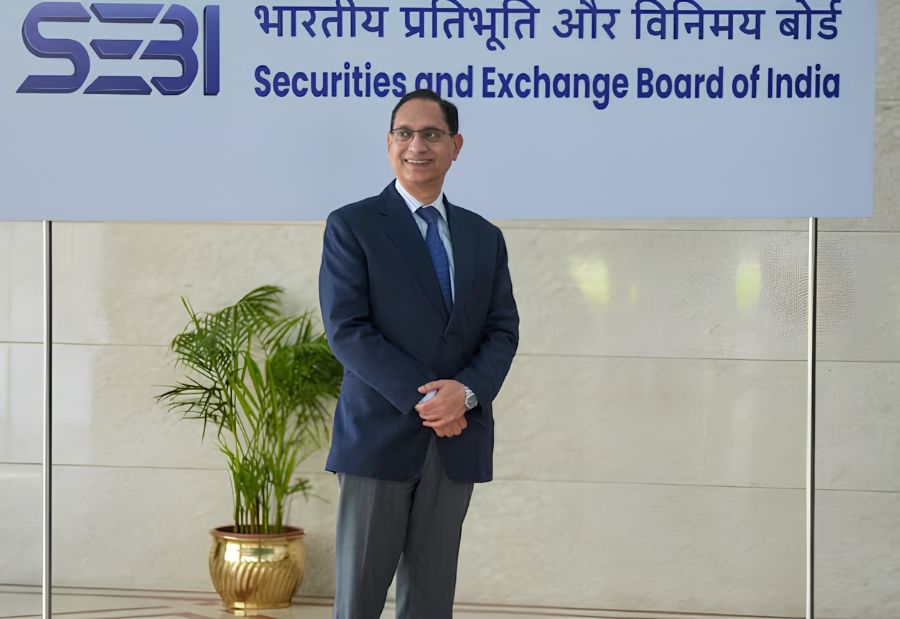
Securities and Exchange Board of India (SEBI) Chairman Tuhin Kanta Pandey has said decisions on how much Indian money can be invested overseas fall under the Reserve Bank of India (RBI), following SEBI’s recent move to allow portfolio managers to invest in specified foreign securities.
Speaking at the Association of Portfolio Managers in India (APMI) annual conference on September 30, Pandey said overseas investment limits and the manner in which funds can move abroad must remain consistent with the RBI’s Liberalised Remittance Scheme (LRS) and Foreign Exchange Management Act (FEMA) rules.
SEBI’s board approved the SEBI (Portfolio Managers) Regulations, 2026 on September 24. The changes allow discretionary and non-discretionary portfolio managers to invest in specified overseas securities, including listed equity and debt, REITs, overseas mutual funds, ETFs, index funds and foreign government debt, subject to applicable FEMA and RBI requirements.
Pandey did not specify how the existing overseas investment limits would apply to clients of portfolio management services. He referred that matter to the RBI.
The SEBI chief also discussed efforts to make the registration process for foreign portfolio investors (FPIs) faster and more digital. He said SEBI and the RBI are working on enabling the uploading of FPI registration documents through the SWIFT system.
Pandey highlighted several measures already introduced to simplify the process, including a revamped NSDL front end, the India Market Access portal and a common application portal that allows applicants to track their submissions. Digital signatures and e-power of attorney have also reduced the need for physical documentation, including notarisation, apostille and consularisation.
Addressing questions about the recent performance of Indian markets compared with markets such as Japan and South Korea, Pandey said investment decisions ultimately rest with investors and that it would not be appropriate for regulators to comment on where investors should put their money.
He said the regulatory focus remains on making market access and registration processes easier.
Pandey also addressed concerns about listed companies that show little or no visible business activity. He said stock exchanges have a continuing responsibility to monitor companies after listing.
Where a listed company is not physically present or is not carrying out economic activity, delisting provisions are available, he said. Pandey added that such processes should be pursued properly because investors need confidence that listed companies represent genuine businesses.
He also said physical verification by stock exchanges is feasible in such cases.
On promoter-level transactions involving unlisted holding companies, Pandey said SEBI’s approach must remain aligned with the Companies Act and applicable listing regulations.
The comments come as SEBI continues to review the portfolio management framework and simplify market processes while keeping regulatory and investor-protection requirements in place.
Also read: Viksit Workforce for a Viksit Bharat
Do Follow: The Mainstream LinkedIn | The Mainstream Facebook | The Mainstream Youtube | The Mainstream Twitter
About us:
The Mainstream is a premier platform delivering the latest updates and informed perspectives across the technology business and cyber landscape. Built on research-driven, thought leadership and original intellectual property, The Mainstream also curates summits & conferences that convene decision makers to explore how technology reshapes industries and leadership. With a growing presence in India and globally across the Middle East, Africa, ASEAN, the USA, the UK and Australia, The Mainstream carries a vision to bring the latest happenings and insights to 8.2 billion people and to place technology at the centre of conversation for leaders navigating the future.