


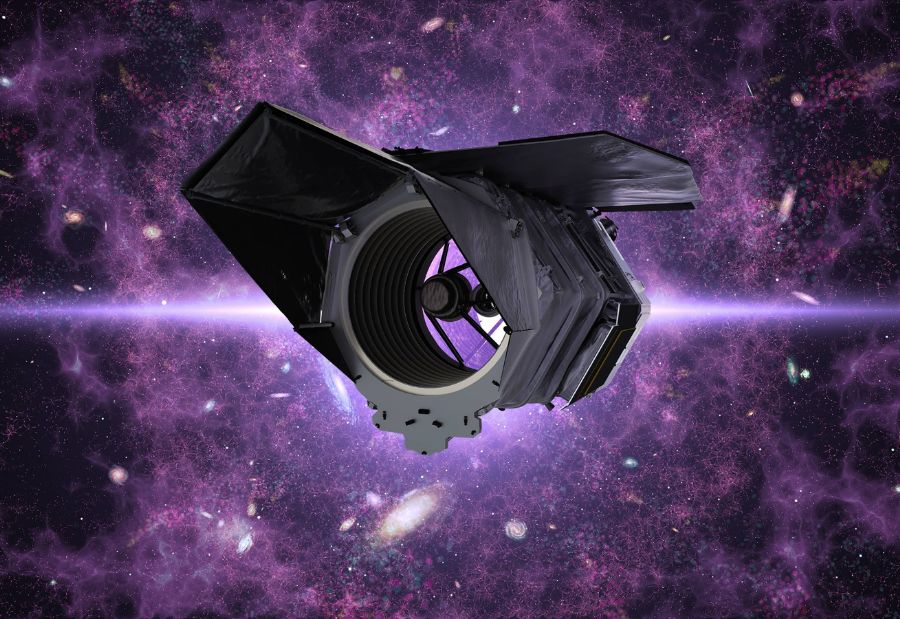
NASA’s Nancy Grace Roman Space Telescope has taken its first test image after activating its powerful 300-megapixel infrared camera, offering an early glimpse of what could become one of the most ambitious astronomical surveys ever conducted.
The telescope’s Wide Field Instrument (WFI) was switched on this week as Roman continues its months-long commissioning process. The spacecraft launched on August 30 and is travelling about 1.6 million kilometres towards Lagrange point L2, where it will operate alongside the James Webb Space Telescope and other scientific missions.
Because the WFI has not yet been fully focused, stars in the first image appear as bright, lime-coloured loops. NASA said the early checks show that the instrument is operating as expected.
“After years of effort to build and test the instrument on the ground, we now have confirmation that it is operational in space. This is a huge milestone,” said Josh Schlieder, chief WFI scientist at NASA’s Goddard Space Flight Center. “There is much to do, but we are on our way to groundbreaking science.”
The image also highlights Roman’s wide-field capability. Its camera contains 18 detectors, with each detector converting light from distant objects into electrical signals that help create large-scale images of the universe.
Roman is expected to send around 1.4 terabytes of data to Earth every day. Its surveys will study distant galaxies, help measure the expansion of the universe and investigate dark energy.
The telescope will also support the search for exoplanets. Its coronagraph, which was also successfully tested this week, will block starlight and allow scientists to study planets around other stars with greater precision.
Roman is expected to begin producing its first full science images in early 2027. Its wide field of view will allow each image to cover an area around 100 times larger than a Hubble image.
The mission could also last far longer than originally planned. NASA said a successful thruster burn and additional fuel carried at launch could extend Roman’s operational life from the planned 10 years to around 22 years.
Also read: Viksit Workforce for a Viksit Bharat
Do Follow: The Mainstream LinkedIn | The Mainstream Facebook | The Mainstream Youtube | The Mainstream Twitter
About us:
The Mainstream is a premier platform delivering the latest updates and informed perspectives across the technology business and cyber landscape. Built on research-driven, thought leadership and original intellectual property, The Mainstream also curates summits & conferences that convene decision makers to explore how technology reshapes industries and leadership. With a growing presence in India and globally across the Middle East, Africa, ASEAN, the USA, the UK and Australia, The Mainstream carries a vision to bring the latest happenings and insights to 8.2 billion people and to place technology at the centre of conversation for leaders navigating the future.