


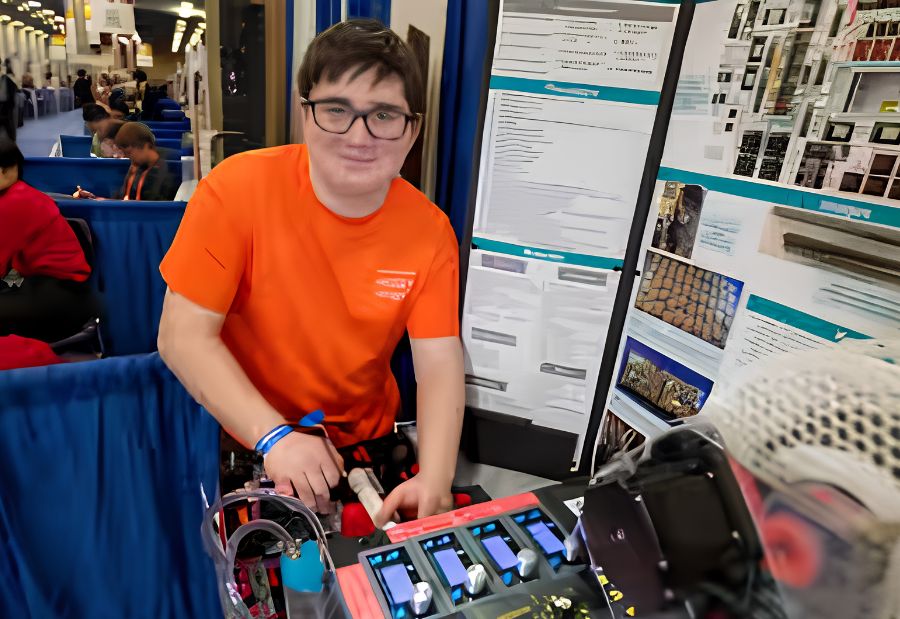
A failed 3D print may look like nothing more than plastic waste, but for 16-year-old Benjamin Davis, it became the starting point for a practical recycling solution.
A student at Bishop Feehan High School in Attleboro, Massachusetts, Davis spent more than 800 hours developing a small recycling system that converts discarded 3D-printing plastic into reusable filament. His project won him $75,000 at the 2025 Regeneron International Science and Engineering Fair (ISEF) in Columbus, Ohio.
The machine processes waste from 3D printing, including failed prints, supports and leftover filament, and converts it into filament that can be used again in a 3D printer.
Davis’s system combines pultrusion and extrusion. According to the Society for Science, the system was roughly 45% more efficient than using the 2 methods separately. It is also designed to produce higher-quality recycled filament while remaining relatively easy to operate.
Cost was another focus of the project. Davis’s design costs about 90% less than recycling machines currently available on the market. This could make small-scale plastic recycling more accessible to schools, hobbyists and individual 3D-printer users.
The project addresses a growing waste issue linked to 3D printing. The technology is increasingly used in classrooms, homes, laboratories and workplaces, while failed prints, supports and leftover filament can quickly accumulate. Information cited by the Society for Science indicates that up to 67% of the filament in a regular 3D-printing project can become waste.
Developing the machine required extensive testing. Davis went through more than 50 iterations of its components and completed several major redesigns to improve the recycling process.
At the 75th annual ISEF, Davis received the Regeneron Young Scientist Award and finished as runner-up in the competition’s top award category.
The desktop-sized design points toward a model where plastic waste could be recycled closer to where it is created, rather than being sent to large industrial facilities.
The project has also strengthened Davis’s interest in advanced manufacturing, mechanical engineering and materials engineering, areas he may explore further in college.
Also read: Viksit Workforce for a Viksit Bharat
Do Follow: The Mainstream LinkedIn | The Mainstream Facebook | The Mainstream Youtube | The Mainstream Twitter
About us:
The Mainstream is a premier platform delivering the latest updates and informed perspectives across the technology business and cyber landscape. Built on research-driven, thought leadership and original intellectual property, The Mainstream also curates summits & conferences that convene decision makers to explore how technology reshapes industries and leadership. With a growing presence in India and globally across the Middle East, Africa, ASEAN, the USA, the UK and Australia, The Mainstream carries a vision to bring the latest happenings and insights to 8.2 billion people and to place technology at the centre of conversation for leaders navigating the future.