


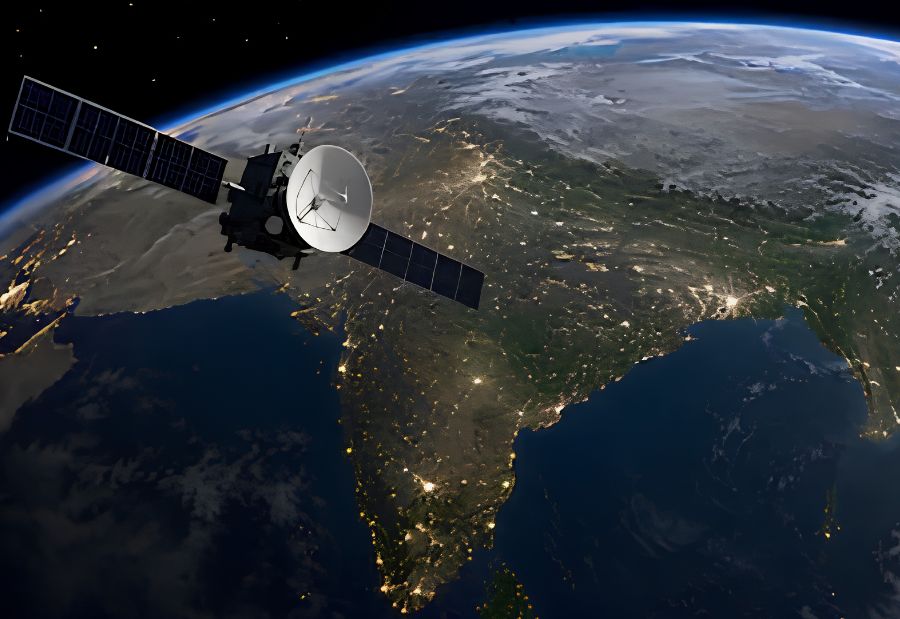
India has moved closer to opening its satellite broadband market to more operators after the Digital Communications Commission (DCC) approved a spectrum usage charge framework for satellite communication services.
The DCC has approved a 5% of adjusted gross revenue (AGR) spectrum usage charge, with an effective 4% charge for operators serving designated rural and remote areas. The decision was taken at a meeting last week and could allow companies such as Eutelsat OneWeb, Starlink and Amazon Leo to receive spectrum for commercial services, subject to security and other regulatory approvals.
The Department of Telecommunications (DoT) is expected to take the proposal to the Cabinet for final approval. The government has, in principle, agreed to assign spectrum for 5 years, with an option for a 2-year extension.
The decision follows months of discussions around the Telecom Regulatory Authority of India’s (Trai) recommendations. Trai had originally proposed a 4% of AGR spectrum usage charge, along with an additional ₹500 per urban subscriber per year for NGSO-based satellite services. Rural and remote subscribers would have been exempt from the additional levy.
The DoT rejected the per-subscriber charge, citing difficulties in distinguishing between rural and urban users. It also rejected Trai’s proposal to subsidise fixed satellite terminals for targeted rural and remote users through the Digital Bharat Nidhi (DBN), stating that the existing framework does not provide for such a subsidy.
However, the DoT accepted Trai’s recommendation for a 5-year spectrum assignment with a 2-year extension option.
While the DCC decision provides greater clarity on spectrum pricing and allocation, security approvals remain a major hurdle for commercial launches.
“Final approvals remain contingent on existing security conditions. MHA security clearance remains a key outstanding issue,” a source said.
Companies holding Global Mobile Personal Communication by Satellite (GMPCS) licences, including Starlink, Eutelsat OneWeb and Jio Satellite Communications, are still required to address security concerns raised by the Ministry of Home Affairs (MHA), DoT and other agencies. Amazon Leo is still awaiting its GMPCS licence.
Starlink faces an additional issue involving its 100% foreign direct investment structure. The company has also reapplied to IN-SPACe for approval of its next-generation constellation, seeking authorisation for nearly 30,000 low-Earth-orbit satellites under its Gen 2 network, including direct-to-device capabilities.
Currently, only geostationary orbit (GSO)-based fixed satellite networks such as Hughes and Nelco are permitted to provide services in India, paying spectrum charges of around 3-4% of AGR.
The government will now work on finalising pricing and other modalities for non-GSO operators including Starlink, Eutelsat OneWeb, Jio Satellite and Amazon Leo to enter India’s satellite broadband market.
Also read: Viksit Workforce for a Viksit Bharat
Do Follow: The Mainstream LinkedIn | The Mainstream Facebook | The Mainstream Youtube | The Mainstream Twitter
About us:
The Mainstream is a premier platform delivering the latest updates and informed perspectives across the technology business and cyber landscape. Built on research-driven, thought leadership and original intellectual property, The Mainstream also curates summits & conferences that convene decision makers to explore how technology reshapes industries and leadership. With a growing presence in India and globally across the Middle East, Africa, ASEAN, the USA, the UK and Australia, The Mainstream carries a vision to bring the latest happenings and insights to 8.2 billion people and to place technology at the centre of conversation for leaders navigating the future.