


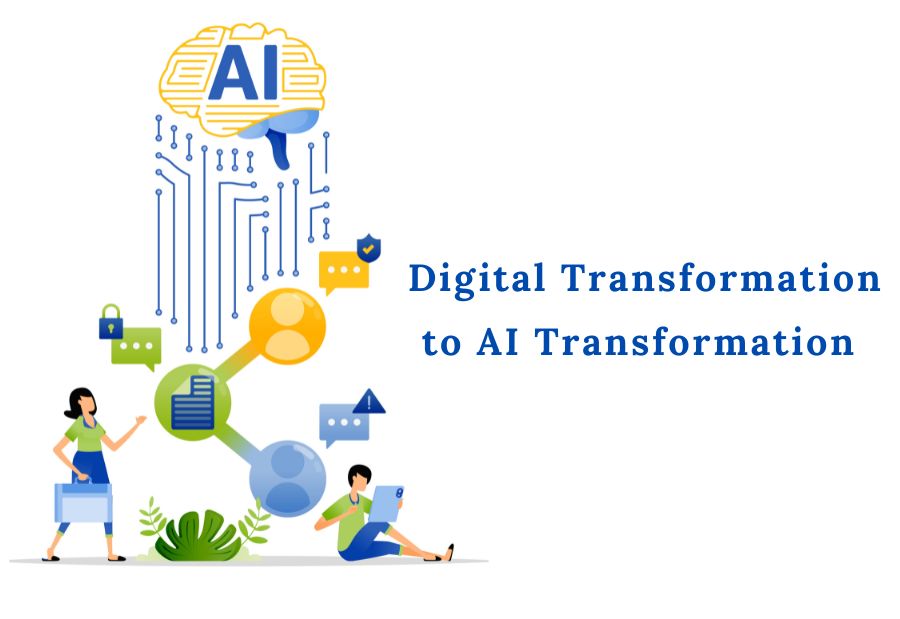
Digital transformation is focused on moving businesses toward cloud computing, connected systems, automation and digital customer experiences. AI transformation is the next phase, where artificial intelligence becomes embedded into business processes, decision-making, software and everyday operations.
Key facts
- Digital transformation created the technology foundation for large-scale AI adoption.
- AI transformation embeds intelligence directly into business processes.
- Generative AI and AI agents are expanding enterprise use cases.
- Data quality and governance are becoming critical to AI success.
- Cloud and AI infrastructure are increasingly connected.
- Employees need new skills to work effectively with AI.
- AI governance, security and responsible use must develop alongside adoption.
What is AI transformation?
Digital transformation generally involves replacing manual processes with digital systems.
AI transformation goes a step further.
Instead of simply asking, “Can this process be digitized?” businesses are increasingly asking, “Can AI make this process smarter, faster or more autonomous?”
For example, a digital customer-service system may allow customers to submit support requests online. An AI-enabled system can understand the request, retrieve relevant information, recommend an answer and potentially resolve the issue automatically.
This represents a fundamental shift from digitisation to intelligent automation.
Why are enterprises moving toward AI transformation?
1. AI is becoming part of core operations
AI is moving beyond experimental projects into functions such as marketing, software development, finance, customer service, cybersecurity and supply-chain management.
Deloitte’s 2026 State of AI research found that 40% of Indian respondents reported significant or full AI usage, showing the growing movement toward enterprise-scale adoption.
2. Data is becoming more valuable
AI transformation depends heavily on enterprise data.
Businesses need reliable, accessible and well-governed data to train, evaluate and operate AI applications. This makes data governance, data quality and security important parts of the transformation strategy.
3. AI is changing enterprise software
Traditional enterprise applications largely wait for employees to enter information and initiate actions.
AI-powered applications can increasingly understand information, recommend actions and automate parts of workflows.
AI agents could take this further by completing multi-step tasks across business systems.
Key technologies driving AI transformation
- Generative AI: Creates text, code, images and other content.
- AI agents: Perform multi-step tasks with limited human intervention.
- Predictive AI: Identifies patterns and forecasts potential outcomes.
- Machine learning: Supports classification, recommendations and automation.
- AI copilots: Assist employees within enterprise applications.
- AI-powered analytics: Helps organisations convert data into business insights.
- AI infrastructure: Provides the computing and data foundation needed for AI workloads.
Expert perspective
The biggest change is not the technology itself. It is the way enterprises design their operating models around AI.
Businesses that simply add an AI tool to existing processes may achieve limited benefits. Greater value can come from redesigning workflows around what AI can realistically automate while keeping humans responsible for important decisions.
This also means CIOs need to work closely with business, security, data and finance leaders.
AI transformation should therefore be treated as an enterprise strategy, not only an IT project.
Statistics and data
AI investment is continuing to grow among Indian enterprises. Deloitte’s 2026 research found that 94% of Indian organisations expected AI spending to increase. Security and compliance controls were identified as a leading AI-scaling investment priority by 68% of respondents.
These figures highlight an important point: enterprises are increasing AI investment while also recognising that governance, security and infrastructure must mature alongside adoption.
Industry impact
BFSI: AI can support fraud detection, risk analysis, customer service and compliance.
Healthcare: AI can improve administrative processes, research and information management.
Manufacturing: AI can support predictive maintenance, quality control and production optimisation.
Retail: AI can improve customer personalisation, demand forecasting and support.
IT Services: AI can accelerate software development, testing, service management and employee productivity.
Conclusion
The transition from digital transformation to AI transformation represents a major change in enterprise technology. Cloud, data, automation and digital platforms created the foundation, while AI is now adding intelligence and greater automation to those systems.
For enterprises, the priority is to build the right combination of AI, data, infrastructure, security, governance and human skills. The Mainstream continues to cover AI, enterprise technology, cybersecurity and digital transformation trends shaping the future of business.