


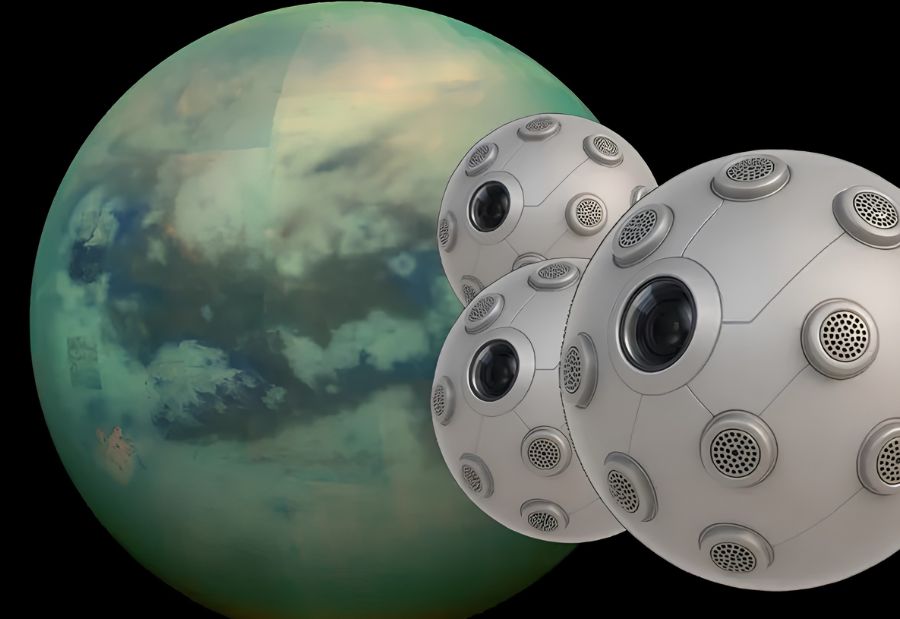
Exploring the underground terrain of Saturn’s Moon Titan could one day involve small flying robots rather than traditional rovers. NASA has awarded early-stage funding to a concept called SPARK, which aims to develop spherical “Aerobots” capable of navigating Titan’s caves and underground formations.
Titan is considered one of the most Earth-like worlds in the solar system. Its surface features rivers, lakes and seas made of hydrocarbons such as methane and ethane. It also has unusual “karst” terrain that includes underground sinkholes and caves. Such environments would be difficult for conventional rovers to navigate, creating an opportunity for flying vehicles.
SPARK stands for Solid-state Propulsion for Autonomous Reconnaissance of Karst. The project is led by Daniel Drew, an assistant professor at the University of Hawaii at Mānoa. The concept is beginning a 9-month Phase 1 grant under NASA’s Innovative Advanced Concepts program. A successful project would then need to complete a Phase 2 study lasting up to 2 years before becoming a more realistic mission option.
NASA’s Dragonfly mission is currently targeted for launch in 2028. Drew said it is unclear whether SPARK could be ready in time to join Dragonfly, although a delay to that mission could create additional opportunities.
“Where does that line up with the current Titan mission timeline, assuming we’ve missed the window for Dragonfly? I don’t know,” Drew said.
Drew believes SPARK could perform well on Titan because it would use novel ion-based electric thrusters. The system could offer “persistence, maneuverability, robustness to the challenging near-cryogenic [icy] conditions, and minimize downwash disturbance of scientifically-important hydrocarbon layering.”
He hopes the technology could eventually serve as a cave-exploration pathfinder, much like NASA’s Ingenuity helicopter on Mars, which completed 72 flights.
Drew has studied electrohydrodynamic (EHD) propulsion since graduate school at the University of California, Berkeley. His research has focused on small flying robots powered by atmospheric ion thrusters. His work has included microfabricated centimeter-scale flying robots, ionocraft capable of carrying payloads and an ion-propelled micro-hovercraft.
With the new funding, Drew and his team will study EHD propulsion’s scalability, low noise and solid-state design. However, the technology has a major limitation. “The huge weakness is that it just isn’t very efficient,” Drew said, noting that conventional rotors and jet engines remain more practical for most Earth-based applications.
During the 9-month Phase 1 study, Drew and collaborators Ethan Schaler, Jacob Izraelevitz and Michael Malaska will develop experiments, evaluate subsystem priorities such as power and model thermal effects on the power system.
The team plans to publish a comprehensive public report that can build on earlier research and NASA studies.
Also read: Viksit Workforce for a Viksit Bharat
Do Follow: The Mainstream LinkedIn | The Mainstream Facebook | The Mainstream Youtube | The Mainstream Twitter
About us:
The Mainstream is a premier platform delivering the latest updates and informed perspectives across the technology business and cyber landscape. Built on research-driven, thought leadership and original intellectual property, The Mainstream also curates summits & conferences that convene decision makers to explore how technology reshapes industries and leadership. With a growing presence in India and globally across the Middle East, Africa, ASEAN, the USA, the UK and Australia, The Mainstream carries a vision to bring the latest happenings and insights to 8.2 billion people and to place technology at the centre of conversation for leaders navigating the future.