


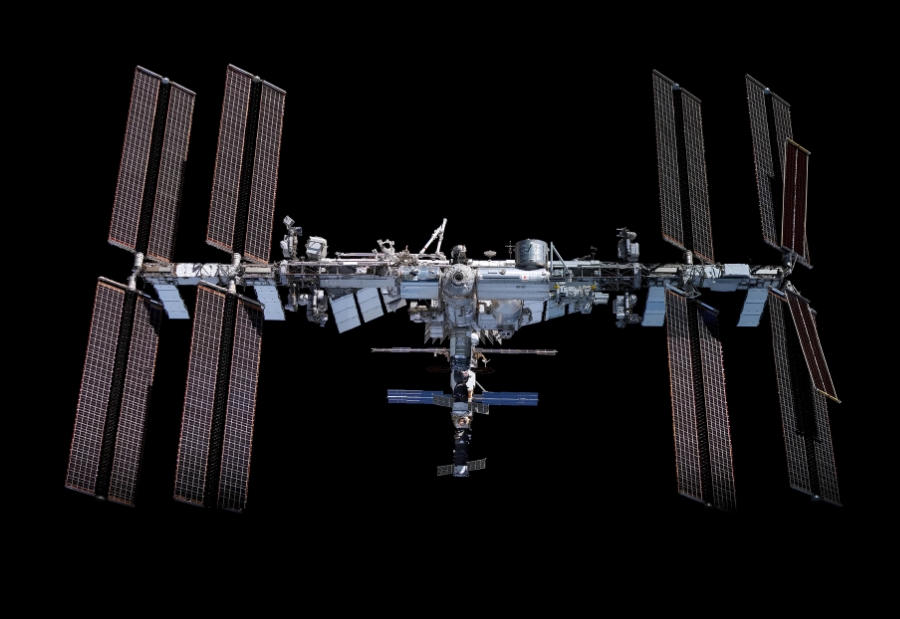
The International Space Station (ISS) is approaching the final stage of its remarkable journey, with NASA preparing a dedicated spacecraft to safely guide the 430-tonne structure back into Earth’s atmosphere. The controlled re-entry is currently planned for late 2030, after the final crew leaves the station.
NASA selected SpaceX in June 2024 to develop the U.S. Deorbit Vehicle under a contract worth up to $843 million. Based on Cargo Dragon, the spacecraft will feature an enlarged trunk and additional Draco thrusters. It will dock with the ISS, help control its position, and perform the final burns needed to direct its re-entry.
The vehicle is scheduled for delivery in late 2028. NASA’s development cost and schedule baselines were approved in February 2026.
The ISS is too large to be allowed to re-enter randomly. Instead, operators will gradually lower its orbit and guide the resulting debris toward a remote area of the South Pacific, near the region commonly known as Point Nemo. NASA’s target is not the exact geographic point but a broader debris corridor.
Point Nemo lies at 48°52.6′S, 123°23.6′W, around 2,688 kilometres from the nearest land in 3 directions. Because the ISS orbits roughly 400 kilometres above Earth at an inclination of 51.6°, astronauts can briefly become the closest humans to the area when the station passes overhead.
The station’s descent will happen in stages. Atmospheric drag and the ISS’s existing propulsion systems will first help lower and shape its orbit. After the final crew has safely returned, the deorbit vehicle will carry out the final manoeuvre to establish the required re-entry path.
NASA expects the station to break apart during re-entry. Solar arrays and radiators are expected to separate first, followed by larger structural sections. Most material should melt or vaporise, although some dense components may survive and reach the ocean.
The ISS has hosted people continuously since November 2000. Its construction involved 27 shuttle flights, 13 years, and 161 spacewalks. With the Space Shuttle retired and no current spacecraft capable of returning entire ISS modules to Earth, preserving the station indefinitely is not considered practical.
NASA’s plans also involve 2 Russian Progress spacecraft as part of the broader deorbit strategy, with NASA and Roscosmos maintaining technical and contingency protocols.
The planned retirement could mark the end of more than 25 years of continuous human presence in orbit. However, NASA has left open the possibility of extending ISS operations if commercial replacements are not ready and the international partners agree.
The deorbit mission will ultimately ensure that the station’s final chapter is controlled rather than accidental, guiding one of humanity’s largest structures safely away from populated areas.
Also read: Viksit Workforce for a Viksit Bharat
Do Follow: The Mainstream LinkedIn | The Mainstream Facebook | The Mainstream Youtube | The Mainstream Twitter
About us:
The Mainstream is a premier platform delivering the latest updates and informed perspectives across the technology business and cyber landscape. Built on research-driven, thought leadership and original intellectual property, The Mainstream also curates summits & conferences that convene decision makers to explore how technology reshapes industries and leadership. With a growing presence in India and globally across the Middle East, Africa, ASEAN, the USA, the UK and Australia, The Mainstream carries a vision to bring the latest happenings and insights to 8.2 billion people and to place technology at the centre of conversation for leaders navigating the future.