


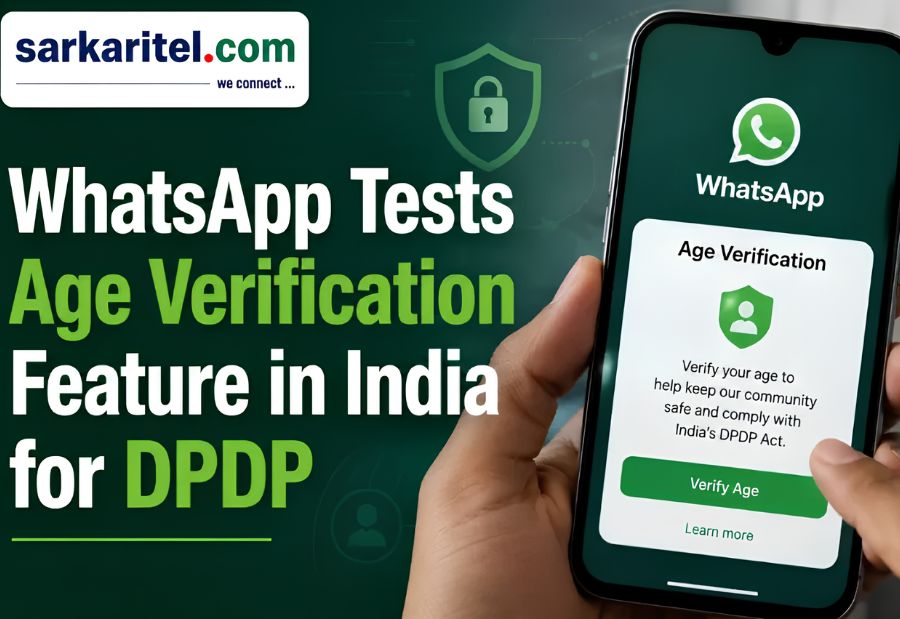
As India’s data protection framework moves toward implementation, WhatsApp is testing ways to establish users’ age while limiting the privacy risks associated with collecting more personal information. For years, age verification on digital platforms has largely been a matter of ticking a box or entering a date of birth. In India, that is beginning to change.
Meta-owned WhatsApp has started testing an optional age-confirmation feature with a limited set of users in India, prompting them to provide their date of birth. The move comes as platforms prepare to meet obligations under India’s Digital Personal Data Protection (DPDP) framework, particularly requirements concerning the processing of children’s personal data and verifiable parental consent. The development may appear to be a relatively small product change. But it points to a much bigger shift: age is increasingly becoming a data-governance issue, not merely a user-profile attribute.
Under India’s DPDP framework, children receive additional protection when their personal data is processed. The law requires data fiduciaries to obtain verifiable parental consent before processing the personal data of a child.
The rules provide for mechanisms through which a platform can establish the identity and age of the parent, including reliable information already available with the data fiduciary or voluntarily provided identity and age information, including through authorised virtual tokens and Digital Locker-linked mechanisms.
That creates an obvious technical prerequisite for platforms such as WhatsApp: they need some reasonably reliable way of determining whether a user is an adult or a child before they can apply the appropriate consent and protection mechanisms.
WhatsApp’s current pilot appears to be part of that preparation. The company has said the test is optional and is intended to explore privacy-protective methods of confirming age. Users participating in the test can continue using WhatsApp without confirming their age.
The distinction is important. WhatsApp is testing the capability, rather than announcing a blanket requirement for every Indian user to submit their date of birth. Age verification presents an inherent privacy paradox. To protect children, platforms need more certainty about who is using their services. But establishing that certainty can itself require platforms to collect or process additional personal information.
A simple date-of-birth field may be easy to implement, but it does not necessarily prove that the information supplied is accurate. A more rigorous verification process could require stronger identity signals, which could create an even larger privacy and security footprint.
This is where the principle of data minimisation becomes important.
The objective should not simply be to answer, “How old is this user?” It should be to answer the narrower question: “Is this user above or below the relevant age threshold?”
That distinction could shape the next generation of age-assurance technologies.
Privacy-preserving approaches can potentially allow a service to establish eligibility without retaining a user’s complete identity or date-of-birth information. Technologies such as virtual tokens and other privacy-preserving verification mechanisms are already being considered in broader age-assurance discussions.
From Compliance Checkbox to Product Architecture
The WhatsApp experiment also illustrates how regulation is increasingly moving into the product-engineering layer. Data protection compliance is no longer limited to privacy policies, legal notices and consent language. Platforms have to translate regulatory requirements into actual product architecture.
For WhatsApp, that could eventually mean being able to distinguish between different categories of users and apply different safeguards depending on age.
That becomes particularly relevant because the DPDP framework does not treat children’s data in exactly the same way as adult data. The requirement for verifiable parental consent means platforms need mechanisms that can identify when such consent becomes necessary.
In other words, compliance needs to become an operational capability.
The technology has to determine when consent is required, establish whether the person providing it is genuinely authorised, record the necessary evidence and ensure that the process itself does not result in excessive collection of personal information.
WhatsApp’s experiment is significant because of the scale of the platform and because it offers a glimpse into how India’s privacy regime could affect everyday digital experiences.
Age verification could eventually become relevant across social media, gaming, online education, entertainment, e-commerce and other consumer internet services where age can determine the type of content, interaction or data processing permitted.
The question, therefore, is not simply whether platforms will start asking users for their age.
It is how they will verify it.
The technology industry is already experimenting with more sophisticated age-assurance systems. Meta, for example, has been developing AI-based approaches for identifying potentially underage users on its other platforms, including technologies that examine contextual and visual signals to estimate whether an account may belong to a minor. Meta says its visual analysis is not facial recognition and is intended to assess general age-related cues rather than identify an individual.
India’s regulatory environment could therefore become an important testing ground for privacy-preserving age assurance at scale.
The success of WhatsApp’s approach will ultimately depend on what happens to the information collected during verification. Will the platform retain the actual date of birth, or only an age category? Can a user prove they are above a particular threshold without revealing their exact birth date? Can verification be performed using a trusted third-party token without creating another centralised database of identity information? And, perhaps most importantly, what happens if the age-verification system itself is compromised?
These questions matter because age data may appear relatively innocuous compared with financial or biometric information, but it remains personal information that can contribute to a user’s broader digital identity.
India’s DPDP framework is therefore forcing an important rethink: privacy protection cannot end after a platform has established compliance. The mechanism used to achieve compliance must itself be privacy-conscious.
As India’s data protection regime moves from legislation into implementation, regulatory obligations are beginning to surface directly inside the apps people use every day.
The next phase of digital privacy will therefore not be defined only by what data platforms collect. It will also be defined by how little data they need to collect to establish what they need to know. For age assurance, that could become the central design principle: verify the attribute, protect the identity, and collect only what is necessary.
WhatsApp’s experiment is ultimately less about asking users for their birthday and more about a larger question facing the digital ecosystem – Can platforms build regulatory compliance into their technology without making privacy the price of compliance?
Also read: Viksit Workforce for a Viksit Bharat
Do Follow: The Mainstream LinkedIn | The Mainstream Facebook | The Mainstream Youtube | The Mainstream Twitter
About us:
The Mainstream is a premier platform delivering the latest updates and informed perspectives across the technology business and cyber landscape. Built on research-driven, thought leadership and original intellectual property, The Mainstream also curates summits & conferences that convene decision makers to explore how technology reshapes industries and leadership. With a growing presence in India and globally across the Middle East, Africa, ASEAN, the USA, the UK and Australia, The Mainstream carries a vision to bring the latest happenings and insights to 8.2 billion people and to place technology at the centre of conversation for leaders navigating the future.