


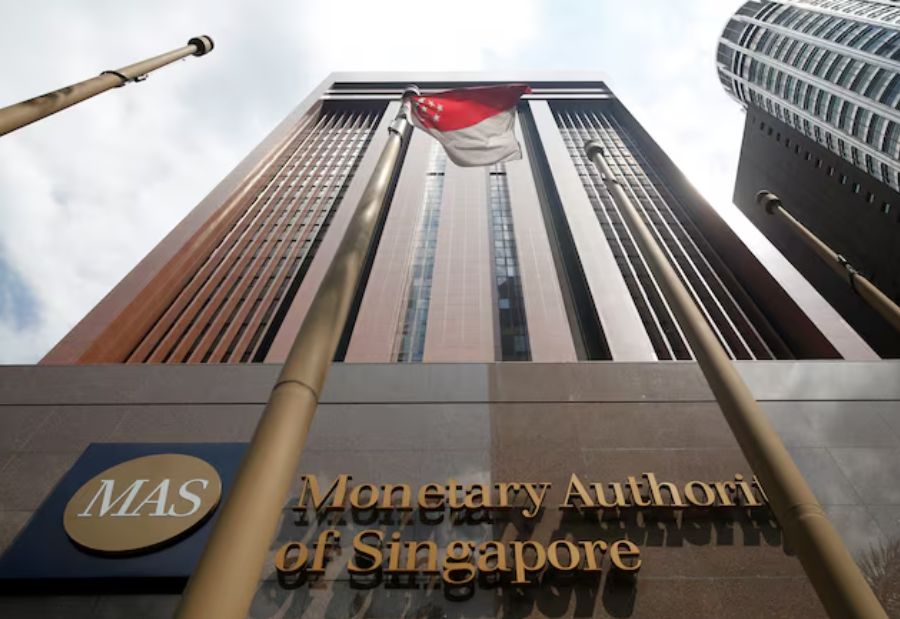
Singapore’s central bank unexpectedly tightened its monetary policy on Monday, citing persistent inflation risks as tensions in the Middle East continue to keep energy costs elevated.
The Monetary Authority of Singapore (MAS) announced a very slight increase in the rate of appreciation of the Singapore dollar nominal effective exchange rate (S$NEER) policy band. The move was smaller than the tightening introduced in April. The MAS kept the width and midpoint of the policy band unchanged and did not disclose the exact extent of the adjustment.
The central bank said core inflation is expected to rise from July and remain elevated before easing noticeably from around mid-2027. Following the announcement, the Singapore dollar strengthened slightly to 1.2888 per U.S. dollar.
Before the policy review, 12 of 16 analysts had expected the MAS to leave its policy unchanged, while 4 had forecast a tightening.
The MAS warned that there is “significant uncertainty” surrounding the economic outlook. It said inflation could rise faster than expected if energy prices increase again due to renewed supply disruptions in the Middle East. The central bank also noted that strong investment growth could keep inflation elevated, while tighter financial conditions or a slowdown in AI-related investments could weaken economic growth and reduce inflationary pressures.
Singapore’s electricity tariffs increased by 17% this month because of higher imported natural gas prices.
The country’s trade ministry expects economic growth of 2%–4% this year. Preliminary data showed the economy expanded by a stronger-than-expected 5.7% year-on-year in the 2nd quarter, supported by AI-related demand. Meanwhile, core inflation stood at 1.6% year-on-year in June, below market expectations.
An economist at a financial institution expects headline and core inflation to rise to around 2.5% and 2.3% year-on-year in the coming months before falling below 2% in the 2nd half of 2027.
Unlike many central banks, Singapore manages monetary policy through its exchange rate rather than interest rates. The MAS allows the Singapore dollar to move within the undisclosed S$NEER policy band and adjusts policy using 3 tools: the slope, midpoint, and width of the band.
Also read: Viksit Workforce for a Viksit Bharat
Do Follow: The Mainstream LinkedIn | The Mainstream Facebook | The Mainstream Youtube | The Mainstream Twitter
About us:
The Mainstream is a premier platform delivering the latest updates and informed perspectives across the technology business and cyber landscape. Built on research-driven, thought leadership and original intellectual property, The Mainstream also curates summits & conferences that convene decision makers to explore how technology reshapes industries and leadership. With a growing presence in India and globally across the Middle East, Africa, ASEAN, the USA, the UK and Australia, The Mainstream carries a vision to bring the latest happenings and insights to 8.2 billion people and to place technology at the centre of conversation for leaders navigating the future.