


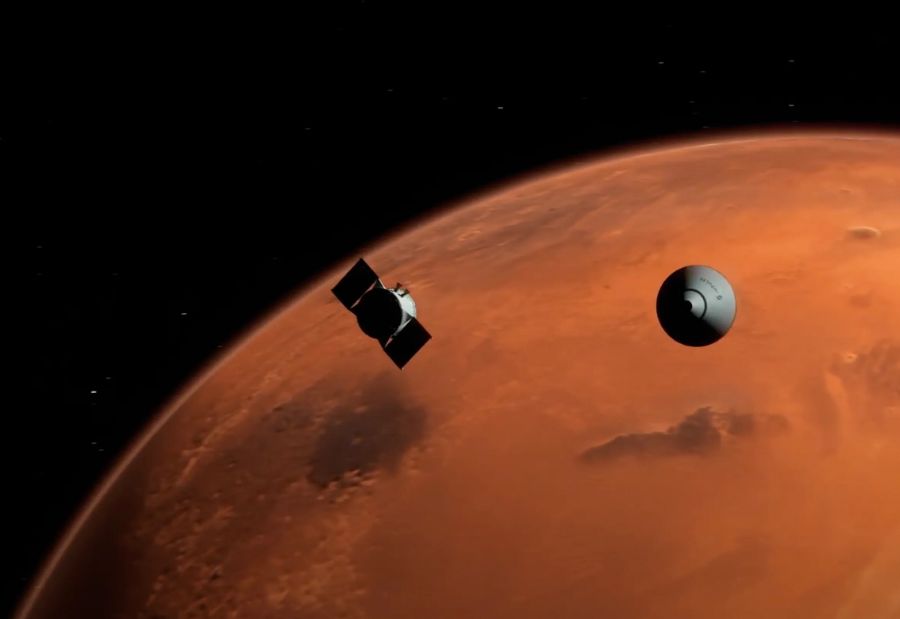
NASA has announced a new public-private partnership with Relativity Space to advance Mars exploration by combining the agency’s scientific expertise with commercial space capabilities. The collaboration aims to accelerate Mars research while supporting future human missions to the Red Planet.
Under the agreement, NASA will provide the Aeolus atmospheric science instrument payload suite, while Relativity Space will supply the spacecraft, launch vehicle, and cruise operations required to transport the instruments to Mars.
The mission reflects NASA’s strategy of leveraging commercial innovation and investment to increase mission frequency and gather critical scientific data more efficiently. The information collected will help scientists better understand Mars’ atmosphere and support safer future landings for both robotic and human missions.
“Public-private partnerships like this are a force multiplier for science,” said NASA Administrator Jared Isaacman. “By pairing NASA’s world-class instruments with commercial innovation and investment, we can deliver more science, more often, and reduce the time it takes to get essential data into the hands of researchers preparing for future human missions to Mars.”
Scheduled for launch in 2028, Aeolus is a NASA-developed suite of 4 instruments designed to deliver the first integrated daily global view of Martian winds, temperatures, dust, and clouds. The mission is expected to improve atmospheric models and provide detailed environmental data critical for entry, descent, and landing systems.
The project builds on more than 20 years of Mars atmospheric research conducted through missions such as Mars Atmosphere and Volatile Evolution (MAVEN), Mars Reconnaissance Orbiter, and Mars Odyssey. Researchers at NASA’s Ames Research Center in California will design, build, and integrate the payload, while Relativity Space will oversee spacecraft development and mission operations.
“As NASA’s Innovation Center of Excellence, Ames is committed to delivering the technologies, capabilities, and creative partnerships that enable the agency’s boldest missions,” said Dr. Eugene Tu, Center Director, NASA Ames. “Aeolus reflects how innovative collaboration accelerates science and strengthens the foundation needed for one day landing humans on Mars.”
The Aeolus payload suite includes 4 NASA-built instruments:
- Doppler Wind and Temperature Sounder (DWTS-Ozone) – Measures wind and temperature profiles from the surface to approximately 60 km. Developed in collaboration with GATS.
- Thermal Limb Sounder (TLS) – Provides vertical temperature profiles and observations of dust and water-ice clouds. Developed with Xiomas Technologies.
- Surface Radiometric Sensor Package (SuRSeP) – Measures surface energy balance, dust, and cloud properties.
- Wide-Field Context Camera (WFCC) – Captures daily global images of atmospheric activity.
NASA will support science instrument operations for at least 1 Martian year, while Relativity Space will manage spacecraft operations. The agency will also develop the data-processing system needed to convert raw observations into scientific data products for researchers worldwide.
The initiative is being carried out under NASA’s first 6-year reimbursable Space Act Agreement, creating a long-term framework for collaboration, mission continuity, and future scientific exploration.
Also read: Viksit Workforce for a Viksit Bharat
Do Follow: The Mainstream LinkedIn | The Mainstream Facebook | The Mainstream Youtube | The Mainstream Twitter
About us:
The Mainstream is a premier platform delivering the latest updates and informed perspectives across the technology business and cyber landscape. Built on research-driven, thought leadership and original intellectual property, The Mainstream also curates summits & conferences that convene decision makers to explore how technology reshapes industries and leadership. With a growing presence in India and globally across the Middle East, Africa, ASEAN, the USA, the UK and Australia, The Mainstream carries a vision to bring the latest happenings and insights to 8.2 billion people and to place technology at the centre of conversation for leaders navigating the future.