


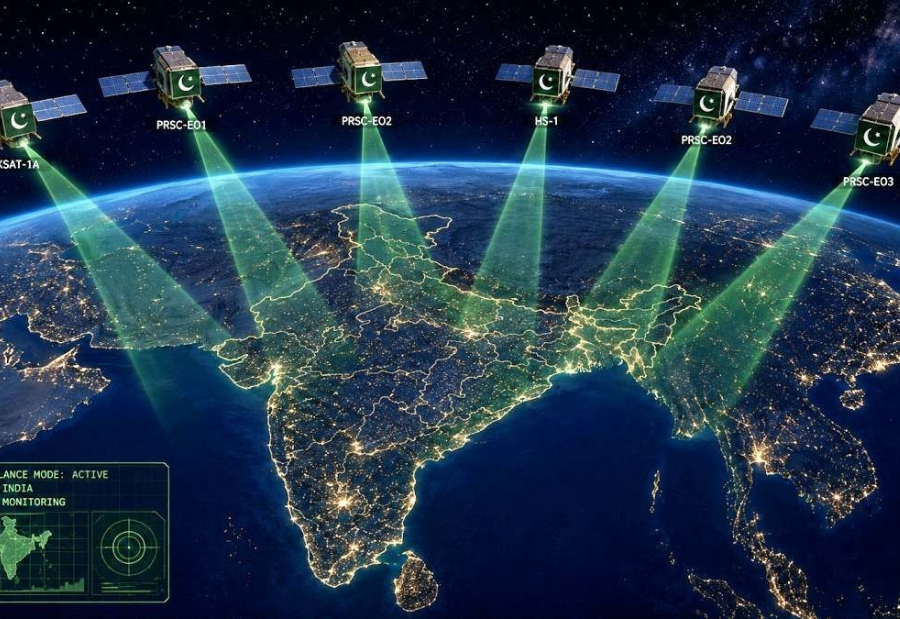
A new phase of strategic competition is gradually taking shape in space, as Pakistan rapidly strengthens its satellite surveillance capabilities with significant support from China. More than a year after India and Pakistan stepped back from tensions following Operation Sindoor, attention is shifting to developments taking place hundreds of kilometres above Earth.
Pakistan has launched 6 Earth-observation satellites between January 2025 and April 2026, creating a constellation capable of regularly monitoring Indian territory. The launches began even before the Pahalgam attack and India’s Operation Sindoor response.
The pace marks a major shift for Pakistan’s space programme. Since the establishment of the Space and Upper Atmosphere Research Commission (SUPARCO) in 1961, the country had launched only a limited number of satellites over several decades. However, in just 16 months, Pakistan deployed 6 new Earth-observation satellites, including optical imaging, hyperspectral and remote-sensing platforms.
Experts believe the significance lies not only in the number of satellites but also in their combined capabilities.
“The constellation that has emerged from this sixteen-month burst is not a civilian earth observation system that happens to have military applications on the side. Its orbital architecture, its sensor complement, and above all its institutional provenance tell a different and more consequential story,” Rear Admiral Sudhir Pillai, former flag officer of the Indian Navy, said in a blog post analysing the launches.
The constellation includes satellites capable of capturing high-resolution imagery, detecting changes on the ground, identifying camouflaged objects and conducting persistent surveillance over strategically important areas.
Pakistan’s HS-1 hyperspectral satellite, launched in October 2025, can distinguish between different materials and detect objects that may not be visible through conventional optical sensors. Newer satellites such as PRSC-EO2 and PRSC-EO3 feature advanced imaging systems and AI-assisted data processing capabilities.
China has played a key role in this expansion. Several satellites were launched using Chinese rockets, while others were developed through collaborations between Pakistani and Chinese organisations. Analysts believe the cooperation includes technology transfer, satellite design support and data-sharing arrangements.
Independent analysis by a space situational awareness firm found that PRSC-EO3, launched in April 2026, was placed in an orbit designed for repeated observations over South Asia. This allows more frequent monitoring of Pakistan and northern India, including Jammu and Kashmir.
Experts say the growing satellite network, combined with China’s Earth-observation systems, could significantly improve Pakistan’s intelligence-gathering capabilities and increase the strategic importance of space-based information in the region.
Also read: Viksit Workforce for a Viksit Bharat
Do Follow: The Mainstream LinkedIn | The Mainstream Facebook | The Mainstream Youtube | The Mainstream Twitter
About us:
The Mainstream is a premier platform delivering the latest updates and informed perspectives across the technology business and cyber landscape. Built on research-driven, thought leadership and original intellectual property, The Mainstream also curates summits & conferences that convene decision makers to explore how technology reshapes industries and leadership. With a growing presence in India and globally across the Middle East, Africa, ASEAN, the USA, the UK and Australia, The Mainstream carries a vision to bring the latest happenings and insights to 8.2 billion people and to place technology at the centre of conversation for leaders navigating the future.