


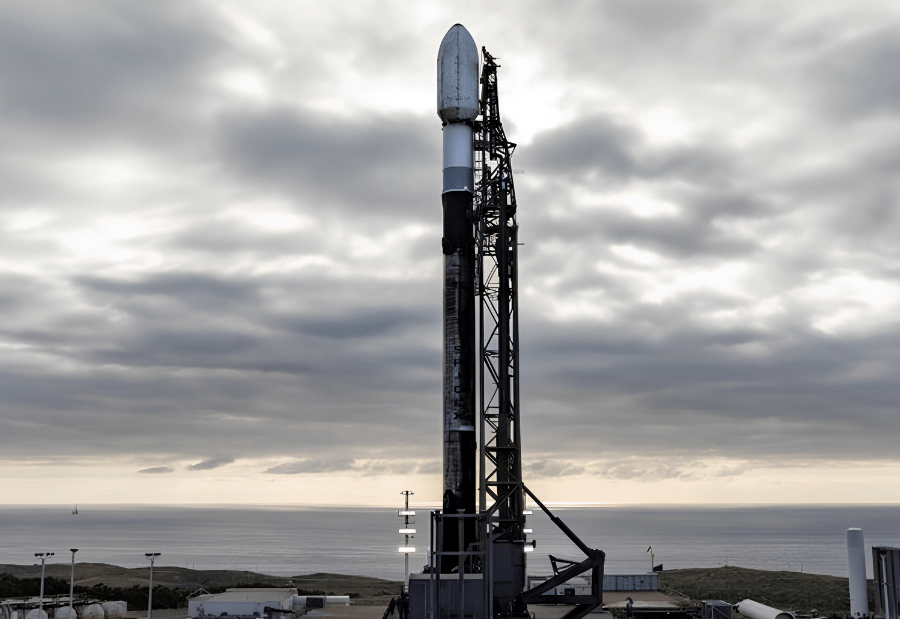
Marking a significant step in space imaging innovation, Indian startup GalaxEye has successfully launched its first satellite, Drishti, designed to capture both optical and radar images simultaneously.
The satellite was launched aboard a Falcon 9 by SpaceX from Vandenberg Space Force Base in the United States at 1230 pm India time, as part of the CAS500-2 mission carrying 45 payloads.
Drishti introduces a new approach called Opto-SAR technology, combining optical imaging with Synthetic Aperture Radar (SAR) in a single satellite. Optical sensors provide clear and easy-to-understand images, while SAR ensures continuous imaging in all weather conditions, including cloudy skies and nighttime.
“Imaging satellites are generally equipped to take multi-spectral or hyper-spectral (optical) images, or they use SAR. Both of these kinds of satellite data are used extensively. But very often they need to be fused together to get correct information because each one of them has limitations. Multi-spectral images are clear and easy to understand, but they are not effective during cloudy weather or night time, for instance. SAR signals can penetrate clouds and take continuous images, but they are not intuitive. Like X-ray images, they need experts to glean the information. The uniqueness of Drishti is that it has both the sensors that will enable simultaneous imaging,” said Suyash Singh, founder of GalaxEye.
The satellite addresses a long-standing challenge in space imaging, where users typically rely on data from multiple satellites. Differences in timing and viewing angles often make it difficult to combine datasets accurately.
“What we are trying to do is to make space imagery available all the time, and understandable to all kinds of users,” Singh said.
“When the optical sensors are unable to take images because of clouds or other similar reasons, we are using artificial intelligence to regenerate optical-like images from the SAR,” he added.
To achieve this, GalaxEye developed a proprietary system that synchronises optical and SAR sensors to capture the same location at the same time.
“SAR and optical sensors are designed in different ways. They look at the Earth at different angles. So, if they are placed side by side, for example, the optical sensor might be looking at Bengaluru while SAR is capturing Dubai at that instant. So we have come up with a technology stack that synchronises the functionalities of these two technologies, enabling them to look at the same location at the same time. This is our proprietary technology. This does away with the need of the users to manually align the datasets from two different satellites,” Singh said.
Singh noted that such solutions are especially relevant for tropical regions like India, where cloud cover often limits optical imaging.
The satellite’s data is expected to support both civilian and military applications. GalaxEye, founded by alumni of Indian Institute of Technology Madras, joins a growing list of Indian space startups making global impact.
Also read: Viksit Workforce for a Viksit Bharat
Do Follow: The Mainstream LinkedIn | The Mainstream Facebook | The Mainstream Youtube | The Mainstream Twitter
About us:
The Mainstream is a premier platform delivering the latest updates and informed perspectives across the technology business and cyber landscape. Built on research-driven, thought leadership and original intellectual property, The Mainstream also curates summits & conferences that convene decision makers to explore how technology reshapes industries and leadership. With a growing presence in India and globally across the Middle East, Africa, ASEAN, the USA, the UK and Australia, The Mainstream carries a vision to bring the latest happenings and insights to 8.2 billion people and to place technology at the centre of conversation for leaders navigating the future.