


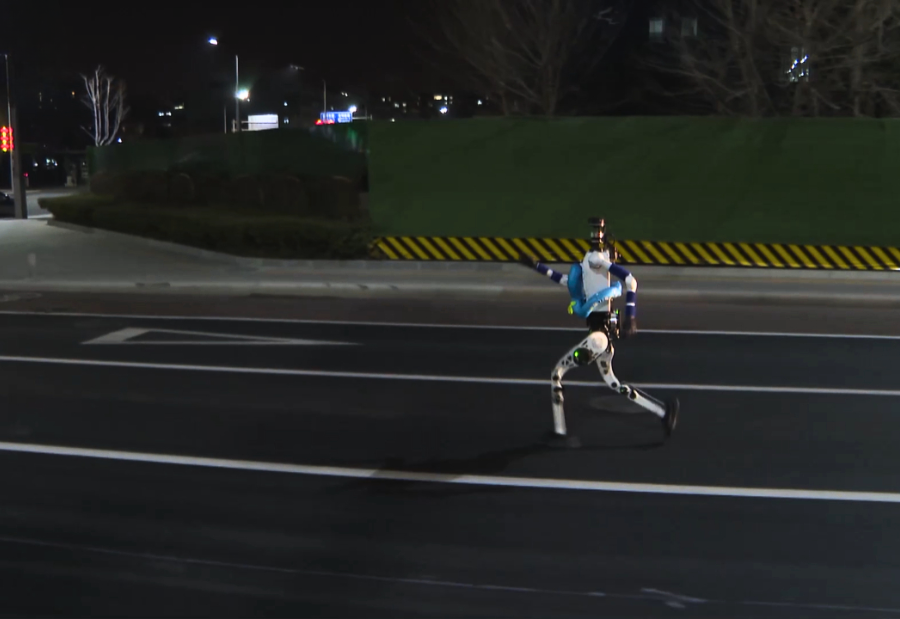
The first practice test for the 2026 Yizhuang Humanoid Robot Half Marathon, scheduled to take place on April 19 in Beijing, was successfully completed early on Sunday morning, marking an important step in preparations for the upcoming event.
More than 20 teams from enterprises and universities participated in the trial run, testing their humanoid robots on the upgraded racecourse designed for this year’s competition.
According to event organizers, the marathon route has been significantly redesigned to support more advanced robotics technologies and a larger number of participating teams. The introduction of autonomous navigation teams has increased the technical complexity of the race and the testing requirements for the course.
Shift toward autonomous robots
In the previous year’s competition, all robots were manually controlled by technicians who either walked alongside the machines or guided them from the front.
This year, however, some teams are introducing fully autonomous robots capable of navigating the course independently. These robots rely on electronic maps and onboard systems to make real-time decisions and determine their route without human guidance.
More challenging racecourse
The updated racecourse includes several challenging sections designed to test the robots’ mobility and adaptability. These include urban ramps, uneven and undulating roads, and eco-paths inside park areas.
Such terrain conditions require more advanced motion control algorithms and terrain adaptability, pushing teams to develop robots capable of stable movement in complex environments.
Testing robot performance and safety systems
The main objective of the practice test was to verify technical compatibility and real-world performance of the participating robots.
Organizers evaluated several key capabilities, including environmental perception, autonomous navigation, real-time decision-making, and battery endurance. The test also examined how well the robots could adapt to different road conditions and multi-scenario environments.
In addition to robot performance, the trial run also tested event management coordination, safety protocols, and traffic control systems. These assessments will help organizers refine race regulations and safety plans ahead of the official competition.
The successful completion of the practice test provides valuable operational insights and is expected to help ensure the smooth execution of the 2026 humanoid robot half marathon in Beijing.
Also read: Viksit Workforce for a Viksit Bharat
Do Follow: The Mainstream LinkedIn | The Mainstream Facebook | The Mainstream Youtube | The Mainstream Twitter
About us:
The Mainstream is a premier platform delivering the latest updates and informed perspectives across the technology business and cyber landscape. Built on research-driven, thought leadership and original intellectual property, The Mainstream also curates summits & conferences that convene decision makers to explore how technology reshapes industries and leadership. With a growing presence in India and globally across the Middle East, Africa, ASEAN, the USA, the UK and Australia, The Mainstream carries a vision to bring the latest happenings and insights to 8.2 billion people and to place technology at the centre of conversation for leaders navigating the future.