


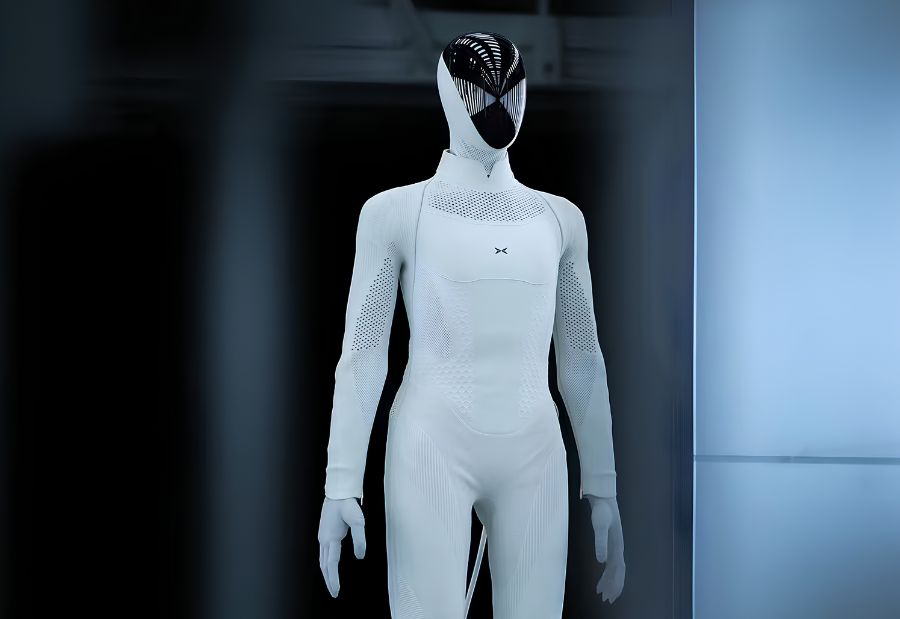
A major step in Xpeng’s robotics push has taken place with the commissioning of its Iron humanoid robot production line, where more than 80% of core processes are automated.
The company said on Tuesday that Iron had completed assembly and autonomously walked off the production line. The development marks a shift from research and development prototypes towards production-line manufacturing.
Xpeng described the facility as the world’s first automated production line for advanced humanoid robots. It combines automotive-grade quality systems from the smart electric vehicle industry with precision robot manufacturing.
The production line was designed for scale from the beginning. Automation across core processes is expected to support consistent manufacturing quality and faster capacity expansion.
The commissioning does not mean Iron has entered mass production. Xpeng said mass production is expected to begin by the end of 2026, with initial deployments planned at its own stores and campuses.
The company plans to officially launch Iron and begin deliveries in China and overseas markets in 2027. Xpeng has not disclosed the production line’s capacity or the robot’s price.
“The robot production lines were created from scratch with no precedent to follow,” said He Xiaopeng, chairman and CEO of Xpeng. He added that the company would continue working towards faster production cycles and greater manufacturing scale.
The new facility supports Xpeng’s expansion into physical AI. The company is applying quality management, supply chain expertise and AI technologies developed through its automotive business to robotics.
Unveiled in November 2025, the latest Iron model has 76 degrees of freedom (DOF) across its body and 21 in each hand. It uses a fully enclosed flexible lattice structure developed by Xpeng to combine a human-like appearance with safety.
Iron is powered by 3 in-house Turing AI chips, delivering up to 2,250 TOPS of effective computing power. This enables Xpeng’s physical AI foundation model to run directly on the robot.
According to Xpeng, the setup allows Iron to perform complex tasks autonomously without remote operation, while reducing inference latency and improving data security.
The company aims to develop Iron as a general-purpose humanoid robot platform for a wide range of applications, with continuous improvement through real-world use.
Xpeng expects advanced humanoid robotics to face high technical barriers and limited high-quality supply, which it believes could support higher gross profit per unit than new energy vehicles (NEVs).
The robotics business also recently secured an independent funding channel. Xpeng’s Dogotix unit signed share purchase agreements with investors for around $900 million in financing commitments. The round was led by IDG Capital, with participation from Gaorong Ventures, while Alibaba and Tencent joined as strategic investors.
Dogotix’s implied post-money valuation could reach around $6.3 billion if the equity incentive pool is fully used. Xpeng will retain control and continue consolidating the business’s financial results after the transaction closes.
Also read: Viksit Workforce for a Viksit Bharat
Do Follow: The Mainstream LinkedIn | The Mainstream Facebook | The Mainstream Youtube | The Mainstream Twitter
About us:
The Mainstream is a premier platform delivering the latest updates and informed perspectives across the technology business and cyber landscape. Built on research-driven, thought leadership and original intellectual property, The Mainstream also curates summits & conferences that convene decision makers to explore how technology reshapes industries and leadership. With a growing presence in India and globally across the Middle East, Africa, ASEAN, the USA, the UK and Australia, The Mainstream carries a vision to bring the latest happenings and insights to 8.2 billion people and to place technology at the centre of conversation for leaders navigating the future.