


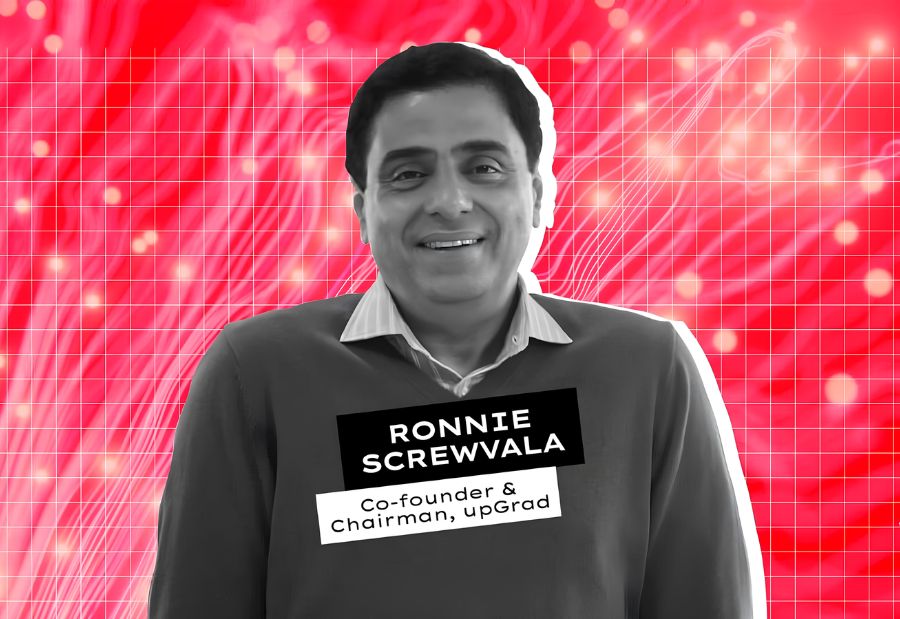
As artificial intelligence reshapes business operations and workforce requirements, edtech company upGrad is expanding its enterprise services with the launch of upGrad Next. The new workforce advisory business aims to help organisations rethink their workforce strategies, covering areas such as organisational structure, recruitment, compensation and employee development.
The launch marks another step in upGrad’s expansion beyond its core skilling business. The company has diversified into higher education, professional courses, study-abroad services and enterprise learning. Its acquisition of Unacademy has also added competitive exam preparation to its portfolio. Led by chairperson and co-founder Ronnie Screwvala, upGrad is also exploring a potential IPO.
Anandorup Ghose will lead upGrad Next as managing director. The initial leadership team includes Hrishikesh Godbole, Krishna Chaitanya and Dinkar Pawan.
Screwvala described the launch as a response to the next phase of digital transformation. “The last decade, in many ways, was about the complete digital transformation of organisations. We see the next decade being about transforming the workforce to manage, and get strong returns from, the change that has already happened.”
Through Next, upGrad will advise organisations on workforce planning, hiring, compensation and employee development, while also helping them implement these strategies. The company plans to bring together experienced advisers, AI capabilities and its existing skilling and hiring operations. Its approach will focus on delivering measurable business outcomes rather than charging based on consultant hours.
Ghose brings over 24 years of experience in human resources and rewards consulting. He previously worked as a partner at Aon and Deloitte and led Deloitte’s global rewards consulting practice. He believes there is a gap between large-scale technology transformation programmes and specialised HR solutions.
“These demand experience and judgment. The next decade won’t be won by those who adopt technology fastest, but by those who unlock human potential most effectively.”
According to Ghose, organisations must align AI investments with job design and employee capabilities. Simply adopting new technologies does not automatically translate into improved productivity.
Data from Aon’s 2026 Human Capital Trends study shows that 43% of organisations in India had deployed AI, while another 20% were running pilot programmes. However, many organisations continue to face challenges in converting these investments into measurable workforce outcomes.
The World Economic Forum’s Future of Jobs Report 2025 estimated that 39% of workers’ existing skills would change or become outdated by 2030. It also found that 63% of employers considered skills gaps a major obstacle to business transformation.
Consulting and technology companies are also bringing workforce advisory and implementation capabilities closer together. In October 2026, KPMG in India partnered with HR technology company PeopleStrong to combine workforce consulting with AI-enabled human capital management software for employee data and HR processes.
In September 2026, Deloitte launched its Open Model Engineering practice to help organisations develop and deploy AI tools for business applications. The firm also announced plans to hire and train specialists to work alongside clients.
Meanwhile, government initiatives are strengthening India’s AI skills ecosystem. The Ministry of Skill Development and Entrepreneurship stated that the Skill India Digital Hub’s SOAR programme now offers 50 qualifications covering AI and its applications. By August 2026, the programme had recorded more than 517,000 enrolments and over 100,000 certifications.
Also read: Viksit Workforce for a Viksit Bharat
Do Follow: The Mainstream LinkedIn | The Mainstream Facebook | The Mainstream Youtube | The Mainstream Twitter
About us:
The Mainstream is a premier platform delivering the latest updates and informed perspectives across the technology business and cyber landscape. Built on research-driven, thought leadership and original intellectual property, The Mainstream also curates summits & conferences that convene decision makers to explore how technology reshapes industries and leadership. With a growing presence in India and globally across the Middle East, Africa, ASEAN, the USA, the UK and Australia, The Mainstream carries a vision to bring the latest happenings and insights to 8.2 billion people and to place technology at the centre of conversation for leaders navigating the future.