


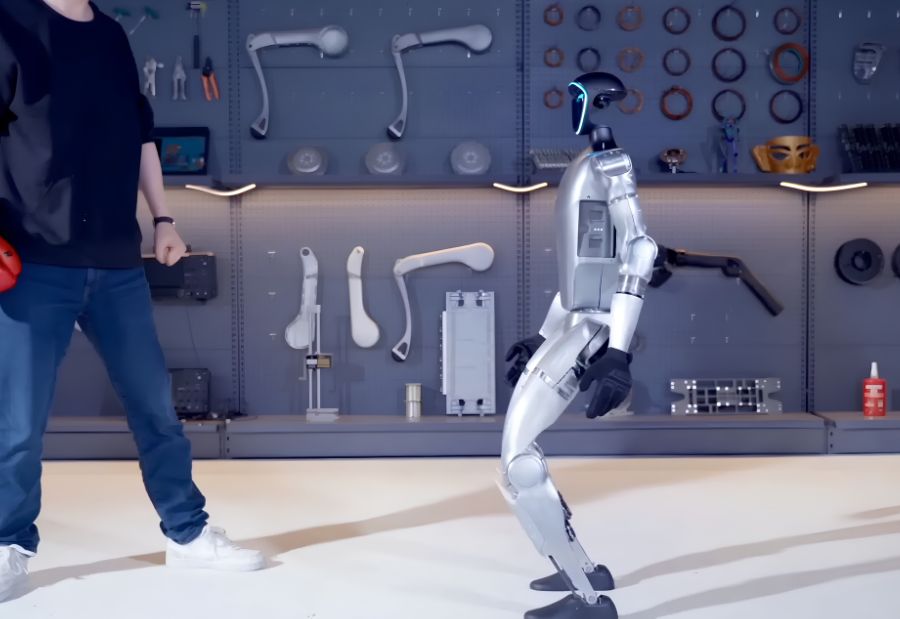
Unitree Robotics has demonstrated its G1 humanoid robot sparring with a human partner without direct human control, highlighting a move toward robots that can perceive, predict and respond to changing environments on their own.
The demonstration uses Unitree’s new AI model, UnifoLM-X2-1.0, which is designed to predict changes around the robot and plan movements in real time instead of relying on a human operator using a VR headset, gamepad or other controller.
During the demonstration, the G1 adjusts its stance and footwork as the opponent approaches, avoids incoming strikes and responds with punches and kicks. Visualisations in the footage show the system predicting future states of the interaction and using those predictions to plan movements before the robot acts.
Unlike earlier humanoid combat demonstrations that relied on remote control or other forms of human intervention, Unitree says the new system removes the need for a human teleoperator.
UnifoLM-X2-1.0 uses a predictive perception-to-action approach. It continuously processes its surroundings, anticipates how the opponent and environment may change, and uses that information to decide its next movement.
“UnifoLM-X2-1.0 breaks through world-action foundation models’ bottlenecks in instant planning, decision-making, and dynamic interactive execution, achieves high dynamics, strong interaction, real-time prediction and planning of the future, achieves fully autonomous combat for humanoid robots,” the video description states.
The technology addresses a key challenge for AI-powered humanoids: reducing the time between perception, decision-making and physical action. Unitree says the model enables faster motion planning, tactical decisions and closed-loop execution during highly dynamic interactions.
The system is part of Unitree’s expanding family of foundation models, which has developed from models focused on factory manipulation toward newer multimodal systems. Its world-model approach is designed to help robots understand their surroundings and predict what could happen next.
However, the demonstration also indicates that the AI may not be running entirely on the G1 itself. Console logs showing commands such as OBS/replan and env.step suggest that sensor data could be sent to a separate computer running the model, which then sends movement instructions back to the robot. Reducing this dependence on external computing remains a challenge.
Unitree views autonomous combat as a test of physical AI. The ability to predict movement, maintain balance and respond to unexpected contact could eventually support safer humanoid robots in complex industrial environments.
Also read: Viksit Workforce for a Viksit Bharat
Do Follow: The Mainstream LinkedIn | The Mainstream Facebook | The Mainstream Youtube | The Mainstream Twitter
About us:
The Mainstream is a premier platform delivering the latest updates and informed perspectives across the technology business and cyber landscape. Built on research-driven, thought leadership and original intellectual property, The Mainstream also curates summits & conferences that convene decision makers to explore how technology reshapes industries and leadership. With a growing presence in India and globally across the Middle East, Africa, ASEAN, the USA, the UK and Australia, The Mainstream carries a vision to bring the latest happenings and insights to 8.2 billion people and to place technology at the centre of conversation for leaders navigating the future.