


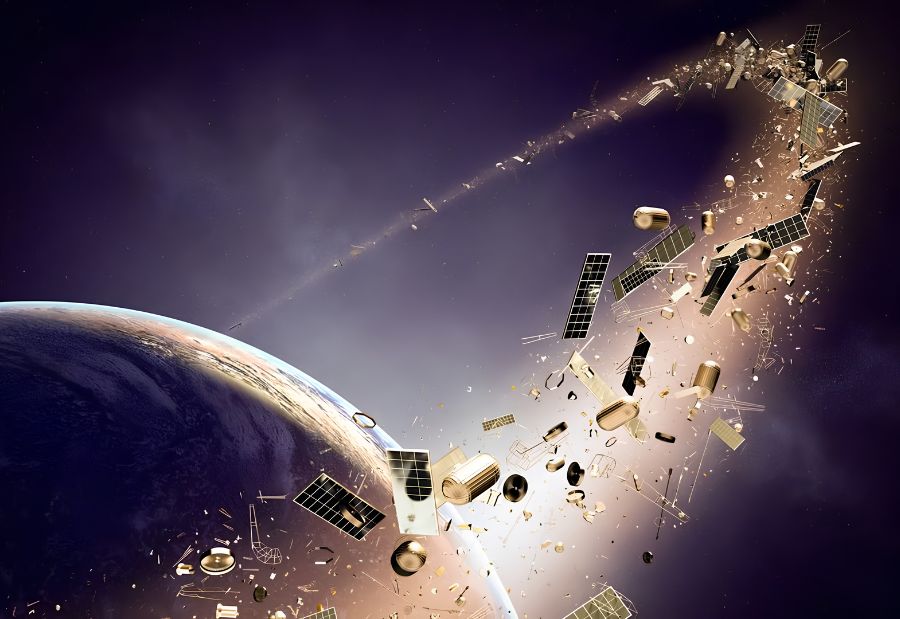
Earth’s orbit is becoming increasingly crowded, with an estimated 13,486 tonnes of space debris now surrounding the planet. Around 70 years ago, Earth had only 1 natural satellite—the Moon. Today, it has more than 15,000 satellites, including nearly 10,000 operated by SpaceX, raising concerns about the long-term sustainability of space activities.
Space debris includes discarded rocket stages, inactive satellites and fragments ranging from large objects to microscopic particles. Researchers estimate there are around 36,000 debris objects larger than 10 cm, along with tens of millions of smaller fragments. The United States, Russia (including the former USSR) and China remain the largest contributors to orbital debris.
Travelling at an average speed of around 7 km per second in low Earth orbit, even small debris can severely damage operational satellites. Scientists warn of the Kessler syndrome, a scenario in which repeated collisions create a chain reaction of debris that could make parts of Earth’s orbit unusable and significantly disrupt future space missions.
The growing debris problem is already affecting human spaceflight. The International Space Station (ISS) performs collision-avoidance manoeuvres at least 1 time each year to reduce the risk of impact from orbiting debris.
One common approach to managing space debris is allowing inactive satellites to re-enter Earth’s atmosphere, where they burn up. For example, at least 1 Starlink satellite is deorbited daily. However, researchers caution that the resulting soot and alumina particles may gradually affect the ozone layer, which protects Earth from harmful ultraviolet radiation.
To address the challenge, experts are focusing on both active debris removal and improved spacecraft design. Proposed technologies include nets, magnets, tethers, sails, slingshots and harpoons to either deorbit old spacecraft or move them into dedicated “graveyard” orbits. Researchers have also identified a list of the 50 most hazardous abandoned spacecraft for potential removal.
Future spacecraft designs are also evolving. Scientists are exploring more durable materials to extend satellite lifespans, along with materials that enable safer disposal. Japan is testing wood as a spacecraft material, while other approaches include in-orbit refuelling to extend satellite operations and reduce future space debris.
Also read: Viksit Workforce for a Viksit Bharat
Do Follow: The Mainstream LinkedIn | The Mainstream Facebook | The Mainstream Youtube | The Mainstream Twitter
About us:
The Mainstream is a premier platform delivering the latest updates and informed perspectives across the technology business and cyber landscape. Built on research-driven, thought leadership and original intellectual property, The Mainstream also curates summits & conferences that convene decision makers to explore how technology reshapes industries and leadership. With a growing presence in India and globally across the Middle East, Africa, ASEAN, the USA, the UK and Australia, The Mainstream carries a vision to bring the latest happenings and insights to 8.2 billion people and to place technology at the centre of conversation for leaders navigating the future.