


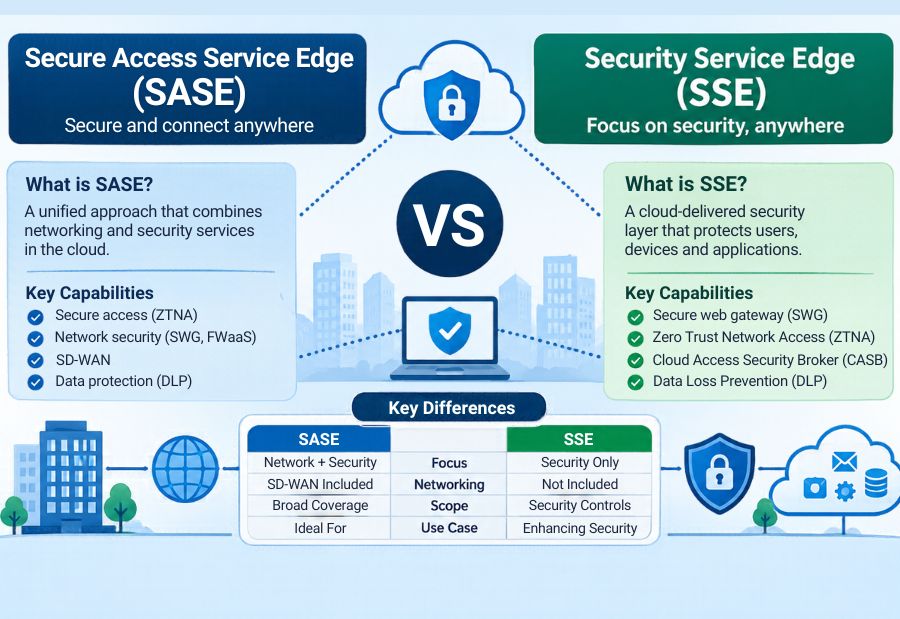
As organisations support remote employees, cloud applications and distributed business operations, traditional network security models face new challenges. Employees may access company resources from different locations, devices and networks, making it difficult to apply consistent security controls. Two approaches gaining importance in modern security architecture are Secure Access Service Edge (SASE) and Security Service Edge (SSE). Both help protect access to applications and digital resources, but they differ in the capabilities they cover. Understanding SASE vs. SSE helps technology leaders determine which architecture better supports their network and security requirements.
What is Secure Access Service Edge (SASE)?
Secure Access Service Edge is a cloud-based architecture that combines networking and security services into a unified framework.
It brings together network connectivity capabilities, such as Software-Defined Wide Area Networking (SD-WAN), with security services that protect users, devices and applications.
A SASE architecture commonly includes:
- SD-WAN: Connects distributed locations and directs network traffic.
- Secure Web Gateway (SWG): Filters web traffic and blocks access to malicious websites.
- Cloud Access Security Broker (CASB): Applies security policies to cloud application usage.
- Zero Trust Network Access (ZTNA): Provides controlled access based on user and device identity.
- Firewall as a Service (FWaaS): Applies network security policies through a cloud-delivered firewall.
The objective is to provide consistent network connectivity and security, regardless of where users or applications are located.
What is Security Service Edge (SSE)?
Security Service Edge is a security-focused architecture that delivers cloud-based security services to protect access to websites, cloud applications and private applications.
SSE includes capabilities such as SWG, CASB and ZTNA. It may also include Firewall as a Service and other security functions, depending on the provider.
Unlike SASE, SSE does not inherently include the networking component of SD-WAN.
For example, an organisation may use an existing SD-WAN solution for network connectivity while adopting SSE to improve security for remote users and cloud applications.
SASE vs. SSE: Key Differences
| Comparison Area | SASE | SSE |
| Primary focus | Unified networking and security | Cloud-delivered security |
| Networking | Includes SD-WAN capabilities | Does not inherently include SD-WAN |
| Security services | Combines network and security controls | Combines multiple security services |
| Architecture | Converged networking and security framework | Security-focused cloud architecture |
| Deployment | Requires coordination of network and security components | Can integrate with existing network infrastructure |
| Suitable for | Organisations seeking network and security convergence | Organizations prioritizing security modernization |
The main distinction is that SASE combines networking and security, while SSE concentrates on security services.
Key benefits of SASE
- Unified Network and Security Management
SASE helps organisations manage networking and security through a more integrated architecture. This can reduce the complexity of maintaining separate systems.
- Consistent Access Policies
Security policies can be applied across users, locations and applications, supporting more consistent protection.
- Improved Cloud Connectivity
Its networking capabilities help direct traffic across distributed locations and cloud environments.
- Support for Distributed Workforces
Employees can securely access applications without depending entirely on traditional office-based network boundaries.
Key benefits of SSE
- Stronger Application Access Security
SSE provides security controls for users accessing cloud and private applications from different locations.
- Better Cloud Application Visibility
CASB capabilities can help organisations identify cloud application usage and enforce security policies.
- Zero Trust Access
ZTNA can restrict access based on identity, device condition and other contextual factors rather than automatically trusting users based on network location.
- Flexible Security Modernization
Organisations can adopt cloud-delivered security services without necessarily replacing their existing network architecture.
When should organisations choose SASE or SSE?
The right approach depends on existing infrastructure and long-term technology plans.
SASE may be suitable when:
- An organization wants to modernize both networking and security.
- Multiple office locations require consistent connectivity.
- Existing WAN infrastructure needs transformation.
- IT teams want to reduce dependence on separate networking and security systems.
SSE may be suitable when:
- The organization already has a mature SD-WAN or networking setup.
- The immediate priority is improving cloud and application security.
- Remote access policies need to be strengthened.
- Security teams want to adopt Zero Trust capabilities without redesigning the entire network.
Some organisations may also adopt SSE first and gradually move towards a broader SASE architecture.
Final Thought
SASE and SSE address different but connected requirements in modern network security. SASE combines networking and security services, while SSE focuses on protecting access to applications and digital resources.
Technology leaders should evaluate existing network infrastructure, security gaps, cloud adoption and operational requirements before selecting an approach. The Mainstream explores how organisations can adapt their technology and cybersecurity strategies to support increasingly distributed digital environments.