


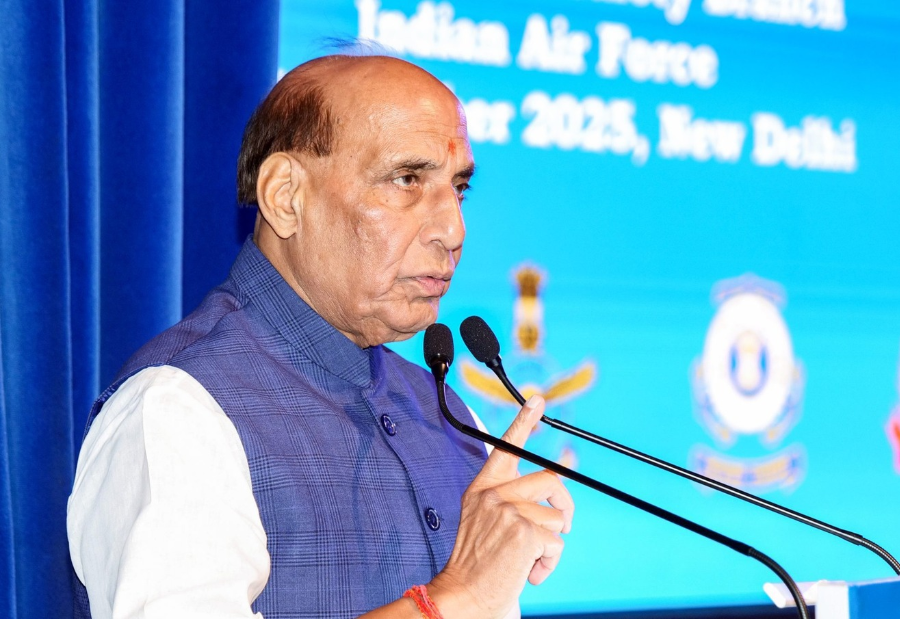
India must strengthen its ability to develop and innovate in advanced technologies rather than depend on other countries, Defence Minister Rajnath Singh said on Sunday, November 15, 2026. He called for greater investment in indigenous Non-Destructive Testing (NDT) capabilities to support defence preparedness and technological self-reliance.
Addressing the 36th Annual Conference on Non-Destructive Evaluation and Enabling Technologies and the 15th International Symposium on Non-Destructive Testing in Aerospace virtually, Singh stressed that reliable testing and quality assurance are essential for national security.
“There can be no compromise on the integrity of testing results in strategic applications,” he said. He urged India to develop its own advanced inspection technologies, specialised sensors, evaluation equipment and software to reduce dependence on foreign suppliers and protect critical defence supply chains.
NDT key to defence quality and safety
Singh explained that NDT allows materials, components and structures to be examined without causing damage, much like ultrasound and X-rays are used to examine the human body. As defence systems become more advanced, every material, component and manufacturing process must meet strict quality and reliability standards.
He warned that hidden defects could reduce equipment availability, increase maintenance needs, shorten service life and, in critical situations, put missions at risk.
“We need to move beyond a culture of merely identifying defects towards actively preventing them by embedding quality at every stage of the manufacturing process,” he said.
He added that quality in missiles, aircraft, naval platforms and spacecraft is not just a manufacturing requirement but a key part of operational reliability and national security.
AI and innovation to support self-reliance
The Defence Minister cited India’s progress in missile development, naval platforms, aerospace engineering, radar systems and space applications. He also described the commissioning of INS Vikrant, the country’s first indigenous aircraft carrier, as an important milestone in self-reliance.
Singh highlighted the growing use of artificial intelligence, machine learning, robotics, advanced sensors, digital twins and predictive analytics in inspection and structural health monitoring. He called for solutions designed around India’s strategic and industrial needs.
Referring to initiatives such as Innovations for Defence Excellence (iDEX) and the Technology Development Fund (TDF), he stressed collaboration among government, industry, academia and research institutions.
The 3-day conference in Hyderabad, organised by the Indian Society for Non-Destructive Testing, brought together more than 2,000 professionals, researchers, industry experts and students to discuss emerging NDT technologies, particularly in defence and aerospace.
Also read: Viksit Workforce for a Viksit Bharat
Do Follow: The Mainstream LinkedIn | The Mainstream Facebook | The Mainstream Youtube | The Mainstream Twitter
About us:
The Mainstream is a premier platform delivering the latest updates and informed perspectives across the technology business and cyber landscape. Built on research-driven, thought leadership and original intellectual property, The Mainstream also curates summits & conferences that convene decision makers to explore how technology reshapes industries and leadership. With a growing presence in India and globally across the Middle East, Africa, ASEAN, the USA, the UK and Australia, The Mainstream carries a vision to bring the latest happenings and insights to 8.2 billion people and to place technology at the centre of conversation for leaders navigating the future.