


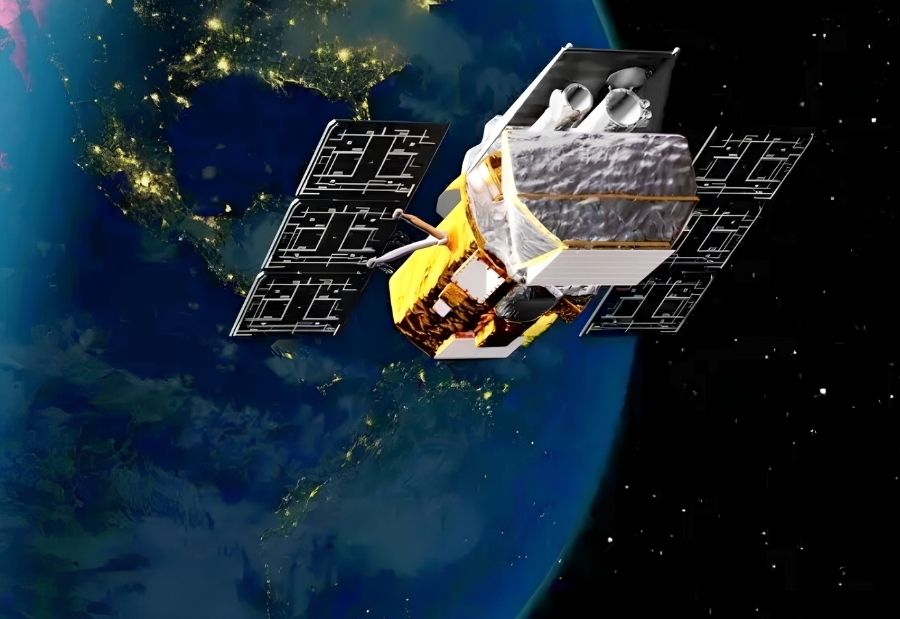
NASA’s Neil Gehrels Swift Observatory is back to collecting scientific data after a change in plans for a commercial mission that was intended to raise the spacecraft to a higher orbit. The commercial mission will now focus on testing technologies for future in-space satellite servicing.
On August 26, the Swift team switched on 2 of its 3 science instruments: the Ultraviolet/Optical Telescope and the X-ray Telescope. Both instruments had been turned off in February to reduce atmospheric drag and help extend Swift’s time in orbit while the planned boost effort was underway.
The mission’s 3rd instrument, the Burst Alert Telescope, was shut down in April to reduce power use. This allowed Swift’s solar panels to be positioned in a way that further reduced drag. The team expects to restore the instrument to science operations within the next few weeks.
Swift has spent more than 21 years studying the universe. The observatory can detect different types of light, quickly point toward short-lived cosmic events and send alerts to other observatories to support follow-up observations.
Like other spacecraft in low Earth orbit, Swift experiences atmospheric drag. Because it does not have a propulsion system to counter that drag, its altitude gradually decreases. Recent increases in solar activity have expanded Earth’s atmosphere and increased the drag on the spacecraft, causing its orbit to decline faster than expected.
In September 2025, NASA selected Katalyst Space to attempt to raise Swift’s orbit. The company was given 1 year to design, build, test and launch its LINK spacecraft before attempting to rendezvous with, capture and lift Swift.
LINK launched in July aboard a Northrop Grumman Pegasus rocket. Later that month, the spacecraft developed problems with its ability to control its orientation. On August 19, NASA and Katalyst announced that LINK would no longer attempt to capture and boost Swift.
Katalyst will instead attempt to rendezvous with Swift and conduct proximity operations to demonstrate satellite-servicing technologies for future space missions.
NASA had predicted that Swift’s low-drag operations would keep the spacecraft above 185 miles (300 kilometres) until October. Once it drops below that altitude, telescope operations become difficult and the spacecraft’s descent accelerates. With science observations now resumed, Swift is expected to reach that point within the next 1–2 months.
Also read: Viksit Workforce for a Viksit Bharat
Do Follow: The Mainstream LinkedIn | The Mainstream Facebook | The Mainstream Youtube | The Mainstream Twitter
About us:
The Mainstream is a premier platform delivering the latest updates and informed perspectives across the technology business and cyber landscape. Built on research-driven, thought leadership and original intellectual property, The Mainstream also curates summits & conferences that convene decision makers to explore how technology reshapes industries and leadership. With a growing presence in India and globally across the Middle East, Africa, ASEAN, the USA, the UK and Australia, The Mainstream carries a vision to bring the latest happenings and insights to 8.2 billion people and to place technology at the centre of conversation for leaders navigating the future.