


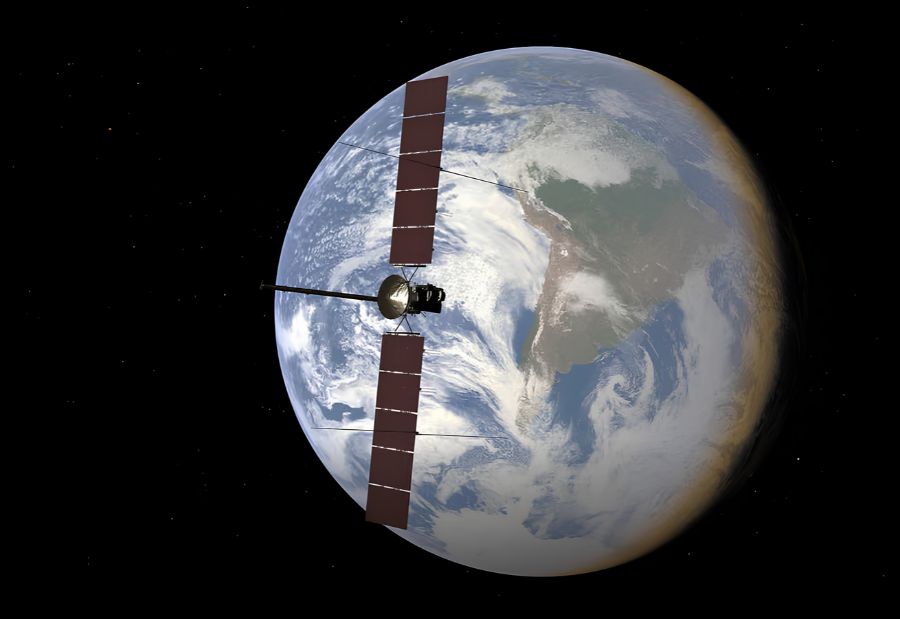
NASA’s Europa Clipper spacecraft is set to make a close flyby of Earth on December 3, more than 2 years after its launch. The spacecraft will pass approximately 2,000 miles from Earth, using the planet’s gravity to gain speed for its journey towards Jupiter’s icy moon, Europa.
The spacecraft is scheduled to make its closest approach west of Africa at 3:14 p.m. EST. During the flyby, all 9 of its science instruments will collect data.
How Earth’s gravity will help the spacecraft
Although Europa Clipper is travelling towards Jupiter, it continues to orbit the Sun after leaving Earth. Its speed and direction determine the shape of its path and how far it can travel from the Sun.
A close encounter with a planet can change the spacecraft’s speed and trajectory, reducing the amount of fuel needed for future manoeuvres.
As Clipper approaches Earth, the planet’s gravity will bend its flight path. Since Earth is also moving around the Sun, the carefully timed encounter will transfer a small amount of Earth’s orbital energy to the spacecraft, sending it away at a higher speed around the Sun.
The spacecraft previously used Mars for a similar manoeuvre in March 2025, passing approximately 550 miles above the planet. That encounter slowed Clipper and reshaped its orbit, bringing it back towards Earth for the upcoming flyby.
By the time it reaches Jupiter in April 2030, the spacecraft is expected to have travelled approximately 1.8 billion miles.
Earth flyby will help test scientific instruments
The upcoming encounter will also allow scientists to check the performance of Europa Clipper’s instruments.
The spacecraft will measure Earth’s magnetic field, which scientists have studied for decades. Engineers will compare these readings with existing measurements to check the spacecraft’s magnetometer and improve its calibration.
The instrument will later help researchers investigate whether Europa has a hidden ocean beneath its icy surface.
As Europa moves through Jupiter’s magnetic field, the changing field can generate electrical currents in a conductive ocean beneath the ice. These currents would create their own magnetic signal. By studying changes in this signal during repeated flybys, scientists hope to confirm the presence of the ocean and estimate its depth and salinity.
Clipper’s infrared camera will also scan Earth every 8 hours as it approaches. At Europa, the camera will map surface temperatures and identify areas that cool more slowly than their surroundings. These observations could help researchers understand differences in surface materials and investigate possible activity beneath the ice.
Comparing Earth measurements with observations from other spacecraft will also help the team work with data collected from different viewing positions.
What happens when Europa Clipper reaches Jupiter?
Another gravity-assist manoeuvre awaits the spacecraft at Jupiter. A close flyby of Ganymede, the largest of Jupiter’s moons, will slow Clipper before it fires its engines to enter orbit around the planet.
Once in orbit, the spacecraft is scheduled to make 49 flybys of Europa, with some passing as close as 16 miles above its surface. Each encounter will cover a different area, helping scientists build a detailed picture of nearly the entire moon.
Europa’s surface features cracks and ridges that could provide important clues about its structure. Scientists will study these features using cameras, temperature measurements and ice-penetrating radar. While cameras will capture surface details, temperature readings will show how the surrounding ice cools, and radar could reveal underground layers or pockets of liquid water.
Combined with measurements of the moon’s composition, these observations could help researchers understand whether material moves between Europa’s surface and its underlying ocean.
Finding liquid water alone would not establish whether Europa can support life. Scientists will also need to understand whether the environment has an energy source and the chemicals required to sustain life.
The December 3 flyby will be an important step in preparing for these investigations as Europa Clipper continues its journey towards Jupiter.
Also read: Viksit Workforce for a Viksit Bharat
Do Follow: The Mainstream LinkedIn | The Mainstream Facebook | The Mainstream Youtube | The Mainstream Twitter
About us:
The Mainstream is a premier platform delivering the latest updates and informed perspectives across the technology business and cyber landscape. Built on research-driven, thought leadership and original intellectual property, The Mainstream also curates summits & conferences that convene decision makers to explore how technology reshapes industries and leadership. With a growing presence in India and globally across the Middle East, Africa, ASEAN, the USA, the UK and Australia, The Mainstream carries a vision to bring the latest happenings and insights to 8.2 billion people and to place technology at the centre of conversation for leaders navigating the future.