


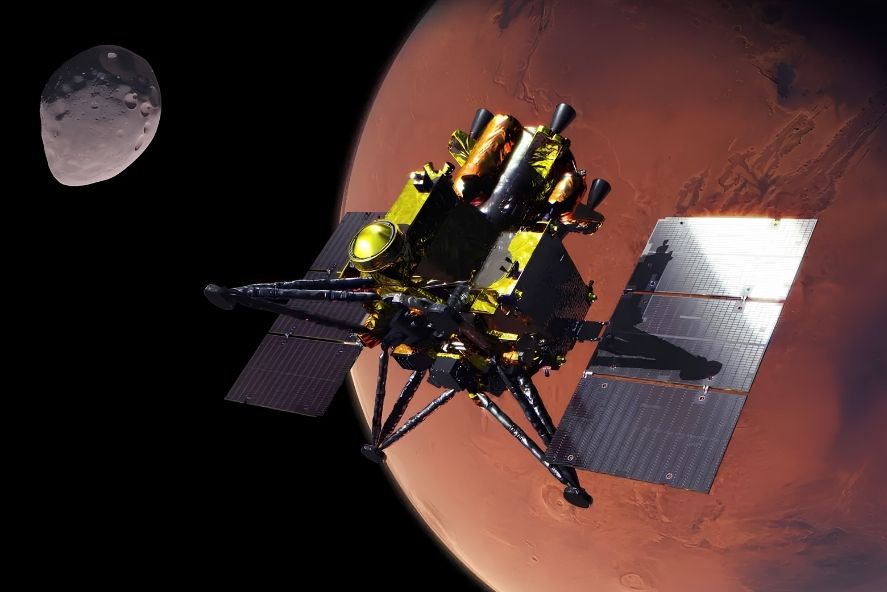
NASA will hold a media briefing on October 15, 2026, to outline its contributions to Japan’s Martian Moons eXploration (MMX) mission, which is scheduled to launch from the Japan Aerospace Exploration Agency’s (JAXA) Tanegashima Space Center on October 19 EDT, or October 20 in Japan Standard Time.
The briefing will take place at 4 p.m. EDT, with audio streamed on NASA’s official website. The session will cover the mission’s objectives and the technologies and scientific support provided by NASA.
Participants will include Lindsay Hays, Acting Director of NASA’s Planetary Science Division; Tom Statler, MMX Program Executive and Scientist; David Lawrence, principal investigator of the MEGANE instrument at Johns Hopkins Applied Physics Laboratory; and Kris Zacny, Vice President of Blue Origin’s Honeybee Robotics.
The MMX spacecraft is expected to arrive at Mars in August 2027 to study its 2 moons, Phobos and Deimos. After conducting a detailed survey of Phobos, the spacecraft plans to collect a surface sample no earlier than December 2028 and return it to Earth in 2031.
NASA’s contributions include the MEGANE gamma-ray and neutron spectrometer, a surface-sampling mechanism, communications and navigation support through its Deep Space Network, and funding for US scientists participating in the mission’s science team.
The MEGANE instrument was developed by Johns Hopkins Applied Physics Laboratory, while Honeybee Robotics, a Blue Origin company, developed the spacecraft’s pneumatic sampling mechanism.
NASA’s contributions are funded through the agency’s Discovery Program, which supports focused planetary science missions. The programme is managed by NASA’s Marshall Space Flight Center in Huntsville, Alabama, for the Science Mission Directorate.
Media representatives wishing to participate in the teleconference by phone must RSVP to Molly Wasser at [email protected] at least 2 hours before the briefing begins. NASA’s media accreditation policy is available on the agency’s website.
The MMX mission aims to improve scientific understanding of Mars’ moons and investigate their origins through detailed observations and the return of a surface sample from Phobos.
Also read: Viksit Workforce for a Viksit Bharat
Do Follow: The Mainstream LinkedIn | The Mainstream Facebook | The Mainstream Youtube | The Mainstream Twitter
About us:
The Mainstream is a premier platform delivering the latest updates and informed perspectives across the technology business and cyber landscape. Built on research-driven, thought leadership and original intellectual property, The Mainstream also curates summits & conferences that convene decision makers to explore how technology reshapes industries and leadership. With a growing presence in India and globally across the Middle East, Africa, ASEAN, the USA, the UK and Australia, The Mainstream carries a vision to bring the latest happenings and insights to 8.2 billion people and to place technology at the centre of conversation for leaders navigating the future.