


NASA researchers are developing advanced solid-state batteries designed to operate in the extreme temperatures of the Moon’s South Pole. The technology could support future lunar missions under the Artemis programme by providing reliable power for astronauts, rovers and scientific equipment in one of the harshest environments in space.
The Moon’s South Pole experiences nighttime temperatures as low as minus 328°F (minus 200°C). Batteries used in future lunar operations must withstand these conditions, activate after being warmed up and provide power safely without creating fire hazards.
The project, called Solid Power for Extreme Environment Adaptability and Resilience in Space (SPEARS), is led by NASA’s Glenn Research Center in Cleveland. It aims to develop batteries that can support a sustained human presence on the Moon.
“Batteries have become an important part of our lives here on Earth, which enable our laptops, cell phones, power tools, and even our vehicles,” said Donald Dornbusch, principal investigator for SPEARS at NASA’s Glenn Research Center. “We will need them on the Moon, too, and these batteries will be required to operate reliably and safely in this harsh environment. That’s why we’re working on this technology.”
Conventional lithium-ion batteries use liquid electrolytes that can freeze in extreme cold, evaporate in the vacuum of space or become unsuitable for operation at high temperatures. SPEARS addresses these limitations by replacing liquid electrolytes with solid ceramic- or polymer-based materials.
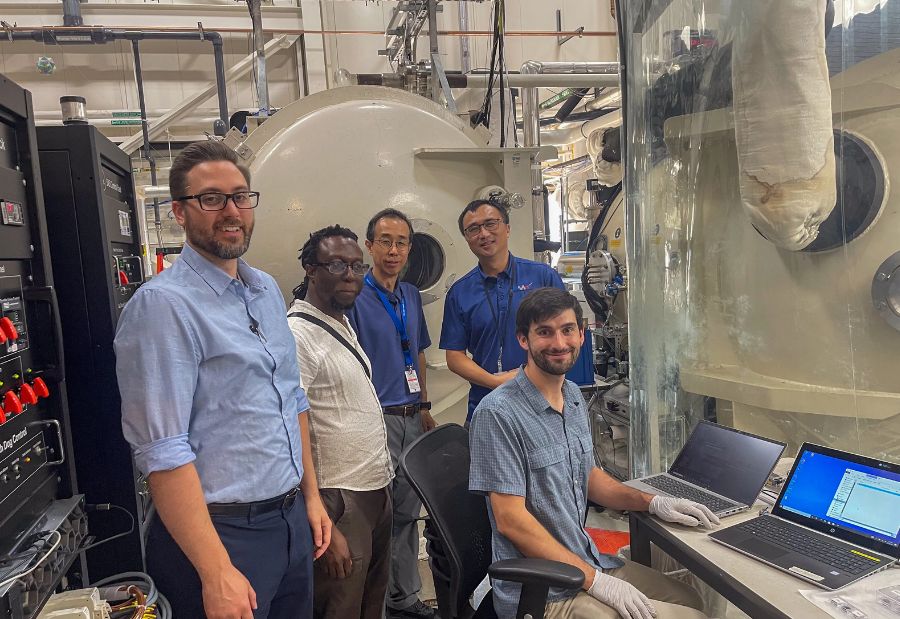
During recent thermal vacuum tests at NASA’s Langley Research Center in Hampton, Virginia, prototype battery cells operated at temperatures up to 176°F (80°C) and down to minus 76°F (minus 60°C). They also demonstrated slightly reduced performance at minus 112°F (minus 80°C).
“We proved for the first time that these cells can work down to minus 80 degrees Celsius,” said Yi Lin, SPEARS testing and research lead at NASA Langley. He added that further research could improve performance and expand the operating temperature range.
Testing also showed that the batteries could withstand temperature exposure ranging from 212°F (100°C) to minus 274°F (minus 170°C) without sustaining damage. Although the batteries cannot operate at such low temperatures, their solid electrolytes allow them to survive without the freezing-related damage associated with liquid electrolytes.
Small heaters would bring the batteries back to their operating temperatures when needed. This approach could reduce the need for heavy thermal management systems in spacecraft and lunar habitats, potentially lowering costs, reducing weight and extending mission durations.
Potential applications include drills for permanently shadowed lunar craters, astronaut emergency power packs, exploration rovers and long-duration scientific instruments.
“We can tune the chemistry by using different electrode materials,” Lin said. He explained that the battery chemistry can be adapted to prioritise energy, power or durability, depending on the intended application.
Although SPEARS is being developed for space exploration, the technology could also benefit Earth-based applications. The project evolved from an earlier battery initiative focused on aviation. Ji Su, a polymer materials scientist and task lead at NASA Langley, said, “The potential market for solid-state batteries is very broad,” citing automobiles, cell phones, communication devices and drones as possible applications.
Launched in 2026 with funding from NASA’s Advanced Research and Technology division, SPEARS will initially focus on technology development before potentially moving towards commercial collaboration. NASA’s Ames Research Center in California is developing flight hardware, including test boards and electronics, to prepare the batteries for spaceflight and testing in space environments.
Also read: Viksit Workforce for a Viksit Bharat
Do Follow: The Mainstream LinkedIn | The Mainstream Facebook | The Mainstream Youtube | The Mainstream Twitter
About us:
The Mainstream is a premier platform delivering the latest updates and informed perspectives across the technology business and cyber landscape. Built on research-driven, thought leadership and original intellectual property, The Mainstream also curates summits & conferences that convene decision makers to explore how technology reshapes industries and leadership. With a growing presence in India and globally across the Middle East, Africa, ASEAN, the USA, the UK and Australia, The Mainstream carries a vision to bring the latest happenings and insights to 8.2 billion people and to place technology at the centre of conversation for leaders navigating the future.