


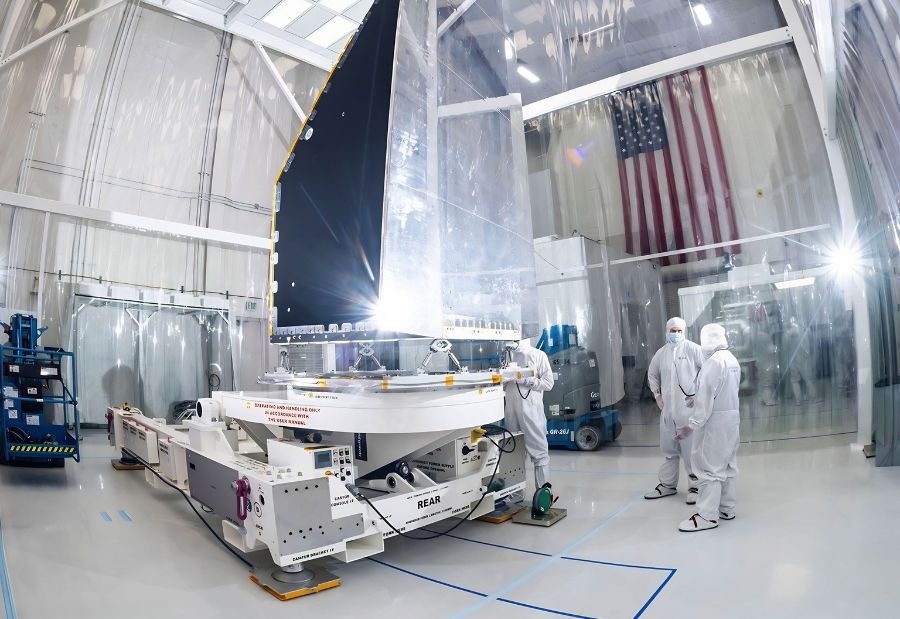
National Aeronautics and Space Administration (NASA) is moving forward with the integration and testing of the Near-Earth Object (NEO) Surveyor, its first infrared space telescope specifically designed to detect potentially hazardous asteroids and comets. The mission is currently targeted for launch no earlier than September 2027.
The NEO Surveyor mission was developed in response to a 2005 Congressional directive asking NASA to identify dangerous near-Earth objects (NEOs). Many of these objects are difficult to detect through ground-based observatories because some are extremely dark, very small, or hidden in the Sun’s glare. Unlike optical telescopes, the NEO Surveyor will detect infrared heat emitted by asteroids and comets after they are warmed by the Sun.
The spacecraft will operate nearly 1 million miles (1.5 million kilometers) away from Earth at the Sun-Earth L1 Lagrange point, where it will continuously scan large areas of the sky for at least 5 years.
Jim Fanson, the mission’s project manager at NASA Jet Propulsion Laboratory, said: “NEO Surveyor is a one-of-a-kind mission designed to solve a specific challenge: finding asteroids and comets that pose the greatest risk to Earth.”
The spacecraft’s infrared telescope and instrument enclosure are currently undergoing integration and testing at Utah State University Space Dynamics Laboratory. The enclosure, measuring 12 feet (3.7 meters) long, is designed to protect the telescope and remove heat that could interfere with infrared observations.
The mission’s camera includes 2 detector arrays that create 16-megapixel infrared mosaics of the sky across 2 infrared bands. By observing the same area in different infrared wavelengths, scientists can estimate the size and temperature of asteroids and comets more accurately.
The spacecraft will also feature a 20-foot-long (6-meter-long) sunshade designed to block sunlight and allow the telescope to observe objects close to the Sun. The sunshade is currently being tested with the spacecraft bus at BAE Systems in Colorado.
NASA’s science teams are simultaneously developing survey strategies and data processing systems to support the mission. Data collected by the telescope will be processed at California Institute of Technology IPAC and shared with the Minor Planet Center and planetary defense groups, including JPL’s Center for Near Earth Object Studies.
Amy Mainzer, the mission lead at University of California, Los Angeles, said: “We are currently working to develop the most efficient survey strategy that the mission will use to detect some of the hardest-to-find asteroids in our solar system, plus any comets that may be headed our way.”
Also read: Viksit Workforce for a Viksit Bharat
Do Follow: The Mainstream LinkedIn | The Mainstream Facebook | The Mainstream Youtube | The Mainstream Twitter
About us:
The Mainstream is a premier platform delivering the latest updates and informed perspectives across the technology business and cyber landscape. Built on research-driven, thought leadership and original intellectual property, The Mainstream also curates summits & conferences that convene decision makers to explore how technology reshapes industries and leadership. With a growing presence in India and globally across the Middle East, Africa, ASEAN, the USA, the UK and Australia, The Mainstream carries a vision to bring the latest happenings and insights to 8.2 billion people and to place technology at the centre of conversation for leaders navigating the future.