


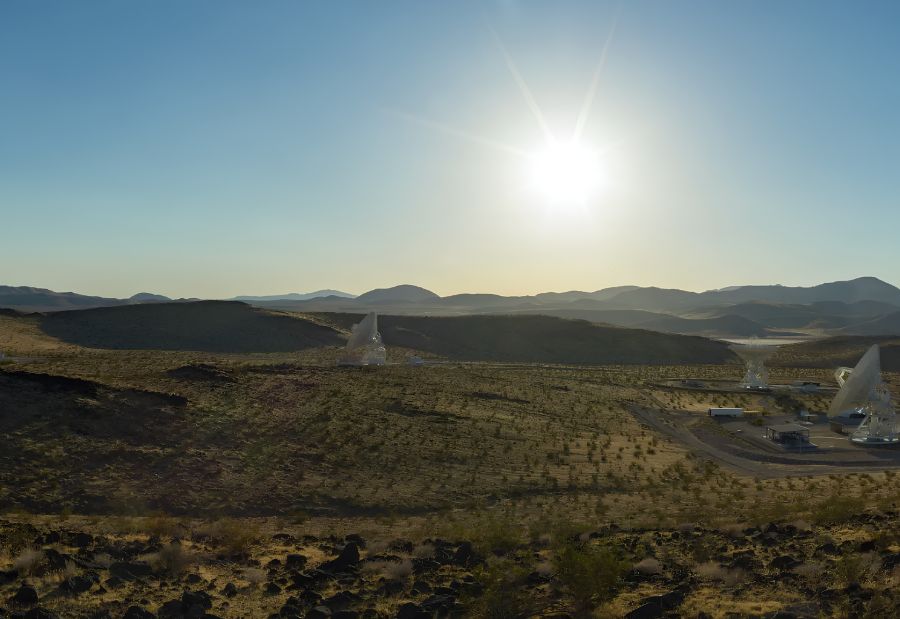
NASA has expanded its Deep Space Network with a new 34-meter-wide radio frequency antenna at the Goldstone Deep Space Communications Complex in California, strengthening the system that keeps the agency connected with spacecraft across the solar system and beyond.
Known as Deep Space Station 23 (DSS-23), the new antenna is located near Barstow and is managed by NASA’s Jet Propulsion Laboratory (JPL) in Southern California. The Deep Space Network operates large dish antennas across 3 global facilities and supports more than 40 spacecraft exploring the solar system and interstellar space.
DSS-23 is part of NASA’s Aperture Enhancement Project, which began in 2009 to modernise and expand the network with 6 new 34-meter multifrequency beam-waveguide antennas. These dishes can operate across different radio frequencies and support a wide range of missions.
After completing testing between May and July, DSS-23 began operations on August 3 by tracking NASA’s Chandra X-ray Observatory. It has since communicated with dozens of missions, including the Mars Reconnaissance Orbiter, Psyche, Juno and Voyager 1.
“By expanding the Deep Space Network, we are strengthening the communications foundation NASA needs for the bold missions ahead — from exploring more of the Moon than ever before to peering deeper into the solar system,” said James Kenyon, associate administrator of NASA’s Research and Technology Mission Directorate.
The new antenna is the 5th antenna at Goldstone, joining 3 existing 34-meter dishes and 1 70-meter, or 230-foot, antenna. It is also the 5th antenna delivered under the enhancement project, which covers NASA’s Goldstone, Madrid and Canberra complexes.
The beam-waveguide design sends radio signals to a stable, climate-controlled underground room instead of placing sensitive electronic equipment directly on the moving dish. This design provides greater flexibility and makes maintenance and future upgrades easier.
Construction of DSS-23 began in February 2020. The 133-ton reflector framework was installed on the antenna pedestal in December 2024, followed by the installation of panels that reflect radio signals between the antenna and spacecraft. Engineers then calibrated the system to work precisely with the wider network.
“The biggest challenge wasn’t actually constructing the antenna. It was transforming a complex collection of mechanical, electrical, software, radio frequency, and infrastructure systems into a single, mission-ready asset,” said Germaine Aziz, manager of the Deep Space Network Aperture Enhancement Project at JPL.
The project will be completed when Deep Space Station 33 (DSS-33) becomes operational at the Canberra facility in 2029. This will bring the total number of 34-meter antennas across the network to 13.
The 34-meter antennas can also be operated together to provide a communications backup equivalent to each facility’s single 70-meter antenna. These larger dishes have been operating for more than 50 years and are becoming increasingly expensive to maintain and repair.
The Deep Space Network supports more than 100 NASA and non-NASA missions, including missions supporting astronauts aboard the International Space Station, future Artemis missions, Earth observation, lunar exploration and missions studying the wider solar system.
Also read: Viksit Workforce for a Viksit Bharat
Do Follow: The Mainstream LinkedIn | The Mainstream Facebook | The Mainstream Youtube | The Mainstream Twitter
About us:
The Mainstream is a premier platform delivering the latest updates and informed perspectives across the technology business and cyber landscape. Built on research-driven, thought leadership and original intellectual property, The Mainstream also curates summits & conferences that convene decision makers to explore how technology reshapes industries and leadership. With a growing presence in India and globally across the Middle East, Africa, ASEAN, the USA, the UK and Australia, The Mainstream carries a vision to bring the latest happenings and insights to 8.2 billion people and to place technology at the centre of conversation for leaders navigating the future.