


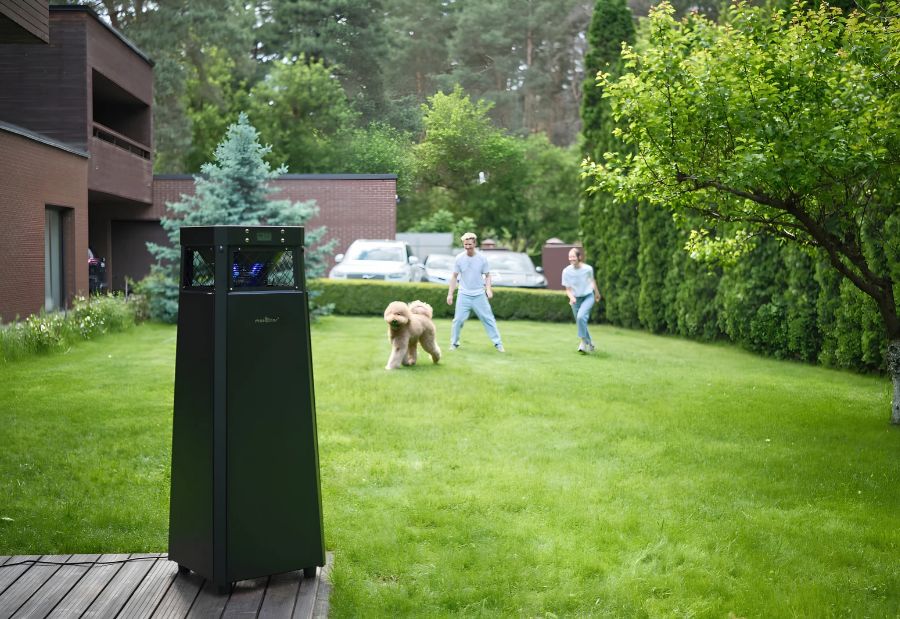
As rising temperatures, changing rainfall patterns and international travel expand the reach of disease-carrying mosquitoes, Mosqitter is developing an AI-powered system to monitor mosquito populations and identify potential health risks. The Pennsylvania-based company aims to move beyond mosquito control by using its devices to track mosquito species, measure population changes and provide early insights into possible disease threats.
According to the World Health Organization (WHO), reported dengue cases increased from 6.5 million globally in 2023 to a record 14.6 million in 2024. Dengue is a viral illness transmitted through mosquito bites.
Mosqitter, a startup with a 30-person team, initially developed chemical-free devices that attract and trap female mosquitoes by mimicking human heat, scent and breathing. Co-founder and CEO Anastasiia Romanova said the company wanted to offer more sustainable alternatives in a market that relies heavily on chemical-based products.
The company began research and development in Ukraine in 2019 and launched business operations in 2021. It now has more than 5,000 devices operating across 5 continents, compared with just over 250 when its work was previously covered in 2022.
Mosqitter’s approach focuses on female mosquitoes, which bite humans to obtain blood before laying eggs. According to Romanova, mosquitoes typically lay 100 to 200 eggs at a time in cycles of roughly 3 weeks. The company’s devices combine heat similar to human skin temperature, human-like scent and light to attract mosquitoes. Its premium Grand model also uses carbon dioxide (CO2) to imitate human breathing.
The startup is now integrating artificial intelligence into its devices to identify captured mosquito species. Its computer-vision system analyses biological characteristics, compares results against external datasets and uses entomologists to validate its findings. The system then assigns a confidence score based on how closely the assessments match.
“You can think about it as three judges analyzing a case and producing a verdict,” Romanova said.
The platform also incorporates weather, wind and humidity data. Mosqitter plans to use these inputs, along with growing datasets, to forecast mosquito population changes and assess potential health risks.
The company’s current portfolio includes Mosqitter Grand, designed for larger areas and public spaces, and Mosqitter Mini, intended for smaller residential spaces and portable monitoring. It also plans to officially introduce its Febris Monitoring System, which will add continuous mosquito monitoring and disease-risk assessment capabilities.
Romanova clarified that Febris does not diagnose diseases or confirm whether an individual mosquito carries dengue. Instead, it identifies mosquito species whose presence may indicate an increased risk of diseases they can transmit.
Chief Operating Officer and co-founder Olga Diachuk said the company is seeking global business-to-business partners, particularly distributors with established sales networks and relationships with governments and retailers. Febris is aimed at governments, public-health agencies, mosquito-control organisations, airports, municipalities and universities.
Brazil is among Mosqitter’s expansion markets, with local manufacturing and sales operations already established. The company also identifies the US, Greece, India, Ukraine and Nigeria as key markets. In Greece, it works with an established pest-control company, while in the US, it sells Mosqitter Mini directly through Amazon and its website.
The company is also working with the UK Health Security Agency to deploy Febris at locations including Heathrow and Gatwick airports. International travel can introduce mosquitoes and mosquito-borne diseases into new regions, making continuous monitoring increasingly important.
Mosqitter Mini retails for $199, while the professional Grand system costs $1,999. Hardware sales currently generate revenue, with Febris expected to add recurring income through monitoring, dashboards, analytics and data services.
Romanova said the company expects to generate more than $1 million in revenue in 2026. Although Febris revenue has only recently begun, Mosqitter projects its data business could generate more than $3.5 million in 2027, based on contracts it is currently bidding for.
The startup is raising $5 million in 2 tranches, beginning with $1 million and followed by $4 million, linked to milestones for the Febris system. It has raised $1.9 million to date.
The company’s name reflects its original focus on trapping mosquitoes. Diachuk explained that “Mosqitter” combines “mosquito” and “eater,” rather than “mosquito” and “quitter.”
Also read: Viksit Workforce for a Viksit Bharat
Do Follow: The Mainstream LinkedIn | The Mainstream Facebook | The Mainstream Youtube | The Mainstream Twitter
About us:
The Mainstream is a premier platform delivering the latest updates and informed perspectives across the technology business and cyber landscape. Built on research-driven, thought leadership and original intellectual property, The Mainstream also curates summits & conferences that convene decision makers to explore how technology reshapes industries and leadership. With a growing presence in India and globally across the Middle East, Africa, ASEAN, the USA, the UK and Australia, The Mainstream carries a vision to bring the latest happenings and insights to 8.2 billion people and to place technology at the centre of conversation for leaders navigating the future.