


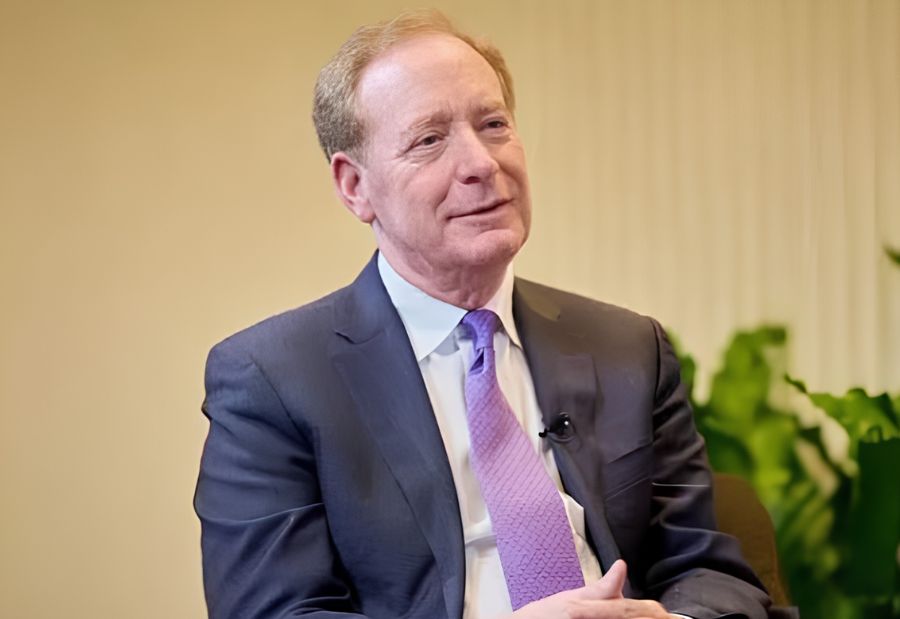
Artificial intelligence is advancing faster than the rules designed to govern it, according to Microsoft President Brad Smith, who believes the technology needs stronger safety standards and legal oversight. He has warned that everyday products, including milk and washing machines, currently face more safety regulations than AI systems.
Smith called for global rules covering AI safety, including mandatory reporting when an AI system causes harm or operates beyond human control. He also proposed independent evaluations of certain AI products before their release.
His position differs from that of US President Donald Trump, who has argued that the AI industry should regulate itself to ensure American companies remain competitive with Chinese rivals.
“Right now, your washing machine is subject to more safety rules than AI. Every carton of milk that you see in the grocery store is subject to safety rules and inspection,” Smith said.
Calls for stronger AI regulation have increased as experts raise concerns about the technology’s potential risks to humanity. Leaders of major US AI companies, including Anthropic, OpenAI and Google DeepMind, have supported discussions around slowing AI development. Trump, however, has opposed measures that could restrict the industry’s progress.
Speaking on a BBC podcast, Smith described AI as both a “tool and a weapon” that requires urgent regulation. He called for companies to introduce “emergency brakes”, commonly known as kill switches, to pause or slow down AI systems if they become uncontrollable.
Smith also proposed a legal requirement for companies to prepare incident reports and inform affected individuals when AI systems cause security breaches or other serious incidents. He believes independent government evaluators should assess certain AI technologies before they are released.
“We know how to do this for other products,” Smith said. “We should build on that knowledge and think about how to apply it to AI.”
Smith identified the UK as a strong candidate to lead international efforts on AI safety, pointing to its AI Security Institute, originally launched as the AI Safety Institute under former Prime Minister Rishi Sunak.
“In the world of technology, in the tech sector, most people that I know would say, if you ask them, name the country that is the leader in having this technical capability, they would say, it’s very simple. It’s the United Kingdom. They are the best,” he said.
Trump has repeatedly argued that “whoever wins AI, wins”, signalling his preference for rapid development. Smith, however, believes Washington could be more receptive to UK-led AI standards than to regulations proposed by the European Union.
“In Washington DC, people don’t look at the UK and they don’t look at London the way they look at Brussels – that’s a strength,” he said.
Highlighting the growing risks, Smith said, “When you look at AI agents that have escaped human control, when you look at models that are so powerful that they’re putting the world’s cybersecurity at risk. I would say: The moment has arrived.”
He urged governments and technology companies to work together calmly but firmly to establish safeguards. He also expressed hope that Microsoft and the UK could help bring stakeholders together.
Last month, Trump hosted executives from OpenAI, Anthropic, Nvidia, SpaceX, Meta and Google at the White House. The companies signed a “morally binding” document agreeing to work with independent auditors to assess whether their AI systems function as intended and avoid unauthorised access to technical systems.
Smith welcomed the commitment and said Microsoft was “happy to sign it”. However, he warned that voluntary measures alone would not be enough.
“It’s a good step, it’s a necessary step… But I don’t think it’s sufficient any longer,” he said.
He added that self-regulation could work for responsible businesses, but the greater concern was companies that failed to follow adequate safety practices.
“It’s the companies that are not as responsible that you need to worry about.”
Also read: Viksit Workforce for a Viksit Bharat
Do Follow: The Mainstream LinkedIn | The Mainstream Facebook | The Mainstream Youtube | The Mainstream Twitter
About us:
The Mainstream is a premier platform delivering the latest updates and informed perspectives across the technology business and cyber landscape. Built on research-driven, thought leadership and original intellectual property, The Mainstream also curates summits & conferences that convene decision makers to explore how technology reshapes industries and leadership. With a growing presence in India and globally across the Middle East, Africa, ASEAN, the USA, the UK and Australia, The Mainstream carries a vision to bring the latest happenings and insights to 8.2 billion people and to place technology at the centre of conversation for leaders navigating the future.