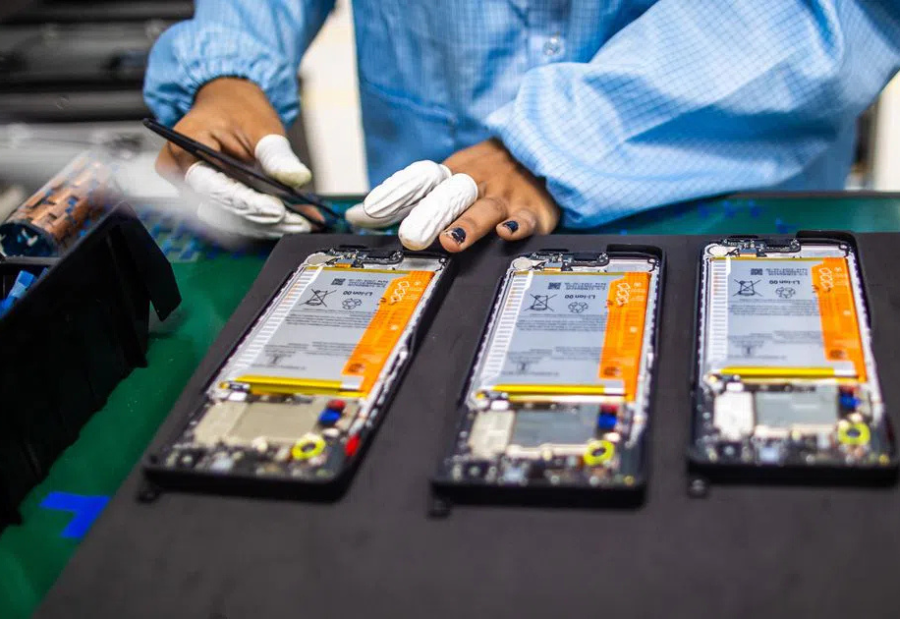
India is preparing a new round of incentives for smartphone manufacturers, aiming to boost exports and increase the use of locally produced components. The proposed policy is expected to benefit major companies such as Apple and Samsung Electronics, along with their manufacturing partners.
According to people familiar with the discussions, the proposal represents the second phase of the government’s smartphone production program. Unlike the current Production-Linked Incentive Program, which focuses mainly on increasing domestic output and ends on Mar 31, the new policy will directly link incentives to exports and localisation.
Details such as the incentive structure, total budget and policy design are still being finalised and may change during inter-ministerial consultations.
The planned shift highlights Apple’s growing role in India’s electronics manufacturing sector. Contract manufacturers producing iPhone devices account for around 3/4 of India’s smartphone exports. This growth has helped transform the country into one of the fastest-growing smartphone export hubs globally. Apple is also planning to ship most iPhones bound for the United States from India by the end of the year.
Government officials believe the current incentive program has already achieved its initial goal. Nearly every smartphone sold in India is now assembled locally. The next focus will be increasing value addition within the country instead of relying mainly on assembly.
Policymakers are also encouraging Chinese smartphone brands such as Oppo, Vivo and Xiaomi to expand exports from India. At present, these companies mainly manufacture devices in the country for the domestic market.
Another major feature under discussion is linking incentives to localisation levels. Manufacturers may receive higher subsidies if they source components such as camera modules, display assemblies and other parts from Indian suppliers. Devices that meet higher localisation levels and are exported could receive the maximum incentives.
However, challenges remain. India still relies heavily on imported high-value components such as semiconductors and advanced modules from countries including China, South Korea and Taiwan. Expanding the supply chain within India will take time due to logistics costs, supplier capacity and the need to match China’s manufacturing scale.
The updated policy also aligns with Prime Minister Narendra Modi’s “Make in India” strategy, which aims to position the country as a global manufacturing hub and strengthen its role in international supply chains.
The new incentive plan is also expected to complement the Electronics Components Manufacturing Scheme, which promotes domestic production of electronic parts and sub-assemblies.
In a related development, Dixon Technologies (India) Ltd. recently received approval to form a joint venture with HKC Corp. to manufacture display modules in India.
Industry players have been waiting for clarity on the next phase of incentives as the current PLI scheme ends this month.
Also read: Viksit Workforce for a Viksit Bharat
Do Follow: The Mainstream LinkedIn | The Mainstream Facebook | The Mainstream Youtube | The Mainstream Twitter
About us:
The Mainstream is a premier platform delivering the latest updates and informed perspectives across the technology business and cyber landscape. Built on research-driven, thought leadership and original intellectual property, The Mainstream also curates summits & conferences that convene decision makers to explore how technology reshapes industries and leadership. With a growing presence in India and globally across the Middle East, Africa, ASEAN, the USA, the UK and Australia, The Mainstream carries a vision to bring the latest happenings and insights to 8.2 billion people and to place technology at the centre of conversation for leaders navigating the future.