


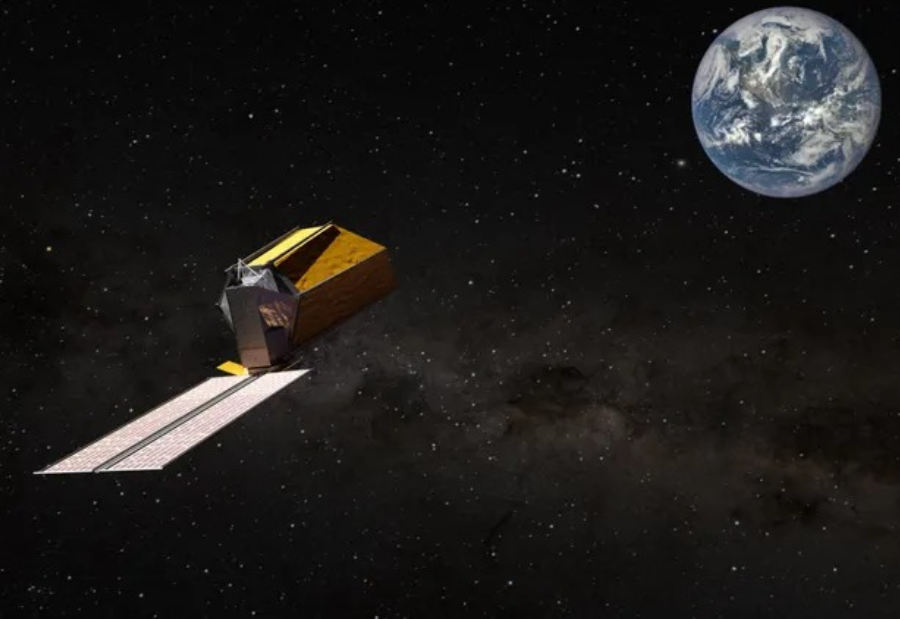
Scientists have identified the key technical requirements that could help NASA’s upcoming Habitable Worlds Observatory (HWO) detect potential signs of life on Earth-like planets beyond the solar system.
The Habitable Worlds Observatory is NASA’s next flagship space telescope, designed to directly image Earth-like planets orbiting nearby stars and analyze their atmospheres for biosignatures. A new study published on the arXiv preprint server examined how the telescope’s spectral resolution could affect its ability to identify indicators of life.
Spectral resolution refers to a telescope’s ability to distinguish between closely spaced wavelengths of light. Higher resolution provides more detailed atmospheric information but also requires longer observation times, creates additional detector noise, and increases engineering complexity.
To determine the optimal settings, researchers modeled how the telescope would observe Earth at different stages of its geological history. The Archean Earth had almost no oxygen, the Proterozoic Earth contained limited oxygen, and the Phanerozoic Earth, which supported complex life, had atmospheric oxygen levels of around 20%. Each period produced distinct atmospheric signatures.
The study found that detecting molecular oxygen, considered one of the strongest biosignatures, would require a visible-light resolving power of approximately 140. Ozone could be identified at a much lower ultraviolet resolving power of around 7. In the near-infrared range, a minimum resolving power of 40 would be needed to distinguish between carbon dioxide and carbon monoxide, while a resolving power of about 70 would be ideal for studying Earth-like atmospheres across different geological eras.
Researchers generated simulated observations across resolving powers ranging from 20 to 5,000 and analyzed the results using atmospheric retrieval models. The simulations accounted for detector noise, exposure times, and atmospheric features that could indicate the absence of life.
The study also highlighted engineering challenges. Detector dark current, a background electronic noise present even without incoming light, limits the benefits of extremely high resolutions. Improving oxygen detection beyond current targets would require reducing dark current by nearly 10 times, while higher resolutions would significantly increase observation times.
The researchers noted that detecting gases such as oxygen, ozone, methane, and water would not automatically confirm the existence of life, as natural non-biological processes can also produce these compounds. Instead, HWO is expected to identify the most promising planets for further investigation.
The study recommends visible-light resolving power of 140, ultraviolet resolving power of 7, and near-infrared resolving power of 70 as key benchmarks for a telescope capable of searching for signs of life beyond Earth.
Also read: Viksit Workforce for a Viksit Bharat
Do Follow: The Mainstream LinkedIn | The Mainstream Facebook | The Mainstream Youtube | The Mainstream Twitter
About us:
The Mainstream is a premier platform delivering the latest updates and informed perspectives across the technology business and cyber landscape. Built on research-driven, thought leadership and original intellectual property, The Mainstream also curates summits & conferences that convene decision makers to explore how technology reshapes industries and leadership. With a growing presence in India and globally across the Middle East, Africa, ASEAN, the USA, the UK and Australia, The Mainstream carries a vision to bring the latest happenings and insights to 8.2 billion people and to place technology at the centre of conversation for leaders navigating the future.