


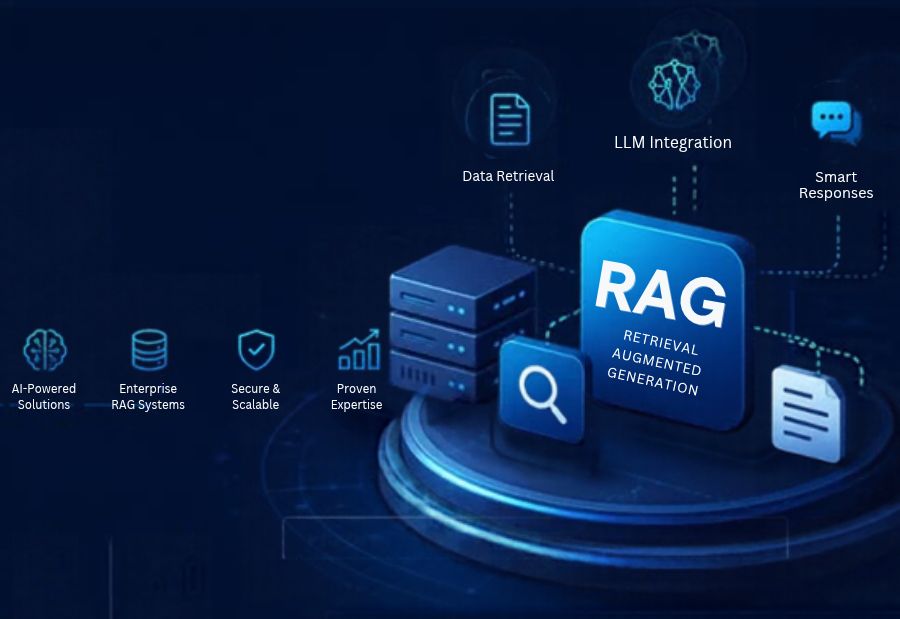
Businesses are increasingly using generative AI to answer questions, summarize documents and retrieve information from internal knowledge sources. However, an AI response can sound convincing while still containing incorrect information or failing to address the user’s question.
Retrieval-augmented generation (RAG) helps reduce this risk by retrieving relevant information from an external knowledge source and providing it to a generative AI model when producing an answer. Yet, the quality of the final response depends on both retrieval and generation.
RAG accuracy evaluation helps organisations determine whether a system retrieves useful information, produces grounded answers and meets the needs of its intended users.
What is retrieval-augmented generation?
Retrieval-augmented generation combines information retrieval with generative AI. When a user asks a question, the system searches a knowledge source, selects relevant content and supplies that context to a language model.
For example, an employee may ask an internal AI assistant about a company policy. The RAG system retrieves relevant policy documents and uses them to generate a response.
This approach can help provide answers based on current or organization-specific information. However, it does not automatically guarantee accuracy. The system may retrieve incomplete documents, overlook relevant passages, or generate statements that the retrieved evidence does not support.
Evaluation should therefore examine the retrieval process and the final answer separately.
1. Evaluate the quality of retrieved information
The first step is to determine whether the system retrieves the right information for a query.
Even a capable language model may produce a poor answer if the supporting documents are irrelevant or incomplete. Retrieval quality can be assessed using measures such as precision and recall.
- Precision at K: Measures how many of the top retrieved results are relevant.
- Recall at K: Measures how many relevant items are found within the top K results.
- Mean reciprocal rank: Measures how highly the first relevant result appears in the ranked list.
The appropriate metrics depend on the use case and the availability of labelled evaluation data.
For example, an internal policy assistant should retrieve the correct policy sections rather than several loosely related documents. Improving retrieval can often address errors that would otherwise be incorrectly blamed on the language model.
2. Check whether answers are grounded in evidence
A RAG system should produce responses supported by the information it retrieves. This quality is often described as groundedness or faithfulness.
Teams can compare generated answers with the retrieved passages to identify unsupported statements, missing qualifications, or invented details.
For example, if a policy document states that approval is required for certain purchases, the AI should not claim that all purchases are automatically approved.
Evaluation can involve human reviewers, automated checks, or a combination of both. Automated evaluation can help process larger test sets, while human review remains valuable for ambiguous questions and high-impact business use cases.
3. Measure answer relevance and completeness
An answer can be factually supported but still fail to address the user’s actual question. Businesses should therefore assess relevance, completeness, clarity and whether the response follows the requested format.
A test set should include realistic questions from the intended users. It should cover common requests, complex queries, questions requiring multiple documents and questions where the available information is insufficient.
Reviewers can compare system answers with expected responses or scoring guidelines. They should also check whether the system appropriately acknowledges uncertainty instead of guessing when evidence is missing.
These evaluations help reveal gaps that a simple factual accuracy score may overlook.
4. Test different types of questions
RAG systems may perform differently depending on how a question is phrased and how much information it requires.
Evaluation datasets should include direct factual questions, paraphrased questions, multi-step queries, ambiguous requests and questions that require combining information from multiple sources.
For internal knowledge assistants, teams should also test outdated documents, conflicting sources and questions that should not be answered because the required information is unavailable.
This helps identify weaknesses in document retrieval, content organization, and answer generation before wider deployment.
5. Check permissions and sensitive information
Accuracy is not the only requirement for a reliable RAG system. It must also retrieve only the information that a user is authorised to access.
Businesses should test whether access permissions are enforced during retrieval and whether restricted documents can appear in answers or citations.
Evaluation should include attempts to access information outside a user’s role, as well as malicious or misleading content placed inside documents. Retrieved content should be treated as data to evaluate, not as trusted instructions that automatically override system controls.
Security testing should cover the full workflow, including document ingestion, indexing, retrieval and response generation.
6. Monitor RAG performance after deployment
A RAG system may become less reliable as documents change, new content is added, or user behavior evolves. Organisations should continue measuring performance after deployment.
Useful indicators include retrieval relevance, groundedness, answer quality, unanswered questions, latency and user feedback. Teams should investigate recurring failures and update the evaluation dataset when new use cases emerge.
Changes to embedding models, retrieval settings, prompts, or language models should also be tested before release. This helps teams identify regressions and understand whether a change improves overall performance.
The Mainstream covers developments in AI and business technology, including the practical evaluation required to use generative AI responsibly.
Final Thought
RAG accuracy evaluation requires more than checking whether an AI-generated answer sounds correct. Organisations should measure retrieval quality, verify that answers are grounded in evidence, test realistic questions and confirm that access controls work as intended.
By maintaining a representative evaluation dataset and monitoring performance over time, businesses can identify weaknesses early and build more reliable AI knowledge systems.