


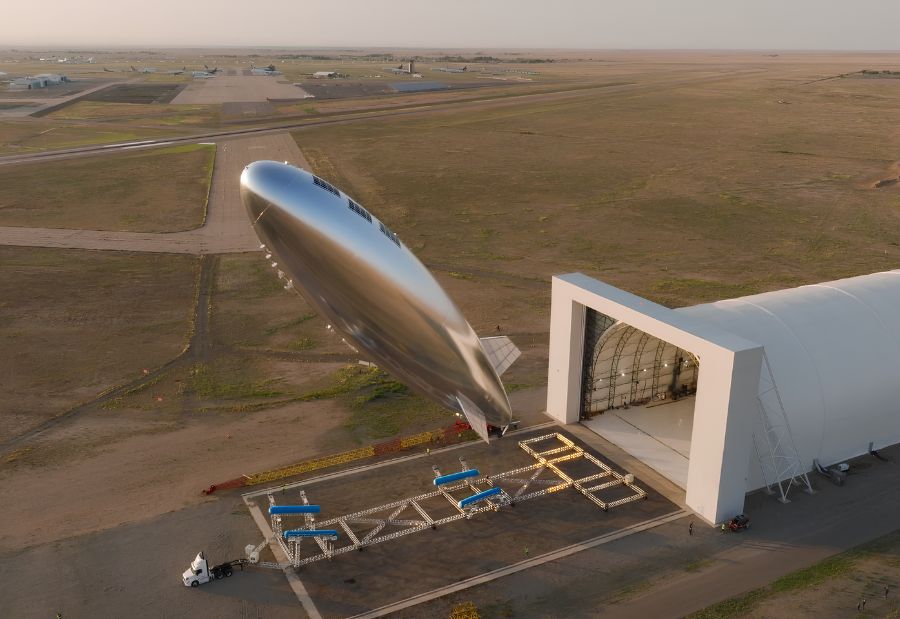
A new approach to mobile connectivity has been tested from the stratosphere, with an unmanned airship flying from New Mexico to Japan and back while providing cellular service directly to standard smartphones. The test could support SoftBank’s plans for commercial high-altitude connectivity in Japan from 2027.
The mission, called Service Test 1 (ST1), began on August 9 from Roswell, New Mexico. The airship reached Japan 13 days later, covering nearly 30,000 km (18,600 miles) during the journey. It returned to the continental US on September 4 and landed near the company’s headquarters in Moriarty, New Mexico, on September 5.
The technology is known as a High-Altitude Platform Station (HAPS). It functions like a mobile tower positioned in the stratosphere, above the altitude used by commercial aircraft.
The airship spent more than 7 days over Japanese airspace, operating at an altitude of 16.5 to 17 km (about 54,100 to 55,800 ft). It maintained a station-keeping radius as small as 5 km (3.1 miles) around its target area near Cape Muroto.
The platform carried SceyeCELL, its onboard cellular system, which worked through SoftBank Corp.’s core network. It provided mobile broadband directly to standard devices without requiring modifications. Teams tested messaging, calls, web browsing and video streaming outdoors, under trees and indoors.
“That demonstrated how the stratospheric layer can extend an existing mobile network,” said Sceye CTO Johnny Truong.
The companies said performance was comparable to ground towers, while interference was reduced. They also tested disaster alerts and communication with drones as part of a future 3D network.
The test also placed a server and part of the mobile network’s core on the airship. This reduced the need to send data to distant servers. Sceye reported an average response time of 68 milliseconds, more than 40% lower latency than the remote route.
Each fully deployed platform could cover an area equivalent to about 500 ground towers. However, this does not represent network capacity or the number of users it can support simultaneously. Performance will depend on radio frequencies, network links and user demand.
Sceye sees HAPS as a complement to ground networks and satellites. Ground networks provide high capacity in populated areas, while satellites offer broad coverage. HAPS could connect locations that are difficult or expensive to serve.
The next goal is to connect the platform with satellites using lasers. Data could then reach the ground through laser links in clear weather and radio links when clouds interfere.
ST1 also tested laser ranging with SoftBank, Hitotsubashi University and Japan’s National Institute of Polar Research. A reflector on the airship returned laser pulses fired from the ground, helping researchers study signal loss for future optical systems.
Other companies are developing similar HAPS technologies, including Airbus subsidiary AALTO with Zephyr, AeroVironment and SoftBank with Sunglider, and Stratospheric Platforms with hydrogen-powered aircraft.
Sceye says its lighter-than-air design can carry larger antenna arrays than winged platforms. Truong compares it to a geostationary satellite that is 1,800 times closer and much cheaper, although no figures have been provided to verify that comparison.
There is currently no pricing or coverage plan, and no comparison with Starlink or other existing systems. SoftBank plans to move toward commercial service in Japan from 2027, while Sceye is now focused on “serving more people for longer periods.”
Also read: Viksit Workforce for a Viksit Bharat
Do Follow: The Mainstream LinkedIn | The Mainstream Facebook | The Mainstream Youtube | The Mainstream Twitter
About us:
The Mainstream is a premier platform delivering the latest updates and informed perspectives across the technology business and cyber landscape. Built on research-driven, thought leadership and original intellectual property, The Mainstream also curates summits & conferences that convene decision makers to explore how technology reshapes industries and leadership. With a growing presence in India and globally across the Middle East, Africa, ASEAN, the USA, the UK and Australia, The Mainstream carries a vision to bring the latest happenings and insights to 8.2 billion people and to place technology at the centre of conversation for leaders navigating the future.