


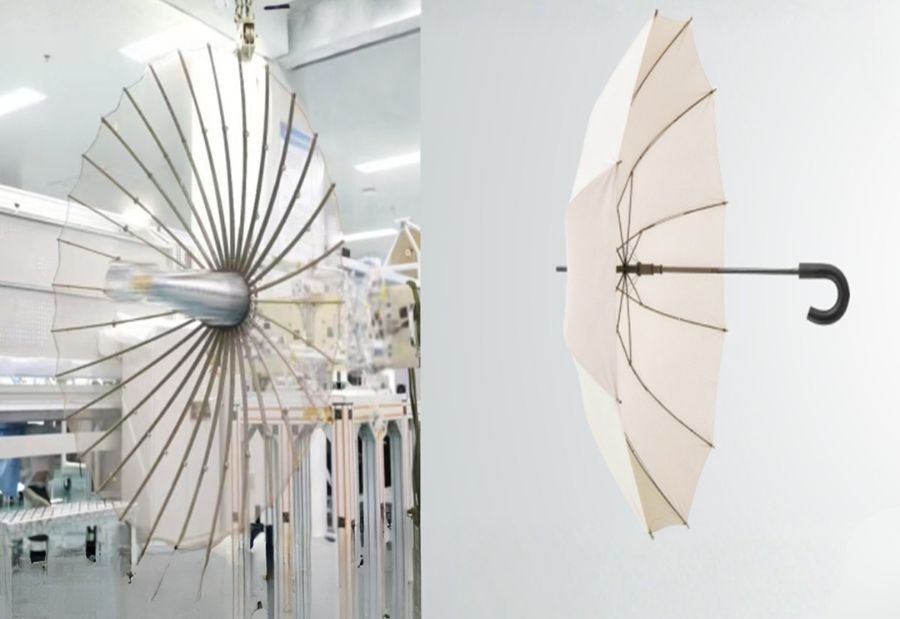
China’s private space company GalaxySpace has unveiled a large deployable umbrella antenna designed for low-Earth orbit satellites, marking a major breakthrough in satellite internet and direct-to-cell communication technology.
The Beijing-based company said the newly developed antenna is the first of its kind created by a private Chinese space firm. The technology is expected to significantly improve satellite internet capacity while enhancing launch efficiency for future broadband satellite constellations.
The antenna, described as resembling a giant shining umbrella in space, reportedly delivers communication performance up to 10 times stronger than GalaxySpace’s earlier mechanically steerable Q/V-band antennas. At the same time, it occupies far less space inside a rocket fairing before launch.
The development comes as China continues increasing its focus on commercial aerospace and satellite internet technologies. In China’s 2026 Government Work Report, aerospace was officially recognised for the first time as one of the country’s “emerging pillar industries.”
As modern rockets increasingly carry multiple satellites in a single launch, payload space has become extremely valuable. Traditional large communication antennas often consume significant onboard space, limiting the number of satellites that can be launched together.
To solve this challenge, GalaxySpace engineers created a foldable antenna system that remains tightly compressed before launch and automatically deploys once in orbit, similar to the opening mechanism of an umbrella.
According to Xu Zhi, Chief Engineer of Payload Systems at GalaxySpace, the 1-meter-diameter antenna achieves a stowage ratio of less than 12%, allowing the fully deployed structure to compress into a volume roughly the size of a small computer case before launch.
The company stated that this compact design meets internationally advanced standards and enables satellites to carry larger communication reflectors without reducing launch efficiency.
GalaxySpace also announced advancements in manufacturing technology. Traditionally, space-grade mesh antennas require extensive manual craftsmanship and precision adjustments. The company claims its newly developed integrated mesh-forming technology improves manufacturing efficiency by more than 70%, supporting faster and more scalable production.
Industry observers say the project reflects China’s broader push toward “industrialized aerospace,” where advanced industrial manufacturing methods are applied to space engineering.
Beyond broadband internet satellites, the antenna could also support remote sensing, navigation systems, and future direct-to-cell communication networks alongside phased-array antenna technologies.
Also read: Viksit Workforce for a Viksit Bharat
Do Follow: The Mainstream LinkedIn | The Mainstream Facebook | The Mainstream Youtube | The Mainstream Twitter
About us:
The Mainstream is a premier platform delivering the latest updates and informed perspectives across the technology business and cyber landscape. Built on research-driven, thought leadership and original intellectual property, The Mainstream also curates summits & conferences that convene decision makers to explore how technology reshapes industries and leadership. With a growing presence in India and globally across the Middle East, Africa, ASEAN, the USA, the UK and Australia, The Mainstream carries a vision to bring the latest happenings and insights to 8.2 billion people and to place technology at the centre of conversation for leaders navigating the future.