


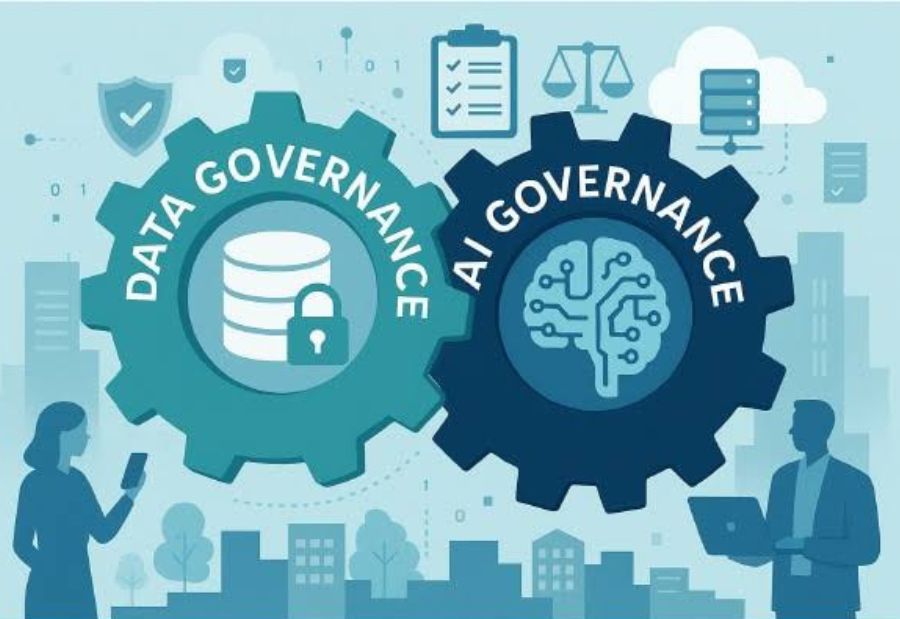
Enterprises can connect data governance with AI governance by creating common policies for data quality, security, privacy, access, accountability and compliance across the AI lifecycle. Since AI systems depend on data for training, testing and decision-making, strong AI governance is difficult to achieve without strong data governance. Connecting both frameworks helps businesses build more reliable, secure, transparent and responsible AI systems.
Why data governance and AI governance need to work together
Data governance defines how an organization collects, manages, protects, shares and uses data. AI governance focuses on how artificial intelligence is developed, deployed, monitored and controlled.
These areas are closely connected because data is the foundation of most AI systems. Poor-quality, outdated, biased, or improperly managed data can affect AI outputs and create operational, security and compliance risks.
For enterprises, connecting the two governance frameworks can help:
- Improve AI data quality: Ensure AI systems use accurate and relevant information.
- Protect sensitive data: Apply privacy and security controls to AI datasets.
- Improve accountability: Define who owns data and AI-related decisions.
- Support compliance: Maintain consistent regulatory and policy controls.
- Reduce AI risks: Identify data-related risks before they affect AI systems.
- Improve transparency: Maintain records about data sources and how they are used.
- Strengthen AI trust: Give business users greater confidence in AI outputs.
Detailed explanation
The first step is to create a shared governance structure. Data, security, technology, risk, compliance and business teams should work together instead of managing data and AI independently.
Organizations should establish clear ownership for datasets, AI models, applications and business decisions. A data owner may be responsible for the quality and appropriate use of a dataset, while an AI owner can be accountable for the model or application using that data.
Build data controls into the AI lifecycle
Data governance should begin before an AI model is developed. Enterprises should understand where data comes from, whether it can legally and ethically be used, how sensitive it is and whether it is suitable for the intended AI application.
Data classification can help identify confidential, personal, financial, or regulated information. Access controls can then determine which users, applications and AI systems are permitted to use that data.
Maintain data quality and lineage
AI systems require reliable data. Enterprises should establish data-quality checks for accuracy, completeness, consistency and relevance.
Data lineage is also important because organizations need to understand where information originated, how it changed and which AI systems use it. This can make investigations and compliance reviews easier.
Connect monitoring and risk management
Governance should continue after an AI system goes into production. Enterprises can monitor data quality, model performance, access activity and changes in AI behavior.
If an AI system starts producing unreliable results because the underlying data has changed, monitoring should identify the issue and trigger appropriate action.
Expert perspective
CIOs and Chief Data Officers should treat data governance and AI governance as connected capabilities rather than separate compliance programs.
A practical approach is to create common policies for data classification, access, security, quality, retention and accountability, while adding AI-specific controls for model validation, explainability, human oversight and ongoing monitoring.
This approach can help enterprises scale AI while maintaining greater control over the information powering those systems.
The Mainstream continues to cover AI, data governance, cybersecurity and enterprise technology trends that are influencing how organizations build responsible digital strategies.
Statistics and data
AI adoption is increasing the importance of data governance. Deloitte’s 2026 State of AI research found that 68% of Indian respondents identified security and compliance controls as a major investment priority for scaling AI, while 61% highlighted data storage and management.
These priorities show that enterprises increasingly recognize that AI expansion depends on strong data and governance foundations.
India is also developing broader AI and data governance frameworks, increasing the importance of responsible data use, secure information sharing and accountability as AI adoption grows.
Conclusion
Data governance and AI governance should not operate as separate frameworks. Data quality, security, privacy, access, lineage and accountability directly influence the reliability and trustworthiness of AI systems.
By connecting governance teams, establishing shared policies, monitoring data and AI systems together and assigning clear ownership, enterprises can reduce risks while scaling AI more confidently.
As businesses move AI from experimentation into everyday operations, strong data governance will remain one of the foundations of effective AI governance. The Mainstream will continue to track the technology, data and governance trends shaping enterprise AI.