


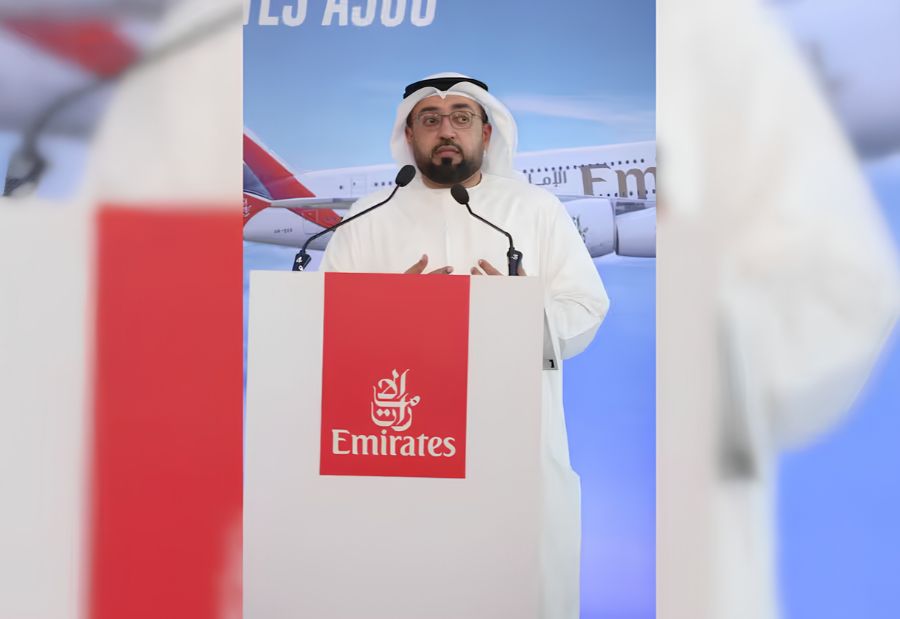
Navi Mumbai International Airport may face challenges in attracting international airline operations due to gaps in essential support infrastructure, including catering and cargo warehousing, according to Essa Sulaiman Ahmad, Senior Vice-President for Commercial Operations (West Asia and Indian Ocean) at Emirates Airline.
Speaking to reporters on Wednesday, Ahmad said airlines could find it difficult to shift operations until the airport develops into a fully functional aviation ecosystem.
A few weeks ago, Mumbai International Airport (MIAL), controlled by the Adani Group, asked airlines to shift 265 of its 770 weekly international departures to Navi Mumbai by 25 October. The proposal was linked to plans to redevelop Terminal 1 at Mumbai airport. Airlines opposed the move, and the issue was escalated to the Ministry of Civil Aviation.
On Tuesday, MIAL met with airlines and assured them that no international flights would be shifted until at least the end of March. When asked whether Emirates would move 33% of its Mumbai flights to Navi Mumbai if the proposal returned, Ahmad said, “The airport is not ready.”
He explained that airlines require essential services such as catering and cargo warehousing to operate smoothly. “At an airport, you will require a facility for catering. You will require a facility, for example, for cargo warehousing. You will require those elements. Until it gets fully built into an ecosystem, I think it’s going to be difficult for any of the airlines to shift there,” he said.
Meanwhile, Emirates displayed its A380 aircraft at Delhi airport on Wednesday ahead of its deployment on the Delhi-Dubai route from 26 October. Ahmad described Delhi as an important market and confirmed that the airline would continue operating 4 daily flights from Dubai to the city. One flight will use the A380, while the other 3 will operate with retrofitted Boeing 777 aircraft offering first-class, business-class, premium-economy and economy cabins.
Ahmad said Emirates was open to exploring operations at new airports, including Navi Mumbai and Noida, if India and the United Arab Emirates grant additional flight and seat entitlements under their air service agreement. The airline is currently operating at the full capacity allowed under its existing entitlements. He added that Navi Mumbai could provide access to a new market closer to Pune, but additional entitlements would be necessary before Emirates considers operating there.
Bilateral air service rights determine the number of flights and seats airlines can offer between 2 countries, along with permitted routes and airports. Ahmad said Emirates’ Dubai-related entitlement stood at around 67,000 seats per week in each direction. Any increase would require an agreement between the 2 governments.
He also said passenger load factors on Emirates’ India routes had initially declined due to the West Asia conflict but were recovering towards pre-conflict levels. He declined to share exact figures ahead of the airline’s half-year results announcement in November. Globally, Emirates was operating at 96% of its pre-conflict network capacity, while passenger traffic had recovered to around 93% of pre-conflict levels.
According to aviation analytics firm Cirium, Emirates operates 167 weekly flights from 9 Indian destinations to Dubai. Mumbai leads with 35 flights, followed by Delhi with 28. Bengaluru, Chennai and Hyderabad each have 21 weekly flights, Kochi has 14, Kolkata 11, Ahmedabad 9 and Thiruvananthapuram 7. The total weekly frequency remains unchanged from October 2025.
Also read: Viksit Workforce for a Viksit Bharat
Do Follow: The Mainstream LinkedIn | The Mainstream Facebook | The Mainstream Youtube | The Mainstream Twitter
About us:
The Mainstream is a premier platform delivering the latest updates and informed perspectives across the technology business and cyber landscape. Built on research-driven, thought leadership and original intellectual property, The Mainstream also curates summits & conferences that convene decision makers to explore how technology reshapes industries and leadership. With a growing presence in India and globally across the Middle East, Africa, ASEAN, the USA, the UK and Australia, The Mainstream carries a vision to bring the latest happenings and insights to 8.2 billion people and to place technology at the centre of conversation for leaders navigating the future.