


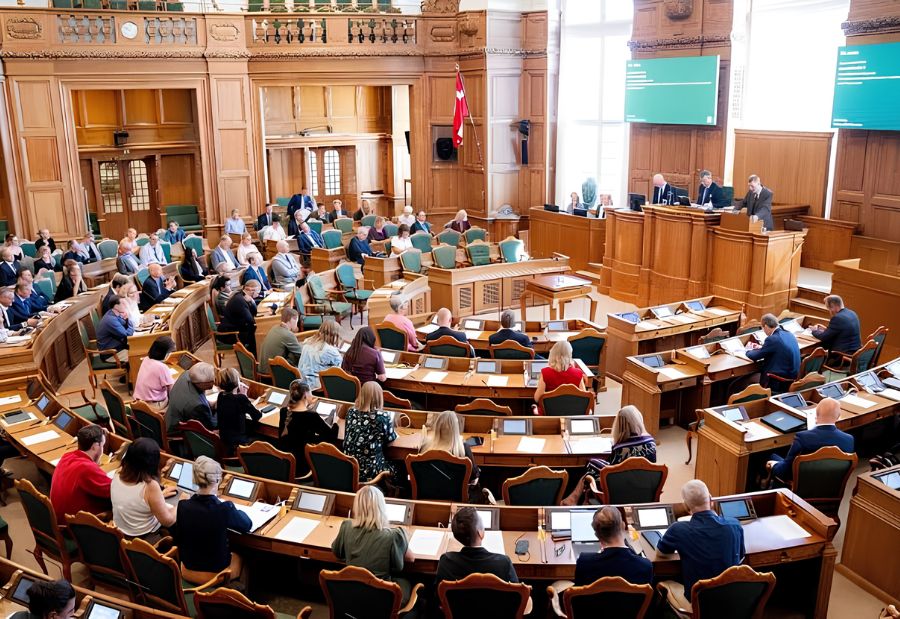
Denmark is preparing legislation to prevent the unauthorised sharing of realistic AI-generated imitations of people’s faces and voices. The proposed law would protect ordinary individuals and artists from digital replicas created or distributed without their consent.
The bill, scheduled to be introduced on Thursday, would amend Denmark’s copyright law to cover realistic deepfakes, including digital imitations of artistic performances. Culture Minister Zenia Stampe said the measure aims to address the growing ease with which manipulated content can be created and circulated online.
“With artificial intelligence, you can create manipulated videos and images with just a few clicks and share them on social media,” Stampe wrote in a statement. She added, “One of the main goals of the bill is to get the tech giants to take down manipulated content quickly, so that it causes the least possible harm.”
Deepfakes are AI-generated or altered images, videos, or audio that make people appear to say or do things they never did. Such content can be used to spread false information, damage reputations, or humiliate those depicted.
The proposal follows a broad political agreement reached in June 2025 under the previous government, led by then-culture minister Jakob Engel-Schmidt. It includes exceptions for satire, parody, caricature, and criticism of political power and society. However, these exceptions would not apply to misinformation that poses specified serious risks to people’s rights, essential interests, life, or property.
The Danish government hopes the law will take effect at the beginning of 2027.
The move comes as governments worldwide introduce measures to address the risks associated with AI-generated content. Under an EU directive on violence against women, member states covered by the rules must criminalise certain forms of non-consensual sexually explicit manipulated content by 14 June 2027. Denmark is not bound by the directive because of its opt-out from EU justice and home affairs rules.
Other countries have introduced their own protections. France prohibits the sharing of AI-generated images or audio depicting a person without consent when the artificial nature of the content is not obvious or expressly disclosed. Separate rules address non-consensual sexual deepfakes regardless of labelling.
In England and Wales, creating or requesting non-consensual intimate deepfakes became a criminal offence in February. Sharing such images can carry a prison sentence of up to 2 years.
Also read: Viksit Workforce for a Viksit Bharat
Do Follow: The Mainstream LinkedIn | The Mainstream Facebook | The Mainstream Youtube | The Mainstream Twitter
About us:
The Mainstream is a premier platform delivering the latest updates and informed perspectives across the technology business and cyber landscape. Built on research-driven, thought leadership and original intellectual property, The Mainstream also curates summits & conferences that convene decision makers to explore how technology reshapes industries and leadership. With a growing presence in India and globally across the Middle East, Africa, ASEAN, the USA, the UK and Australia, The Mainstream carries a vision to bring the latest happenings and insights to 8.2 billion people and to place technology at the centre of conversation for leaders navigating the future.