


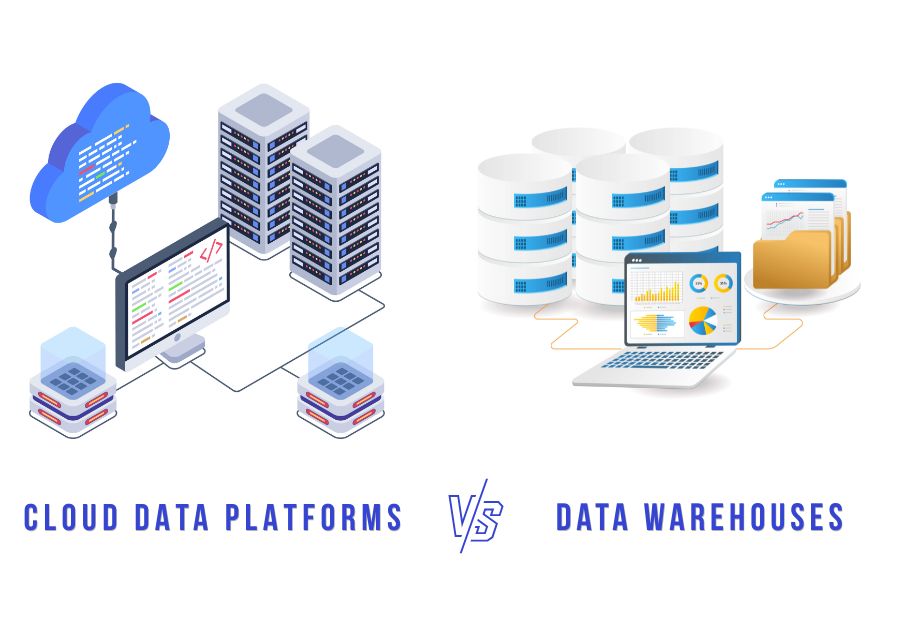
Businesses generate data from applications, websites, customer interactions, transactions, connected devices and internal systems. Managing this information effectively has become important for analytics, reporting and decision-making. This has increased interest in modern cloud-based data platforms alongside traditional data warehouse architectures.
Understanding cloud data platforms vs data warehouses can help technology and business leaders decide which approach better fits their data requirements, workloads and long-term technology strategy.
What is a cloud data platform?
A cloud data platform is a broader environment for collecting, storing, processing and analyzing data using cloud infrastructure. It can bring together different types of data and support multiple workloads through services such as data lakes, analytics engines, databases and machine learning tools.
Cloud data platforms are designed to provide flexibility. Organizations can scale computing and storage resources based on demand without necessarily maintaining all infrastructure themselves.
They can also connect data from multiple sources, making them useful for organizations that need a central environment for analytics, operational insights and advanced data applications.
What is a data warehouse?
A data warehouse is a centralized system designed primarily for storing structured, processed and organized data. It has traditionally been used for business intelligence, reporting and analytical queries.
Data is usually cleaned and transformed before entering the warehouse. This structured approach makes it easier for business teams to work with consistent information and generate reports.
Data warehouses remain useful when organizations have clearly defined reporting requirements and need reliable access to structured business data.
Cloud data platforms vs data warehouses: Key differences
The biggest difference between the two is their scope.
| Area | Cloud Data Platforms | Data Warehouses |
| Purpose | Supports multiple data workloads | Primarily supports analytics and reporting |
| Data types | Structured, semi-structured and sometimes unstructured | Mainly structured data |
| Scalability | Highly flexible cloud scaling | Scalable, depending on architecture |
| Workloads | Analytics, data engineering, AI and applications | Business intelligence and analytical queries |
| Architecture | Broader ecosystem of connected services | More focused data storage and analytics environment |
| Users | Data engineers, analysts, developers and data scientists | Analysts, BI teams and business users |
The distinction is not always absolute. Modern cloud data warehouses have added capabilities that overlap with broader cloud data platforms, while many cloud platforms incorporate warehouse technologies as part of their architecture.
When should businesses use each approach?
A data warehouse can be a strong choice when the primary requirement is structured reporting and business intelligence. For example, finance teams may use warehouse data to analyze revenue, expenses and financial performance.
A cloud data platform may be more suitable when an organization needs to bring together multiple data types and support different workloads. A company could use the same broader environment for analytics, data engineering, application development and advanced data processing.
The decision should therefore be based on business requirements rather than simply choosing the newer technology.
What should technology leaders consider?
When evaluating cloud data platforms vs data warehouses, CIOs and data leaders should consider several factors:
- Data requirements: What types and volumes of data need to be managed?
- Workloads: Is the priority reporting, real-time analytics, application development or advanced processing?
- Scalability: How quickly could data volumes and computing requirements increase?
- Integration: How easily can the environment connect with existing applications and data sources?
- Cost: What are the storage, computing, licensing and management requirements?
- Skills: Does the organization have the expertise needed to operate the selected architecture?
A hybrid approach can also make sense. Many organizations use a data warehouse for structured analytics while connecting it with data lakes, cloud storage and other services.
Conclusion
The comparison of cloud data platforms vs data warehouses is less about choosing one technology over another and more about matching architecture to business needs. Data warehouses remain valuable for structured analytics and reporting, while cloud data platforms provide broader flexibility for diverse data workloads.
As data environments become more complex, The Mainstream continues to cover cloud computing, data strategies and technology developments shaping business decisions. The right data architecture can help organizations turn growing volumes of information into reliable and useful business insights.