


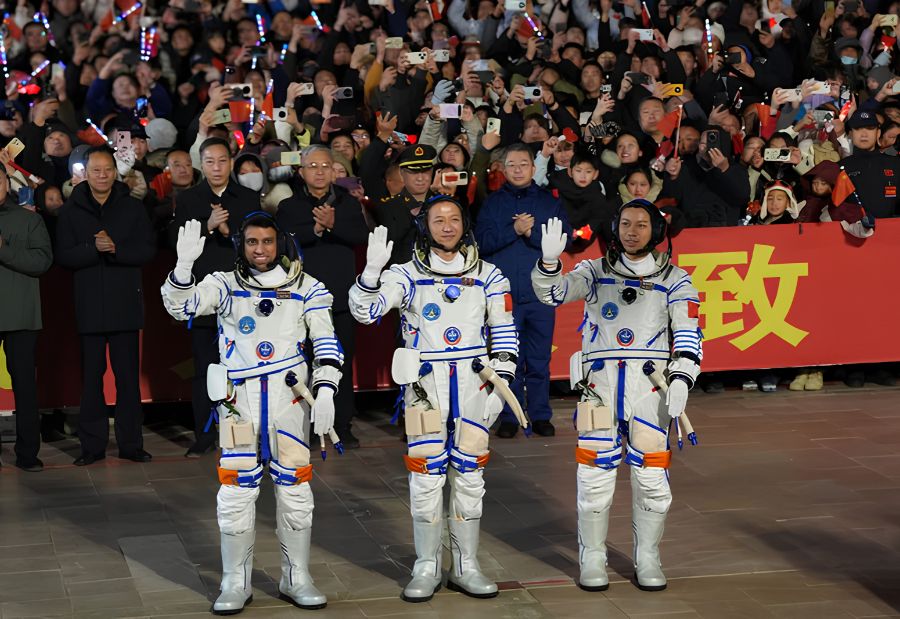
China has marked a new milestone in its space programme by sending a foreign astronaut to its space station for the first time. The Shenzhou 24 spacecraft lifted off on Wednesday, carrying 3 astronauts, including 2 Chinese crew members and 1 Pakistani astronaut.
Pakistani astronaut Muhammad Zeeshan Ali, 40, is travelling with Chinese astronauts Tang Hongbo, 51, and Wu Yi, 39. The spacecraft launched from the Jiuquan Satellite Launch Center in northwestern China on Wednesday morning. It successfully separated from its rocket and entered its planned orbit.
This is the first joint spaceflight involving Chinese and foreign astronauts in the history of China’s crewed space programme.
Hours before the launch, large crowds gathered for the crew’s send-off ceremony, with many recording the occasion on their phones.
During the mission, the crew will conduct more than 90 scientific experiments and technology tests, according to an earlier report by the official Chinese news agency Xinhua. Ali will also carry out an experiment involving photosynthetic cyanobacteria in orbit during his short-term mission. He is expected to return to Earth aboard the Shenzhou 23 spacecraft.
Pakistani Prime Minister Shehbaz Sharif extended his best wishes to the crew ahead of the launch.
“Pakistan-China friendship is surpassing the heights of the Himalayas in its journey to outer space,” he said in a post on X on Tuesday.
The joint mission is part of an agreement signed between China and Pakistan in February 2025.
For Ali and Wu, this is their first spaceflight. Tang, however, has already completed 2 previous missions. He is set to become the first astronaut to visit China’s Tiangong space station 3 times, according to national broadcaster CCTV.
Speaking at a news conference on Tuesday, Tang said differences in language, culture and psychology had made teamwork more challenging. However, he added that the efforts of both sides were beginning to show results.
Ali demonstrated his Mandarin skills in front of reporters by quoting a line of Chinese poetry about climbing higher to gain a wider view.
“It’s like my daily training. Day after day, reaching new heights,” he said in Mandarin.
Speaking in English, Ali said he hoped future space cooperation between the 2 countries would expand from 1 astronaut on a single mission to multiple joint flights, with ambitions extending to the Moon, Mars and beyond.
China’s wider space ambitions are also progressing. In May, it launched Shenzhou 23 with 3 astronauts, including 1 crew member expected to remain in space for around 1 year.
China is also preparing for its first crewed lunar landing by 2030. Meanwhile, the US remains its main competitor in space exploration, with NASA aiming to land astronauts on the Moon in 2028.
Also read: Viksit Workforce for a Viksit Bharat
Do Follow: The Mainstream LinkedIn | The Mainstream Facebook | The Mainstream Youtube | The Mainstream Twitter
About us:
The Mainstream is a premier platform delivering the latest updates and informed perspectives across the technology business and cyber landscape. Built on research-driven, thought leadership and original intellectual property, The Mainstream also curates summits & conferences that convene decision makers to explore how technology reshapes industries and leadership. With a growing presence in India and globally across the Middle East, Africa, ASEAN, the USA, the UK and Australia, The Mainstream carries a vision to bring the latest happenings and insights to 8.2 billion people and to place technology at the centre of conversation for leaders navigating the future.