


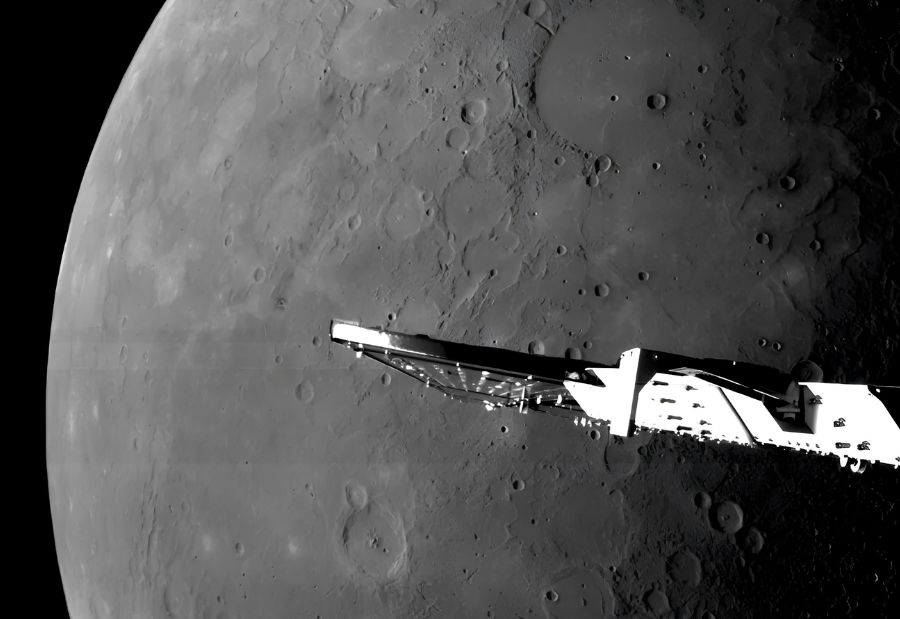
After travelling nearly 6 billion miles (10 billion km) across space, the BepiColombo spacecraft is approaching a major milestone as it prepares to enter orbit around Mercury. Launched in 2018, the mission aims to explore one of the least-understood planets in our inner Solar System and uncover the secrets hidden beneath its harsh surface.
Mercury presents an extremely challenging environment for spacecraft. As the closest planet to the Sun, it experiences temperatures that can rise to 430°C and drop to -180°C. It is also exposed to intense solar radiation, making the mission particularly demanding.
Scientists hope the mission will answer several long-standing questions about the planet. These include explaining how ice survives inside craters near its poles despite Mercury’s proximity to the Sun and identifying the origins of thousands of unusual hollows scattered across its surface.
“I think it’s a little bit of an under-loved planet in the inner Solar System, but I think that’s one of the reasons why it is so compelling,”
said Prof Emma Bunce from Leicester University, a principal investigator on the mission.
“There are lots of reasons, scientifically, why we really want to understand Mercury, how it formed, how it evolved, what it looks like today, but also how it interacts with the Sun and the extreme space weather that it experiences.”
The spacecraft began its journey in 2018 from French Guiana. To overcome the Sun’s powerful gravitational pull and slow down enough to enter Mercury’s orbit, it followed a complex route. This included 1 flyby of Earth, 2 of Venus and 6 of Mercury. Originally planned as a 7-year journey, the mission was extended by 1 year due to a problem with its propulsion system.
The final orbital manoeuvre is particularly challenging. The spacecraft must perform an 11-minute braking turn so Mercury’s gravity can capture it. Any failure could send it flying past the planet.
So far, only 2 spacecraft have visited Mercury, both from NASA. Mariner 10 flew past the planet 3 times during the 1970s, while Messenger entered orbit in 2011 and studied Mercury for 4 years.
Despite its size being only slightly larger than Earth’s Moon, Mercury has ancient volcanoes, towering cliffs and enormous impact craters. Its rotation and orbit also create unusual time patterns. A year on Mercury lasts just 88 Earth days, while 1 complete rotation takes 59 Earth days.
One of the mission’s key objectives is to investigate thousands of mysterious surface hollows. These shallow formations have steep edges, often appear in clusters and are estimated to be around 100,000 years old. Scientists know they are not impact craters but have yet to determine exactly how they formed.
Another major focus is Mercury’s unusually large metal core. Prof Emma Bunce explained that the planet may once have been much larger before losing much of its outer layers through major collisions. Another possibility is that Mercury originally formed in a metal-rich region of the early Solar System.
The mission also has a unique design, carrying 2 spacecraft onboard. A few weeks after reaching Mercury, they will separate. The European Space Agency’s orbiter will study the planet at close range, while the Japanese Space Agency’s spacecraft will observe it from a greater distance.
Engineers have developed a special spring mechanism to ensure the 2 spacecraft separate safely after 8 years together. The mechanism must release gently while also helping the second spacecraft begin rotating. Jessica Marshall, a systems engineer at Airbus, described the separation as a nerve-wracking moment for the team.
A life-size model of BepiColombo, used during spacecraft testing, is currently displayed at the Science Museum in London.
With 2 orbiters equipped with scientific instruments, researchers hope to uncover answers about Mercury’s formation, composition, surface features and relationship with the Sun. However, the mission could also reveal new questions about this mysterious planet.
Also read: Viksit Workforce for a Viksit Bharat
Do Follow: The Mainstream LinkedIn | The Mainstream Facebook | The Mainstream Youtube | The Mainstream Twitter
About us:
The Mainstream is a premier platform delivering the latest updates and informed perspectives across the technology business and cyber landscape. Built on research-driven, thought leadership and original intellectual property, The Mainstream also curates summits & conferences that convene decision makers to explore how technology reshapes industries and leadership. With a growing presence in India and globally across the Middle East, Africa, ASEAN, the USA, the UK and Australia, The Mainstream carries a vision to bring the latest happenings and insights to 8.2 billion people and to place technology at the centre of conversation for leaders navigating the future.