


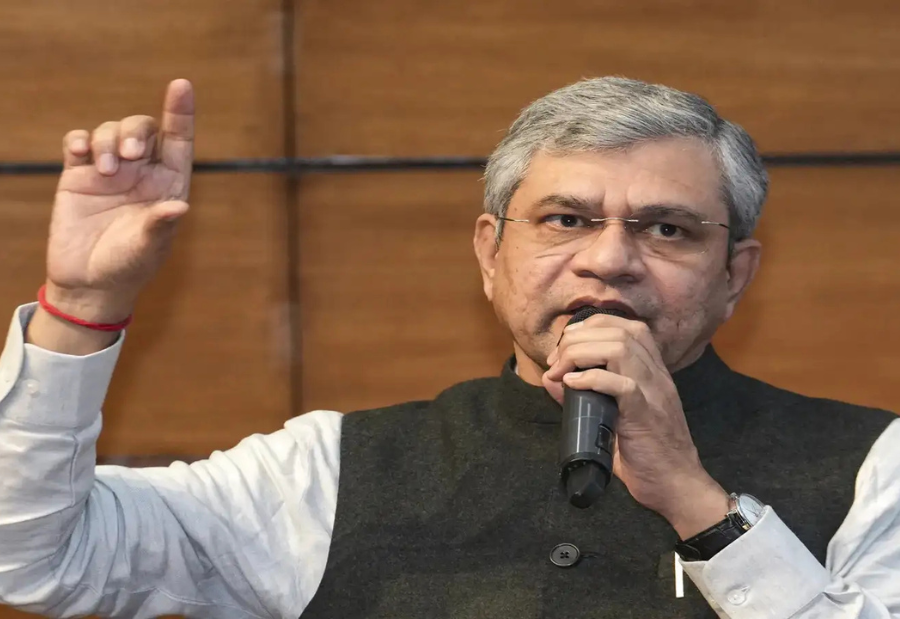
India’s electronics manufacturing industry is steadily advancing up the global value chain, according to Union Minister Ashwini Vaishnaw, who dismissed claims that the country’s manufacturing ecosystem is limited to “screwdriver technology.” He said the level of precision achieved in Indian electronics production reflects the sector’s growing technological capabilities and expanding role in component manufacturing.
Speaking in an interview, Vaishnaw highlighted the precision involved in modern mobile manufacturing. Demonstrating a steel block made from multiple hidden components, he explained how advanced engineering enables complex parts to appear as a single solid unit.
“I will show you what kind of precision our people are achieving in mobile manufacturing, which is where people some of the big names say that it is a screwdriver technology. The precision is absolutely amazing, and without getting that precision. When you look at this, it looks like a good, solid block. Is there a cut you can see? Can you see a cut? You cannot see a cut, right? And this is like so many different pieces. This is what you saw as one solid block. This kind of precision, if you achieve it, then only you are allowed onto the shop floor where mobile phones are manufactured. Now we are manufacturing components,” he said.
The minister noted that India is increasingly contributing to component manufacturing and moving beyond basic assembly operations. He revealed that India exported electronic components worth Rs 35,000 crore to China last year, highlighting the country’s growing role in global supply chains.
According to Vaishnaw, 75 electronics component factories are currently under construction, while around 250 additional component manufacturing facilities are expected to be established over the next 2 to 3 years. He added that the sector has created 25 lakh jobs, describing them as high-quality employment opportunities.
Electronics has now become India’s 3rd-largest export category, contributing significantly to employment generation, women’s workforce participation, MSME growth, and youth skill development.
Over the past 11 years, India’s electronics production has increased from Rs 1.9 lakh crore in 2014-15 to Rs 11.3 lakh crore in 2024-25. During the same period, exports rose from Rs 0.38 lakh crore to Rs 3.3 lakh crore.
The Production Linked Incentive (PLI) Scheme for Large Scale Electronics Manufacturing has attracted investments exceeding Rs 13,475 crore and supported production worth Rs 9.8 lakh crore.
India is also now the world’s 2nd-largest mobile manufacturing country. Mobile manufacturing units have grown from 2 in 2014-15 to around 300 today, while 99.2% of mobile phones sold in India are now made domestically. Mobile phone production has increased from Rs 0.18 lakh crore to Rs 5.5 lakh crore, while exports have reached Rs 2 lakh crore.
The government is now focusing on strengthening capabilities in modules, components, sub-modules, raw materials, and manufacturing equipment through the Electronics Component Manufacturing Scheme.
Also read: Viksit Workforce for a Viksit Bharat
Do Follow: The Mainstream LinkedIn | The Mainstream Facebook | The Mainstream Youtube | The Mainstream Twitter
About us:
The Mainstream is a premier platform delivering the latest updates and informed perspectives across the technology business and cyber landscape. Built on research-driven, thought leadership and original intellectual property, The Mainstream also curates summits & conferences that convene decision makers to explore how technology reshapes industries and leadership. With a growing presence in India and globally across the Middle East, Africa, ASEAN, the USA, the UK and Australia, The Mainstream carries a vision to bring the latest happenings and insights to 8.2 billion people and to place technology at the centre of conversation for leaders navigating the future.