


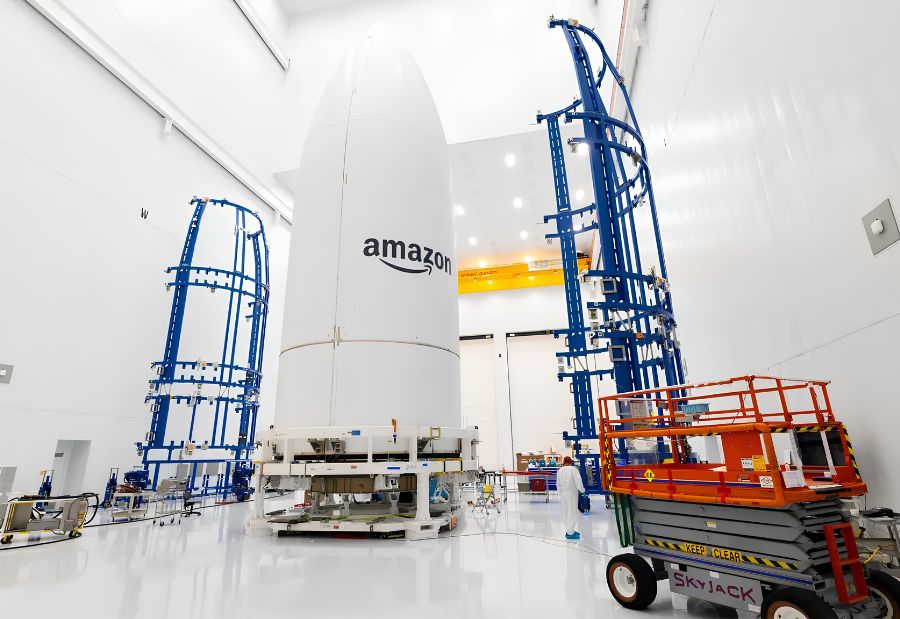
Amazon Leo is continuing preparations to launch its satellite broadband service commercially before the end of 2026, despite missing its original mid-year target. The company has already deployed 396 satellites and recently completed its 1,000th satellite as production accelerates.
Amazon Leo initially planned to begin services by mid-2026. However, the company now expects to launch later this year as it expands its low-Earth orbit (LEO) satellite network.
According to company communications manager Zack Brown, Amazon Leo has deployed 396 broadband satellites through 14 launches, while only 4 satellites have been deorbited. The existing fleet is sufficient to support an initial service launch, although the company has not announced a specific date.
“We’re still doing work to raise them into final position, and…there’s a lot of work on the ground to do. But the plan is to launch initial service in 2026,” said Chris Weber, Vice President of Business and Product at Amazon Leo.
The company has yet to disclose its service pricing or marketing plans. Weber indicated that Amazon Leo could be bundled with other Amazon products and services, potentially including Amazon Prime and Prime Video subscriptions, eero routers and extenders, Ring doorbells and Fire TV devices.
Satellite production gathers pace
Amazon Leo has built more than 1,000 satellites at its 172,000-square-foot manufacturing facility in Kirkland, Washington. Completed satellites are transported to Florida every 2 to 3 days for launch preparations.
The facility can manufacture up to 5 satellites per day, ensuring a steady supply for upcoming missions.
Amazon Leo Vice President Rajeev Badyal highlighted the progress in manufacturing capacity, saying, “It took us six months to make our first 27 satellites. Now we can easily make 27 a week. That’s how far we’ve come.”
Larger launch vehicles to support expansion
The company’s current deployment remains a small portion of its planned first-generation constellation of 3,236 broadband satellites.
In June, the Federal Communications Commission (FCC) granted Amazon Leo a 24-month extension for deploying the first half of its constellation. The company remains committed to completing the full deployment by July 30, 2029.
Amazon had previously expected to deploy around 700 satellites by the end of July 2026, indicating that it also fell short of that target.
To accelerate deployment, Amazon has secured more than 100 launches through multiple partners, including United Launch Alliance (ULA), Arianespace and Jeff Bezos’ Blue Origin.
The rollout will depend on the availability and performance of newer rockets capable of carrying larger satellite payloads into orbit.
Badyal said Amazon Leo was “weeks away” from its first launch aboard ULA’s heavy-lift Vulcan rocket. The company has indicated a similar timeline for launches using Arianespace’s Ariane 6, which can carry more than 32 Amazon Leo satellites. Blue Origin’s New Glenn rocket is designed to transport even larger payloads, although it experienced an explosion during a pre-launch test in May.
Amazon explores direct-to-device connectivity
Separately, Amazon Leo has submitted a plan to the FCC for a constellation of more than 5,000 satellites to support direct-to-device (D2D) services.
The company is also looking to accelerate its D2D ambitions through its pending acquisition of Globalstar.
Also read: Viksit Workforce for a Viksit Bharat
Do Follow: The Mainstream LinkedIn | The Mainstream Facebook | The Mainstream Youtube | The Mainstream Twitter
About us:
The Mainstream is a premier platform delivering the latest updates and informed perspectives across the technology business and cyber landscape. Built on research-driven, thought leadership and original intellectual property, The Mainstream also curates summits & conferences that convene decision makers to explore how technology reshapes industries and leadership. With a growing presence in India and globally across the Middle East, Africa, ASEAN, the USA, the UK and Australia, The Mainstream carries a vision to bring the latest happenings and insights to 8.2 billion people and to place technology at the centre of conversation for leaders navigating the future.