


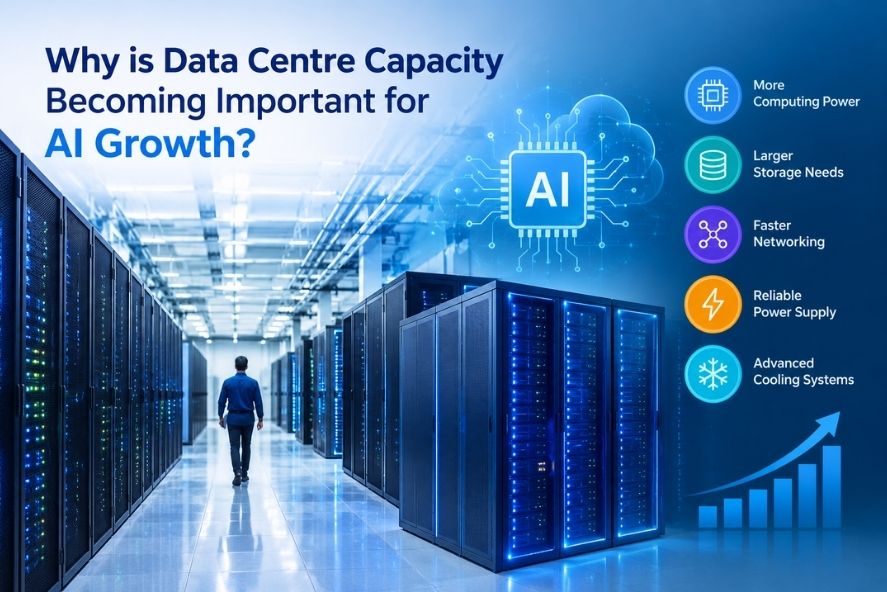
Artificial intelligence is increasing demand for computing power, storage, networking, and reliable electricity. Businesses are using AI to analyse large datasets, develop applications, automate processes, and support faster decision-making. These activities require infrastructure that can handle demanding workloads without affecting performance.
As AI use expands, AI data centre capacity is becoming an important consideration for technology leaders. Businesses need to understand whether their infrastructure can support current requirements and future growth while managing cost, energy use, and reliability.
Why does AI require more computing capacity?
Many traditional business applications can operate with relatively predictable computing requirements. AI workloads, particularly those involving model training and large-scale inference, can require substantial processing power and memory.
Specialised processors, high-speed networking, and fast storage help support these workloads. Demand can also change depending on the size of an AI model, the number of users, and the volume of information being processed.
Businesses therefore need to assess their workload requirements before deciding how much infrastructure to deploy or where to host their AI applications.
How can limited capacity affect AI projects?
Insufficient infrastructure can slow AI development, increase response times, and limit the number of users a service can support. It may also delay projects that depend on processing large volumes of data.
Capacity constraints can affect more than computing resources. Storage performance, network bandwidth, electricity availability, and cooling systems can also influence how effectively a data center supports AI workloads.
Technology leaders should evaluate these factors together rather than treating computing capacity as an isolated requirement.
Should businesses build, buy, or use cloud infrastructure?
Businesses have several options for supporting AI workloads, and the right approach depends on their requirements.
Cloud services can provide flexible access to computing resources without requiring businesses to build their own data centre infrastructure. This can help teams test AI applications and adjust capacity as demand changes.
Dedicated infrastructure may offer greater control over configurations, data handling, and workload placement. However, it can require significant investment and ongoing operational management.
A hybrid approach can also be useful, allowing businesses to place workloads according to performance, security, cost, and regulatory needs. The decision should consider long-term demand rather than only the initial cost of deployment.
Why are power and cooling important?
AI infrastructure can place substantial demands on electricity and cooling systems, especially when workloads use high-performance processors.
Data centre planning must account for power availability, cooling capacity, equipment density, and energy efficiency. If these requirements are overlooked, additional computing equipment may not translate into usable capacity.
Businesses should also consider energy costs and environmental goals when comparing infrastructure options. Improving workload efficiency and using resources effectively can help reduce unnecessary consumption.
How can businesses plan for future AI demand?
AI infrastructure planning should begin with a clear understanding of expected workloads. Technology teams can estimate processing requirements, data growth, user demand, and performance expectations for each application.
Capacity planning should include regular reviews because AI models and usage patterns may change quickly. Monitoring resource utilisation can help teams identify bottlenecks before they affect business services.
Organisations should also consider workload scheduling, model optimisation, and resource sharing. These measures may improve the use of existing infrastructure before additional capacity is required.
What should CIOs consider?
CIOs should evaluate infrastructure investments against business priorities, expected AI adoption, security requirements, operating costs, and resilience needs. They should also assess whether internal teams have the skills to manage AI infrastructure effectively.
The Mainstream covers how AI and digital infrastructure are shaping business technology decisions. As more organisations move AI projects into everyday operations, infrastructure planning will become increasingly connected to long-term technology strategy.
Final Thought
AI data centre capacity is becoming important because AI growth depends on more than the availability of models and software. Businesses also need sufficient computing power, storage, networking, electricity, and cooling to support reliable performance.
By planning capacity around real workloads, comparing cloud and dedicated infrastructure, and monitoring resource use, technology leaders can prepare for AI growth without making unnecessary investments. The aim is to build infrastructure that can support changing demand while remaining efficient, secure, and reliable.