


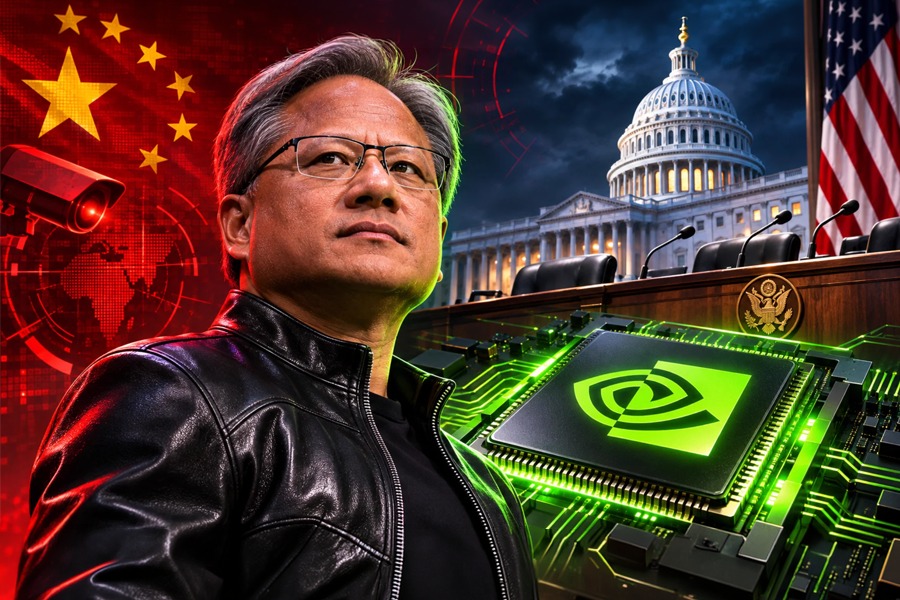
As Nvidia faces scrutiny over alleged China chip diversion, suspected intelligence links and US export restrictions, the controversy highlights the growing intersection of artificial intelligence, semiconductor security and geopolitical tensions.
The global artificial intelligence race is no longer just about developing more powerful AI models or investing billions in data centres. Increasingly, it is also about who controls the advanced semiconductor technology that makes these innovations possible.
Few companies illustrate this shift better than Nvidia.
One of the world’s leading semiconductor companies, Nvidia has become a driving force behind the global AI boom. Its graphics processing units (GPUs) power AI data centres, generative AI platforms and large language models used by leading technology companies and cloud service providers. This growing dependence on Nvidia AI chips has given the company an influential position in the global technology ecosystem, placing it at the centre of the increasingly complex US-China semiconductor rivalry.
That influence is now attracting renewed scrutiny following reports linking a Singapore-based businesswoman associated with a company suspected of facilitating access to restricted Nvidia chips to alleged Chinese intelligence activity. The controversy has raised questions about the security of technology supply chains, the effectiveness of American export controls and the risks surrounding business relationships in strategically sensitive markets.
It also places Nvidia’s internal governance under examination, at a time when its leadership is already facing considerable pressure.
The supply-chain questions behind the controversy
At the centre of the allegations is Alice Huang, a businesswoman associated with Singapore-based Megaspeed International. The company has faced scrutiny over suspected efforts to facilitate the movement of advanced Nvidia processors to Chinese customers despite US export restrictions.
US intelligence officials reportedly suspect Alice Huang of having links to Chinese intelligence. However, these allegations have not been independently established, and Singapore’s investigation has not produced a finding that she was an intelligence operative.
The wider concern is how restricted technology might reach customers through intermediaries and overseas computing infrastructure.
Since 2022, Washington has progressively tightened restrictions on exports of advanced AI processors to China, arguing that such technology could support military applications and strategic capabilities. Nvidia has consequently had to navigate an increasingly difficult commercial environment, balancing access to the Chinese market against US regulatory requirements.
The challenge is that controlling the movement of physical chips does not necessarily mean controlling access to their computing capabilities.
Overseas data centres, cloud infrastructure and third-party computing arrangements can potentially provide alternative routes to advanced processing power. This makes it harder for regulators to establish who ultimately benefits from restricted technology.
A Reuters investigation published on November 13 identified more than $3 billion worth of Chinese computing projects built around Nvidia processors that are no longer available for direct sale into China. The findings underline the continuing demand for advanced AI hardware despite export restrictions.
Why the issue extends beyond Nvidia
The controversy highlights a growing weakness in how the global technology industry manages strategic supply chains.
For years, semiconductor supply chains were primarily viewed through the lens of manufacturing capacity, pricing and commercial competition. Today, they are increasingly shaped by national security priorities.
Advanced chips are no longer just components used to run software. They determine how quickly organisations can train sophisticated AI models, process enormous datasets and develop computing capabilities with potential military and intelligence applications.
This has made companies such as Nvidia important participants in a geopolitical contest they do not entirely control.
The US-China technology rivalry has already reshaped semiconductor investment, manufacturing partnerships and export policies. Restrictions on advanced chips have also encouraged China to accelerate domestic semiconductor development and explore alternative sources of computing capacity.
For Nvidia, this creates a difficult strategic equation. Losing access to the Chinese market could mean surrendering commercial opportunities to domestic competitors. Maintaining that access, however, requires navigating increasingly complex regulatory boundaries.
The latest allegations make that balancing act even more complicated.
Governance becomes part of the technology conversation
The developments have also brought questions about executive accountability and corporate oversight into focus.
Nvidia has faced scrutiny over its business relationships and the circumstances surrounding its chief executive Jensen Huang’s personal associations. Huang subsequently stepped down on November 12, with chief financial officer Colette Kress named interim CEO.
While the leadership change has attracted considerable attention, the more significant question concerns the systems through which companies operating in strategically sensitive sectors identify and manage potential vulnerabilities.
For boards, governance can no longer be limited to financial performance, shareholder returns and regulatory compliance. It must also account for supply-chain integrity, access to sensitive information and exposure to geopolitical risks.
The issue is particularly relevant for technology companies whose products can have applications extending beyond their stated commercial purpose.
The next test for the AI industry
Nvidia’s position in the global AI ecosystem is unlikely to change overnight. Its technology, software ecosystem and relationships with major computing providers have created a competitive advantage that is difficult to replicate.
However, the controversy raises questions that the wider industry cannot afford to ignore. As AI becomes critical infrastructure, companies supplying its underlying technology will face greater expectations around transparency, accountability and security. Governments, meanwhile, will need to reconsider whether export restrictions designed around physical products are sufficient in an economy where computing power can be accessed remotely.
The next phase of the AI race will therefore involve more than developing faster processors or building larger data centres. It will require a clearer understanding of who controls the infrastructure, who can access it and how its use is governed. Nvidia’s latest controversy is a reminder that the business of AI is no longer confined to innovation and market competition. It is increasingly a question of economic influence, national security and institutional trust.
Also read: Viksit Workforce for a Viksit Bharat
Do Follow: The Mainstream LinkedIn | The Mainstream Facebook | The Mainstream Youtube | The Mainstream Twitter
About us:
The Mainstream is a premier platform delivering the latest updates and informed perspectives across the technology business and cyber landscape. Built on research-driven, thought leadership and original intellectual property, The Mainstream also curates summits & conferences that convene decision makers to explore how technology reshapes industries and leadership. With a growing presence in India and globally across the Middle East, Africa, ASEAN, the USA, the UK and Australia, The Mainstream carries a vision to bring the latest happenings and insights to 8.2 billion people and to place technology at the centre of conversation for leaders navigating the future.