


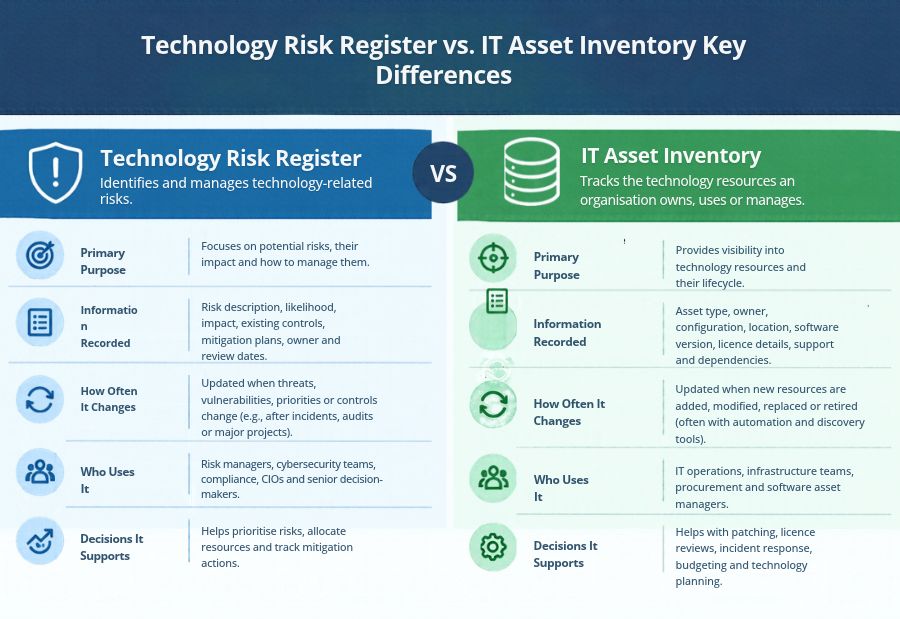
Technology teams need a clear view of both the assets they manage and the risks those assets create. An IT asset inventory identifies technology resources such as applications, servers, endpoints, cloud services and network devices. A technology risk register records potential threats, their business impact, existing controls and planned responses.
Although these records support related activities, they serve different purposes. Understanding the difference between a technology risk register and an IT asset inventory helps organisations improve governance, prioritise security work and make better technology decisions.
What is an IT Asset Inventory?
An IT asset inventory is a structured record of the technology resources an organisation owns, leases, operates or uses through third-party providers.
Depending on the organisation, it may include:
- Hardware such as laptops, servers and network devices.
- Software applications, operating systems and business platforms.
- Cloud resources, virtual machines and hosted services.
- Asset owners, locations, configurations and lifecycle status.
- Licence details, support arrangements and relevant dependencies.
The inventory helps IT teams understand what exists, who is responsible for it and how it is maintained. It supports activities such as patch management, licence reviews, incident response, budgeting and technology replacement planning.
An accurate inventory is particularly important for cybersecurity. Security teams cannot reliably assess or protect resources they do not know are present.
What is a Technology Risk Register?
A technology risk register records identified risks that could affect systems, data, services or business operations. Each entry typically describes a risk, its likelihood, potential impact, existing controls, responsible owner and planned mitigation.
Examples include:
- An unsupported application that no longer receives security updates.
- A critical cloud service with insufficient disaster recovery arrangements.
- A third-party provider that supports an essential business process.
- Excessive user permissions that could enable unauthorised access.
- A technology dependency that could disrupt operations if it fails.
Risk registers help leaders understand which issues require attention first. They also provide a way to track mitigation activities and communicate technology risks to senior management.
Technology Risk Register vs. IT Asset Inventory: 5 Key Differences
1. Primary Purpose
An IT asset inventory answers: What technology resources do we have?
A technology risk register answers: What could go wrong and how are we managing it?
The inventory focuses on visibility and ownership. The register focuses on uncertainty, exposure and risk treatment.
2. Information Recorded
An asset inventory contains details such as asset type, owner, configuration, location, software version and lifecycle status.
A risk register records risk descriptions, likelihood, impact, control effectiveness, mitigation plans and risk ownership. Some entries may also include risk ratings and review dates.
The two records can reference one another, but they should not be treated as interchangeable.
3. How Often They Change
Asset inventories change when organisations deploy new resources, replace hardware, modify cloud environments or retire applications. Automated discovery can help keep these records current.
Risk registers change when threats, vulnerabilities, business priorities or control effectiveness change. Reviews may also be triggered by incidents, audits, major technology projects or changes to third-party services.
Both records need regular maintenance, but their update triggers differ.
4. Who Uses Them?
IT operations, infrastructure teams, procurement and software asset managers often rely on asset inventories.
Technology risk registers are commonly used by risk managers, cybersecurity teams, compliance professionals, CIOs and senior decision-makers.
In practice, ownership overlaps. Asset information helps security teams assess risk, while risk findings can influence asset maintenance and replacement priorities.
5. Decisions They Support
Asset inventories help answer questions such as which systems need upgrades, which licences can be reclaimed and which resources are approaching end of life.
Risk registers help determine which exposures require urgent mitigation, additional controls, management approval or formal acceptance.
Together, they help organisations allocate resources according to both operational needs and risk exposure.
How the Two Records Work Together
Consider an organization running a business-critical application on an operating system approaching the end of its support period.
The IT asset inventory identifies the application, its owner, its dependencies and the operating system version. The technology risk register records the potential consequences of running unsupported software, assesses the risk and documents the mitigation plan.
This connection helps leaders move from simply knowing that an asset exists to understanding why it matters and what action is needed.
Organisations can strengthen this relationship by using consistent asset identifiers, linking risk entries to affected systems and assigning clear owners. Discovery tools and configuration management systems can improve inventory accuracy, while risk management workflows can track mitigation progress.
Final Thought
An IT asset inventory and a technology risk register solve different but connected problems. One provides visibility into technology resources; the other helps organisations understand and manage the risks associated with them.
For The Mainstream readers, maintaining both records—and linking them where appropriate—can improve security planning, operational resilience and technology governance. Accurate information gives leaders a stronger basis for deciding which assets to maintain, which risks to address and where to invest resources.