


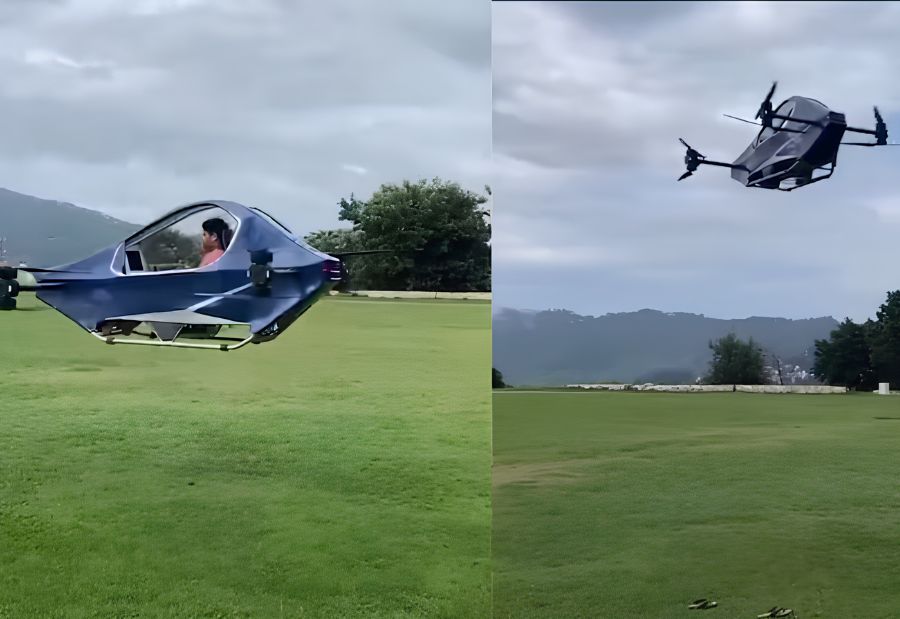
A passion for innovation and years of independent learning have led Ravi Tamta, a Bachelor of Arts graduate from Uttarakhand’s Almora district, to develop an electric flying car prototype without formal training in science or engineering. His single-seater vehicle, HAPIDA SKYNeX, completed a test flight in August, marking an important milestone in his journey towards exploring personal air mobility.
Tamta’s interest in building a flying vehicle began in 2015. Growing up in Kaflikhan, near Jageshwar Dham, he experienced the difficulties of travelling across Uttarakhand’s hilly terrain. Reaching essential services, particularly hospitals, can involve long journeys along winding roads. These challenges inspired him to explore alternative transportation options for remote and difficult-to-access areas.
The HAPIDA SKYNeX prototype features a lightweight frame, a cockpit and a transparent canopy. It runs on battery power and uses a vertical take-off and landing design, eliminating the need for a conventional runway. This approach could potentially make the vehicle suitable for locations with limited transport infrastructure.
Tamta completed his early schooling in his village and later earned a BA degree from the Nainital campus. Without formal engineering or aviation education, he spent 13 years learning through online resources, independent study and practical experimentation. His father, Harish Ram, works as a mechanic, and his family has supported his development journey.
Apart from the flying car, Tamta has reportedly worked on several other inventions, including shoes designed to charge mobile phones, a smart walking stick for people with visual impairments, a bamboo-splitting machine and firefighting equipment. His projects also include a stick mobile charger and a fire extinguisher developed for the Forest Department.
The flying vehicle is intended to make short-distance travel across challenging terrain faster, with potential applications in remote communities and medical emergencies. However, putting such a vehicle into practical use will require further development and rigorous testing.
Battery capacity, structural strength, motor performance, flight stability and emergency systems are among the critical factors that need to be evaluated before the vehicle can be considered safe for regular use. The prototype’s test flight marks progress, but it does not by itself establish its safety or operational reliability.
The vehicle will also need to meet applicable aviation requirements and obtain the necessary regulatory approvals, including permissions from the Directorate General of Civil Aviation (DGCA), as applicable, before operational deployment.
Tamta’s journey highlights how curiosity and self-directed learning can help individuals explore ideas beyond their formal qualifications. The next stage for HAPIDA SKYNeX will depend on further technical validation, safety testing and regulatory clearance.
(With Inputs from ANI)
Also read: Viksit Workforce for a Viksit Bharat
Do Follow: The Mainstream LinkedIn | The Mainstream Facebook | The Mainstream Youtube | The Mainstream Twitter
About us:
The Mainstream is a premier platform delivering the latest updates and informed perspectives across the technology business and cyber landscape. Built on research-driven, thought leadership and original intellectual property, The Mainstream also curates summits & conferences that convene decision makers to explore how technology reshapes industries and leadership. With a growing presence in India and globally across the Middle East, Africa, ASEAN, the USA, the UK and Australia, The Mainstream carries a vision to bring the latest happenings and insights to 8.2 billion people and to place technology at the centre of conversation for leaders navigating the future.